
















Now Reading: Resistance Bands vs. Dumbbells: Which Is Better for Home Workouts?
-
01
Resistance Bands vs. Dumbbells: Which Is Better for Home Workouts?


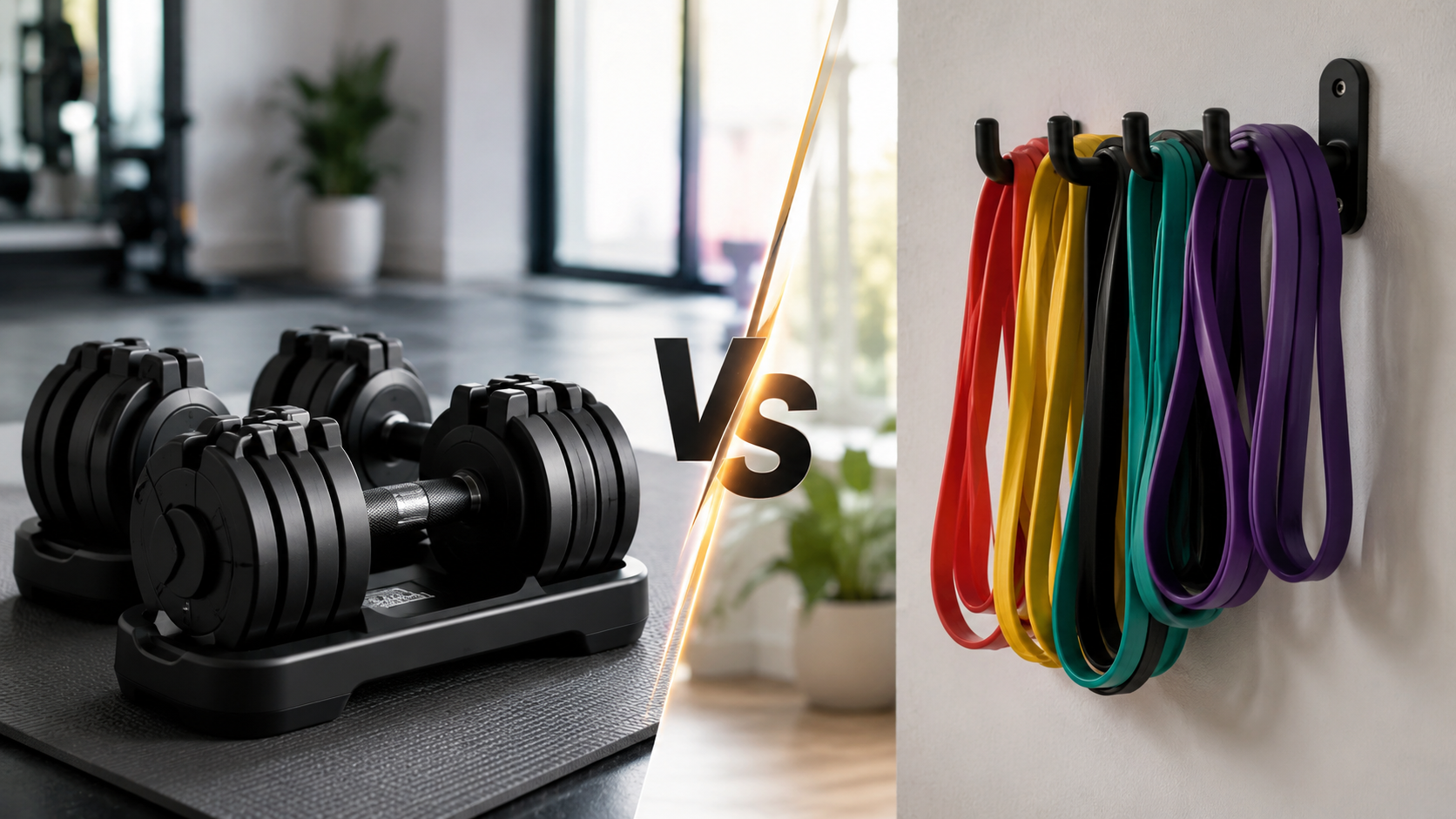
Building a home gym usually comes down to one big decision: do you grab a set of dumbbells, or do you stock up on resistance bands?
Both can absolutely get you stronger, leaner, and more mobile — but they don’t work the same way, and they’re not equally good at every job.
The short answer: dumbbells are the better tool for building raw strength and visible muscle size, while resistance bands win on joint-friendliness, portability, and price.
The right choice — or combination — depends on your goals, your experience level, and your budget.
Let’s break down exactly how each one works, where each one shines, and how to decide (or whether you should just get both).
Table of contents
Key Takeaways
- Dumbbells provide constant, gravity-based resistance, which makes them easier to track and highly effective for building muscle mass.
- Resistance bands provide variable resistance that increases the harder you stretch them, which makes them gentler on joints and great for rehab, toning, and hard-to-reach muscles.
- Portability and cost heavily favor bands — they weigh almost nothing and cost a fraction of a comparable dumbbell set.
- Durability and precision favor dumbbells — they don’t wear out or snap the way bands eventually can.
- The best long-term strategy for most home gyms is combining both, using dumbbells for progressive overload and bands for warm-ups, accessory work, and mobility.
How Dumbbells and Resistance Bands Actually Work
The core difference between these two tools isn’t really about “which is harder” — it’s about how the resistance behaves throughout a movement.
Dumbbells rely on gravity.
A 10 kg dumbbell weighs 10 kg from the first inch of a curl to the last.
Fitness professionals call this isotonic resistance: a steady, constant load your muscles have to control through the entire range of motion. That consistency is exactly why dumbbells are so easy to program — you know precisely what you’re lifting, which makes progressive overload simple to track over weeks and months.
Resistance bands rely on elastic tension.
A band feels almost weightless at the start of a stretch and progressively harder the further you pull it. This is called isokinetic or variable resistance.
As orthopedic physical therapist Erika Mundinger explained to TODAY.com, a resistance band gets noticeably harder near the top of a movement like a bicep curl and eases off again as you return to the start — the opposite feel of a dumbbell, which stays uniformly heavy throughout.
Neither pattern is objectively “better.” A constant load is ideal for building maximal strength; a variable load is often kinder to joints and connective tissue, which is one reason physical therapists lean on bands so heavily during rehab.
Dumbbells: Best for Building Muscle Mass
Benefits
- Precise, easy-to-track loading. You always know the exact number on the plate, which makes progressive overload straightforward.
- Highly effective for compound lifts like squats, presses, and rows that recruit multiple muscle groups at once.
- Greater range of motion than barbells or machines, which helps improve stabilization and joint control.
- A known long-term investment. A well-made pair of dumbbells can last for decades of regular use.
Downsides
- They take up real floor space, especially as your weight range grows.
- Quality sets aren’t cheap, particularly adjustable systems.
- Dropped weights can damage floors or cause injury if handled carelessly.
Best dumbbell exercises
Bent-over rows, upright rows, hammer curls, reverse curls, lateral flys, and reverse flys are all staples that are genuinely difficult to replicate with bodyweight alone — which is exactly why dumbbells remain the gold standard for building visible, measurable strength.
Our pick for a home gym dumbbell set
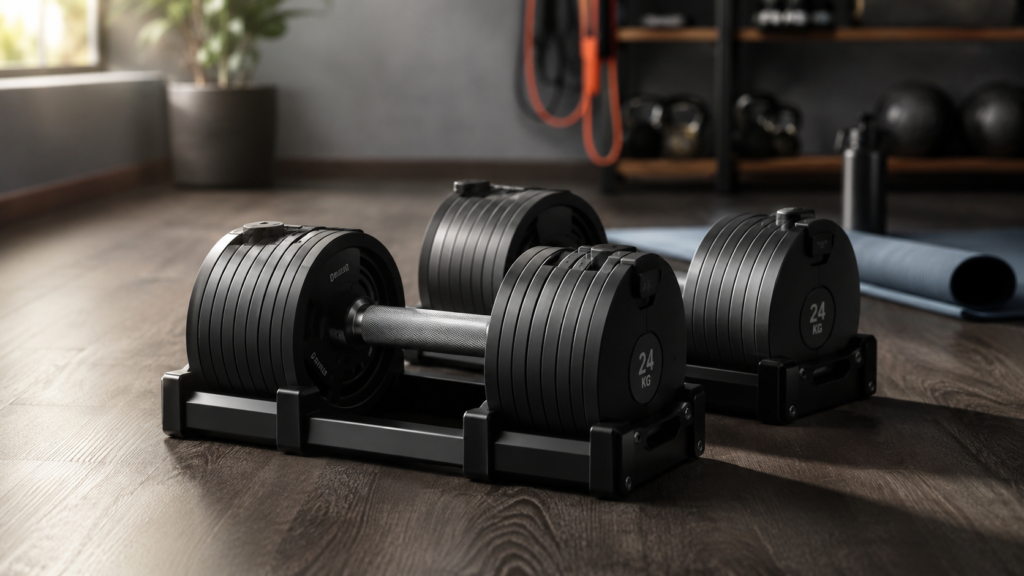
If you want one purchase that covers almost every strength goal, an adjustable set is the smartest move — you get 15+ weight levels without needing a rack full of fixed pairs.
- BowFlex Results Series 552 SelectTech Adjustable Dumbbells — the most popular adjustable dumbbell on the market, adjusting from 5 to 52.5 lbs per hand with a quick-turn dial. Great for beginners through intermediate lifters who want one set that grows with them.
- Amazon Basics Adjustable Dumbbell, 25 lb — a budget-friendly single dumbbell that adjusts in 5-lb increments, ideal if you’re just starting out or want a second, lighter set for high-rep work.
Resistance Bands: Best for Versatility and Joint Health
Benefits
- Extremely portable. A full set fits in a drawer, a carry-on, or your car trunk.
- Gentle on joints. The variable tension means the load is lightest exactly where your joints are most vulnerable — at the start of a stretch.
- Train from any angle. Bands let you push, pull, and rotate in ways that are awkward or impossible with a dumbbell, which makes them excellent for rehab and for isolating smaller, hard-to-reach muscles.
- Very affordable, especially compared to a full dumbbell rack.
Downsides
- Resistance is harder to measure precisely — you’re estimating tension rather than reading a number off a plate.
- Bands wear out over time and can snap if they’re old, nicked, or overstretched, which is why buying a quality set matters more than it might seem.
Best resistance band exercises
- Band thruster: Stand inside a looped band, drop into a squat, then drive upward while pressing the band overhead — a band-based take on the classic barbell thruster.
- Hip abduction: Loop a band around your thighs, sink into a half-squat, and press one knee outward without moving your feet.
- Lateral walk: With a band around your thighs, step sideways in a half-squat stance to fire up the glutes and hips.
- Spanish squat: Anchor a band behind you at knee height and squat back into it, keeping your back vertical — a favorite for targeting the quads without loading the knees.
Our pick for home gym resistance bands
- Bodylastics Basic Series Resistance Band Set — a complete kit with 5 stackable tube bands (up to 190 lbs combined), handles, ankle straps, a door anchor, and a carry bag. A great all-in-one starter system.
- Bodylastics PRO Series Resistance Band Set — a step up in durability with reinforced anti-snap clips and up to 310 lbs of stackable resistance, a long-time favorite among reviewers for its build quality.
- Fit Simplify Resistance Loop Exercise Bands (Set of 5) — lightweight latex loop bands in five resistance levels, perfect for glute, hip, and mobility work, plus travel workouts.
Portability and Cost
There’s no contest here: resistance bands are the far more travel-friendly option. Aside from your own body weight, nothing in strength training is lighter, cheaper, or easier to store than a band. You can toss a full set into a suitcase or keep it in your car for a spontaneous outdoor workout.
Dumbbells, by comparison, are bulky and heavier on your wallet — they make the most sense when you have a dedicated corner of a room (or a garage gym) to keep them in.
Durability and Precision
Flip the comparison around, though, and dumbbells pull ahead. A quality pair of dumbbells — especially cast iron, rubber-coated, or urethane models — can realistically outlast a resistance band by years. Bands are elastic by nature, which means they’re always slowly degrading with UV exposure, stretching, and repeated use, and they can eventually snap. Dumbbells simply don’t have that failure mode.
If precision matters to you — for example, if you’re tracking strength progress for a specific program — dumbbells also make it much easier to know exactly what you’re lifting, rep after rep.
Safety Considerations
Resistance bands are a great low-impact entry point if your goal is toning up, improving mobility, or working around an injury. But if your primary goal is building meaningful muscle mass over time, you’ll eventually need to introduce real, progressively heavier weight — which is where dumbbells take over.
That said, safety cuts both ways: a worn-out band can snap unexpectedly, while a dropped dumbbell can hurt a toe or damage flooring. Buying quality equipment and using proper form matters regardless of which tool you choose.
Comparison at a Glance
| Factor | Dumbbells | Resistance Bands |
|---|---|---|
| Resistance type | Constant (isotonic) | Variable (isokinetic) |
| Best for | Building muscle mass, strength | Toning, rehab, mobility |
| Joint impact | Higher | Lower |
| Portability | Low | Very high |
| Cost | Higher | Lower |
| Durability | Very high | Moderate (wears over time) |
| Tracking progress | Precise (exact weight) | Less precise (estimated tension) |
Should You Combine Resistance Bands and Dumbbells?
You don’t have to pick a side. In fact, most coaches and physical therapists recommend using both. Bands are excellent for warm-ups, mobility work, and accessory exercises that target smaller stabilizer muscles, while dumbbells remain your go-to for progressive overload on major lifts.
You can also combine them in the same movement — looping a band around a dumbbell during squats or presses adds extra tension at the top of the lift, which increases time under tension and can help push past a plateau.
Rotating between the two also keeps your training fresh. Doing the exact same routine for months is a common cause of workout burnout, and alternating tools is a simple way to keep your body — and your motivation — from going stale.
FAQ
Are resistance bands as effective as dumbbells for building strength?
For general strength, toning, and functional fitness, yes — bands can absolutely get you stronger and help you hit weight-loss goals. For maximizing muscle size specifically, dumbbells (or other free weights) still have the edge because they let you progressively add measurable load over time.
Which is better for beginners?
Resistance bands are often a gentler starting point, especially for anyone easing into exercise or working around an injury. That said, a set of light adjustable dumbbells is just as beginner-friendly and gives you a clearer path to progression.
Can resistance bands replace dumbbells entirely?
For most people, no — not if serious muscle building is the goal. But for travel, rehab, or a low-cost home setup, bands can absolutely serve as your primary tool.
What should I buy first if I’m on a budget?
A basic resistance band set is the cheapest way to start training at home. If your budget allows for one piece of equipment, an adjustable dumbbell set gives you the most versatility per dollar since it replaces multiple fixed weights.
This article contains affiliate links. If you make a purchase through one of these links, we may earn a small commission at no extra cost to you.
Related Posts
Stay Informed With the Latest & Most Important News
Previous Post
Next Post










Advertisement