

























Now Reading: How to Work Out When You’re Mentally Exhausted, Not Just Tired
-
01
How to Work Out When You’re Mentally Exhausted, Not Just Tired



You didn’t sleep badly. Your legs aren’t sore. But the idea of a workout still feels like climbing a mountain.
If that sounds familiar, you’re probably not physically tired — you’re mentally exhausted, and that’s a completely different problem with a completely different fix.
Mental exhaustion and physical tiredness can feel identical from the outside, but they come from different places in the body, they respond to different solutions, and they call for different workouts.
Push through mental fatigue the wrong way and you’ll feel worse.
Skip exercise entirely, and you might miss out on one of the few tools that can actually help you recover.
This guide breaks down how to tell the two apart, why mental fatigue makes movement feel so much harder than it is, and exactly how to adjust your training so you can still show up — without wrecking your evening or your motivation.
A practical, science-backed guide to training smart on the days your brain feels wiped, even when your body still has gas in the tank.
Table of contents
- Mental Exhaustion vs. Physical Tiredness: What’s the Real Difference?
- Why Mental Fatigue Makes a Workout Feel So Much Harder Than It Is
- Signs You’re Mentally Exhausted (Not Just Physically Tired)
- Should You Skip the Workout or Push Through? A Quick Framework
- The Best Workouts for Low Mental Energy Days
- How to Adjust Your Workout When You’re Mentally Drained
- Zero Motivation? Here’s How to Start Moving Anyway
- Recovery Still Matters: Don’t Skip the Sleep Side of the Equation
- The Takeaway
Mental Exhaustion vs. Physical Tiredness: What’s the Real Difference?
The two states share a lot of overlapping symptoms — low energy, low motivation, a strong pull toward the couch — but they don’t have the same cause, and that matters for how you should respond.
Physical tiredness usually has a clear trigger: a late night, an intense training block, a physically demanding day. Your muscles are genuinely low on fuel, your nervous system needs recovery, and your body is asking for rest or lighter movement. A nap, an early bedtime, or a deload usually fixes it.
Mental exhaustion comes from cognitive load, not muscular load. Hours of decision-making, problem-solving, video calls, or emotional stress drain a different kind of energy — the kind managed by your prefrontal cortex, the part of your brain responsible for focus, planning, and self-control. Your muscles are largely untouched. Your glycogen stores are fine. But your brain has decided that everything, including a 20-minute walk, requires more effort than it’s willing to spend.
That last point is backed by research, not just a feeling. In a widely cited 2009 study published in the Journal of Applied Physiology, researchers had cyclists complete either a demanding 90-minute cognitive task or a neutral one, then cycle to exhaustion. The mentally fatigued group stopped roughly 15% earlier — not because their heart rate, oxygen consumption, or muscles performed any worse, but because they perceived the same effort as significantly harder. Mental fatigue doesn’t limit what your body can do; it distorts how hard your body feels like it’s working.
A separate line of research backs this up from another angle: people who complete demanding mental tasks report lower intended exertion before a workout and end up doing measurably less work once they get moving, even when nothing about their physical capacity has changed. In other words, mental fatigue doesn’t just make exercise feel harder — it quietly talks you out of doing as much of it.
Why Mental Fatigue Makes a Workout Feel So Much Harder Than It Is
If you’ve ever wondered why a workout that normally feels routine suddenly feels unbearable after a brutal day at your desk, here’s what’s actually happening beneath the surface.
Your prefrontal cortex is running on empty
The same brain region that helped you push through back-to-back meetings, sift through emails, and make dozens of small decisions is also the region responsible for initiating exercise and pushing through discomfort. By the end of a cognitively demanding day, that resource is depleted — so starting a workout, and sticking with it, takes far more willpower than usual.
Decision fatigue is stacking up
Every choice you make throughout the day — what to answer first, what to say in a difficult conversation, what to eat for lunch — draws from the same limited pool of mental energy. By evening, deciding what workout to do, how long to do it, or even what to wear to the gym can feel like one decision too many, so it’s easier to just skip it.
Stress hormones are working against your motivation
Chronic work stress keeps cortisol elevated, and elevated cortisol is linked to lower dopamine activity — the neurotransmitter most responsible for motivation and reward-seeking. Less dopamine availability means the anticipation of a workout (or almost anything else) generates less of a pull than it normally would.
Perceived effort goes up, even though physical capacity doesn’t
As covered above, this is the core finding across multiple studies: mental fatigue raises your rating of perceived exertion without meaningfully changing your cardiovascular or muscular performance. The workout isn’t actually harder. It just feels that way, which is often enough to make you stop early or not start at all.
Signs You’re Mentally Exhausted (Not Just Physically Tired)
Because the two states can feel so similar, it helps to have concrete markers to check yourself against.
- Your body feels fine, but your motivation doesn’t. No soreness, no heaviness in your legs — just a strong mental resistance to starting.
- You’ve been sedentary, but your brain has been working overtime. Back-to-back meetings, heavy problem-solving, or an emotionally charged day, with little physical output.
- Simple decisions feel disproportionately hard. Choosing what to eat, wear, or watch feels like a bigger task than it should.
- You’re irritable, foggy, or struggling to focus. Concentration and short-term memory take a hit before physical performance does.
- A short walk or five minutes of movement genuinely helps. If light activity tends to clear your head rather than wipe you out further, that’s a strong signal the issue is mental, not physical.
Compare that with the signs that you’re genuinely physically depleted and exercise isn’t the answer today:
- Chronic sleep debt. You’ve been getting well under seven hours a night for several days or more, and it’s catching up with your coordination and reaction time.
- Unexplained soreness. Your muscles ache without a clear workout to blame, which usually signals your body hasn’t finished recovering from previous training.
- Elevated resting heart rate or disrupted sleep quality, both classic markers of overtraining or accumulated physical stress.
- Symptoms that don’t improve, or get worse, after light movement. If easy exercise consistently leaves you feeling worse rather than better, your body is asking for rest, not activity.
There’s also a subtler distinction worth making: mental and physical fatigue versus plain lack of motivation. Fatigue tends to show up mid-task — the last few reps get noticeably harder, your usual pace slows by 10 to 20 seconds per mile, or soreness lingers two days longer than normal. Low motivation, on the other hand, tends to show up before you even start — you talk yourself out of the last set, cut a session short on a whim, or skip a class “just in case,” even though your body feels okay. Recognizing which one you’re dealing with makes the decision to train or rest much easier.
Should You Skip the Workout or Push Through? A Quick Framework
Not every mentally drained day calls for the same response. Use this as a rough decision guide.
Exercise is likely to help when:
- Your body feels physically capable and rested.
- You’ve been mostly sedentary today — sitting, screens, meetings.
- Past workouts on similarly tiring days have left you feeling better afterward, not worse.
- The fatigue feels specific to work or one part of your day, not your whole life.
Rest is likely the better call when:
- You notice unexplained soreness, an elevated resting heart rate, or declining sleep quality.
- You feel emotionally depleted across the board, not just tired of one task.
- Previous attempts to “push through” on days like this have consistently backfired.
- The exhaustion has been building for weeks rather than hours — a pattern more consistent with burnout than a single hard day.
If you’re genuinely unsure which category you’re in, treat the workout itself as a diagnostic tool: commit to just five minutes of light movement, then reassess.
A note on burnout: occasional mental fatigue after a demanding day is normal and often improves with light movement. If exhaustion persists for weeks, doesn’t lift with rest, and comes with cynicism, detachment, or a sense of dread about ordinary tasks, that’s a pattern more consistent with burnout than everyday fatigue, and it’s worth talking to a doctor or mental health professional rather than trying to train through it.
The Best Workouts for Low Mental Energy Days
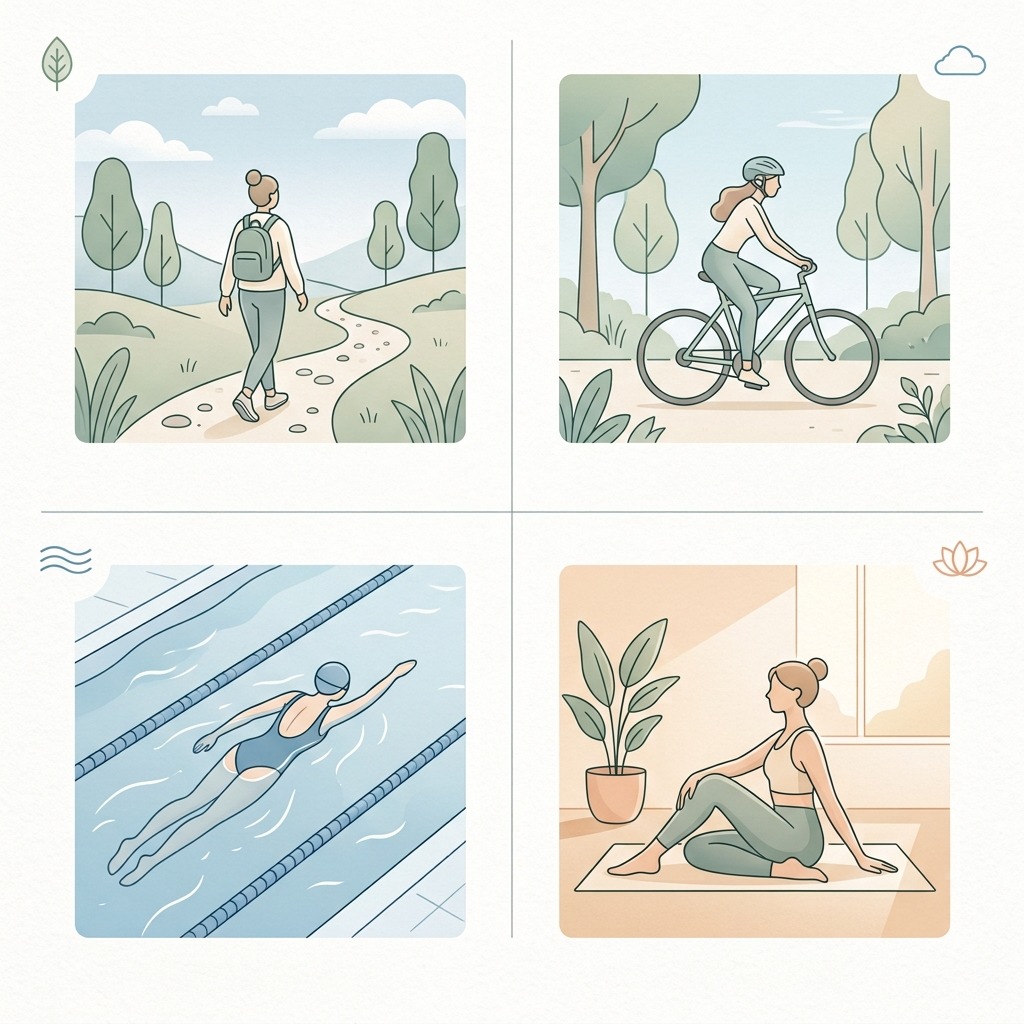
The common thread across every option below is low cognitive load: movements that are repetitive, familiar, and don’t require constant decisions, technique corrections, or strategy. That combination lets your body get the benefits of exercise without asking much of an already-tired brain.
Walking
Walking is close to the ideal mentally-exhausted workout: minimal coordination, adjustable intensity, and no equipment or planning required. It’s also one of the few forms of exercise with dedicated research behind its brain-restoring effects — studies on Attention Restoration Theory have repeatedly found that time in natural settings helps replenish the same “top-down” attention resources that cognitively demanding work drains, with measurable improvements in focus and executive function after just 20 to 40 minutes outdoors.
Cycling
Whether it’s a flat outdoor ride or an easy spin on a stationary bike, cycling lets you dial in a steady, predictable effort with almost no decision-making mid-session. Keep the pace conversational and let your mind drift rather than chasing pace or power targets.
Swimming laps
The repetitive stroke pattern and the sensory environment of water — muffled sound, no phone, no screens — make swimming one of the most mentally quieting workouts available, on top of being a full-body, joint-friendly option.
Rowing
A rowing machine offers a rhythmic, full-body motion that’s easy to fall into once your form is set, with intensity that’s simple to adjust by feel rather than by tracking splits or numbers. Because the movement pattern barely changes from stroke to stroke, it asks very little of a fatigued brain while still delivering a legitimate cardiovascular and strength stimulus.
Gentle yoga or stretching
Familiar poses, done slowly, require far less mental bandwidth than learning something new. The breath-focused nature of yoga also gives your mind something simple to anchor to, which can help shift attention away from lingering work stress.
Bodyweight strength circuits
If you want resistance training without heavy planning, stick to a short, familiar sequence — squats, push-ups, rows, planks — done at a moderate pace. Interestingly, brief strength or power efforts tend to hold up better under mental fatigue than longer endurance work, since the perceived-effort penalty compounds the longer an activity goes on.
What to deliberately avoid on a mentally foggy day: anything that demands split-second decisions or constant technique focus — unfamiliar HIIT formats, complex choreography, high-skill lifts you’re still learning, or team sports that require fast reactions. These have a higher injury risk when your attention is already stretched thin, and they tend to feel disproportionately unpleasant, which can sour your relationship with exercise altogether.
How to Adjust Your Workout When You’re Mentally Drained
You don’t have to choose between a full workout and nothing. A handful of small adjustments can make exercise accessible even on your most mentally fried days.
- Shorten the session. Cut your usual workout down to 10–20 minutes. A short session that actually happens beats an ambitious one that gets skipped, and research on exercise adherence consistently shows that “something is better than nothing” holds up physiologically as well as psychologically.
- Lower the intensity. Choose a steady, moderate pace over hard intervals. Interval training demands constant attention to pacing and effort, which is exactly the kind of decision-making your brain doesn’t have left to give.
- Let someone else make the decisions. Follow a pre-programmed class, a recorded video, or a fixed machine setting. Removing the planning step — what to do, how long, how hard — removes the single biggest barrier for a mentally fatigued brain.
- Shift your focus from data to sensation. Instead of tracking pace, calories, or splits, pay attention to your breathing and the feel of the movement. Turning off performance metrics reduces the cognitive load of the workout itself.
- Prepare a “low mental energy” template in advance. On a day when you do have bandwidth, write down two or three go-to short workouts. Future-you won’t have to think — just follow the plan.
- Stack it onto an existing habit. Attach a short session to something you already do automatically, like changing out of work clothes, so it doesn’t require a separate decision to begin.
Always check in with a doctor before making major changes to your routine, especially if the fatigue is ongoing, unexplained, or paired with other symptoms — persistent exhaustion isn’t always just a busy week.
Zero Motivation? Here’s How to Start Moving Anyway
Some days the issue isn’t just fatigue — it’s that you can’t summon any motivation at all. These strategies are designed to sidestep motivation entirely rather than wait for it to show up.
- The two-minute rule. Commit to just two minutes of movement. That’s a small enough ask to bypass resistance, and once you’re moving, continuing is usually far easier than starting was.
- Remove friction in advance. Lay out your workout clothes, keep equipment visible and ready, or even sleep in workout gear if mornings are your window.
- Pair it with something you enjoy. Save a favorite show or podcast exclusively for workout time, so the session comes bundled with something you’re actually looking forward to.
- Just get into position. Sit on the rowing machine, stand on your mat, or put your shoes on by the door. Physically positioning yourself to start often carries you into the activity without a separate “decision” moment.
- Build in light accountability. A workout partner, a group chat, or a simple tracking app adds just enough external structure to counter a depleted internal one.
None of these require motivation to work — that’s the point. They work by shrinking the gap between deciding to move and actually moving, which is exactly the gap mental fatigue widens.
Recovery Still Matters: Don’t Skip the Sleep Side of the Equation
Adjusting your workouts helps you stay consistent, but it’s not a substitute for addressing the root of the fatigue. Research reviewing sleep and athletic performance has found that inadequate sleep is linked to a higher perceived exertion during exercise, slower pacing, reduced endurance, lower glycogen stores, weaker output, and a higher injury rate — largely because insufficient sleep blunts growth hormone release (needed for muscle repair) and raises inflammatory markers that slow recovery.
Aim for a consistent seven to nine hours a night rather than trying to “catch up” on weekends, since inconsistent sleep patterns don’t offer the same recovery benefit as a steady routine. Most fitness guidelines, including recommendations from the American Council on Exercise, also suggest at least one lighter or fully restful day every seven to ten days to avoid sliding into overtraining, where your body becomes too depleted to benefit from continued exercise at all.
The Takeaway
Mental exhaustion and physical tiredness aren’t the same problem, and they don’t need the same solution.
When your brain is fried but your body is fine, the fix usually isn’t more sleep — it’s a shorter, simpler, lower-decision workout that meets you where you are: a walk, an easy ride, a familiar strength circuit, or ten unhurried minutes on a mat.
Save full rest days for when the signs point to genuine physical depletion, not just a demanding day at work.
The goal isn’t to push through every low-energy day at full intensity, and it isn’t to skip exercise the moment your brain feels tired, either. It’s to learn to tell the two apart — and to have a handful of low-effort, low-decision workouts ready so that showing up never depends on how much motivation you happen to have left.
Related Posts

Stay Informed With the Latest & Most Important News
Previous Post
Next Post










Advertisement