
























Now Reading: Working Out for Mental Health: What Actually Changes in Your Brain
-
01
Working Out for Mental Health: What Actually Changes in Your Brain



You’ve probably heard that exercise is “good for your mental health.”
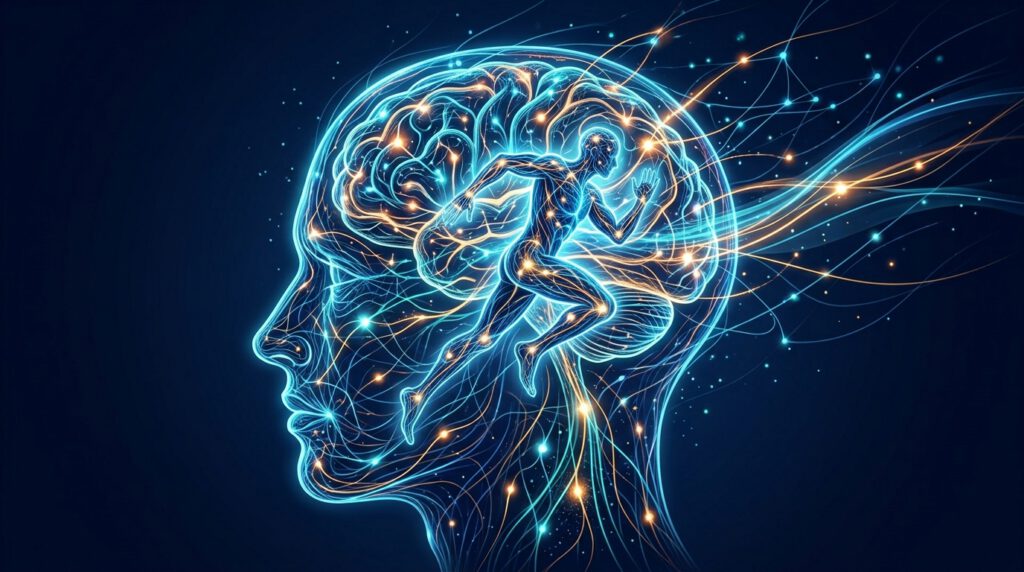
But that phrase undersells what’s actually happening. Working out doesn’t just distract you from stress or give you a temporary mood lift — it physically rewires your brain.
It changes brain chemistry, grows new tissue, calms overactive stress circuits, and even reduces inflammation linked to depression.
This isn’t a philosophy. It’s neuroscience. Here’s exactly what happens inside your skull every time you move your body — and how little you actually need to do to get the benefits.
Table of contents
- 1. The Chemical Shift: Your Brain on Exercise
- 2. Structural Changes: Exercise Physically Rebuilds the Brain
- 3. The Anti-Inflammatory Effect: A Different Pathway Entirely
- 4. Exercise as Stress Rehearsal
- 5. What This Means for Depression, Anxiety, and Everyday Mood
- 6. How Much Exercise Do You Actually Need?
- 7. Getting Started Without Overthinking It
- The Bottom Line
- FAQ
1. The Chemical Shift: Your Brain on Exercise
The first thing that happens when you start moving is a rapid change in brain chemistry.
Neurotransmitters get an immediate boost. Physical activity raises levels of serotonin, dopamine, and norepinephrine almost immediately. These three chemicals are responsible for mood regulation, motivation, focus, and energy — which is why a short workout can shift your mental state faster than almost anything else you can do in 20 minutes.
GABA calms the noise. Exercise increases GABA, the brain’s primary calming neurotransmitter. Higher GABA activity is associated with reduced anxiety and a quieter, less reactive nervous system.
Endorphins and endocannabinoids play a role — but maybe not the one you think. For decades, the “runner’s high” was attributed almost entirely to a flood of endorphins. Newer research complicates that story. Endocannabinoids — the body’s own version of the compounds found in cannabis — appear to contribute significantly to the sense of calm and mild euphoria after exercise, and some researchers argue endorphins alone don’t fully explain the effect. The honest scientific picture is that multiple chemical systems overlap here, rather than one single “happiness chemical.”
Norepinephrine may be the real MVP for stress. This is the most underrated player in the whole system. About half of the brain’s norepinephrine supply is produced in a small brainstem region called the locus coeruleus, which connects to nearly every brain area involved in emotional processing and the stress response. Animal research going back decades shows that exercise reliably increases norepinephrine concentration in these stress-related circuits — essentially training your brain to regulate stress responses more efficiently over time.
2. Structural Changes: Exercise Physically Rebuilds the Brain
This is where things get genuinely remarkable. Exercise doesn’t just create a temporary chemical wave — with consistency, it changes the physical structure of your brain.
BDNF: “Fertilizer” for Neurons
Brain-Derived Neurotrophic Factor (BDNF) is a protein often nicknamed “fertilizer for the brain.” It supports the survival of existing neurons and encourages the growth of new ones. Exercise is one of the most reliable, non-pharmacological ways to raise BDNF levels, and BDNF has been directly linked to improved learning, memory, and resistance to age-related cognitive decline.
The Hippocampus Gets Bigger
The hippocampus — your brain’s memory and learning center — is unusually sensitive to both chronic stress and exercise, but in opposite directions. Chronic stress shrinks it. Aerobic exercise grows it.
Animal studies have shown that regular activity increases blood supply to the brain and promotes adult neurogenesis (the creation of new neurons) specifically in the hippocampus. In humans, controlled activity interventions have been shown to increase hippocampal volume by around one percent over the course of a year — a meaningful reversal of the natural age-related shrinkage most adults experience.
The Prefrontal Cortex Gets Stronger
Consistent exercise strengthens connections in the prefrontal cortex — the region responsible for planning, emotional regulation, and impulse control. This is one reason regular exercisers often report better emotional stability and less reactivity to frustration or setbacks over time.
Muscles Talk to the Brain (Yes, Really)
One of the more recent and genuinely exciting discoveries in exercise science is the role of myokines — signaling proteins released by contracting muscle tissue during exercise. A specific myokine called irisin crosses into the brain and appears to trigger BDNF production and support neuroplasticity, essentially acting as a chemical messenger between your muscles and your mind. This “muscle-brain crosstalk” is an active area of 2025 research and helps explain why whole-body movement seems to matter, not just cardio in isolation.
3. The Anti-Inflammatory Effect: A Different Pathway Entirely
Beyond neurotransmitters and structural growth, there’s a third mechanism that gets far less attention: neuroinflammation.
Depression has increasingly been linked to low-grade chronic inflammation in the brain. Emerging 2025 research shows that exercise has a measurable anti-inflammatory effect on neural tissue, which may partly explain why physical activity improves depressive symptoms independent of its effects on mood chemicals alone. This gives exercise at least three distinct, overlapping mechanisms for improving mental health — chemical, structural, and immunological — which is part of why its effects are so robust across different populations and conditions.
4. Exercise as Stress Rehearsal
It sounds counterintuitive: exercise is a physical stressor, so how does stressing the body reduce stress?
The answer is that exercise acts as a kind of rehearsal for your body’s stress-response systems. During a workout, your cardiovascular, muscular, renal, and nervous systems are forced to communicate and coordinate far more intensely than during rest. Over time, this “practice” makes your entire stress-response network more efficient — so when a real psychological stressor hits, your body handles it with less overreaction.
This is also why exercise is particularly effective for people who struggle with anxiety and panic attacks. Strenuous activity produces physical sensations — racing heart, rapid breathing — that closely mimic a panic response. Regularly experiencing and tolerating these sensations in a safe, controlled context (a workout) can help retrain the brain not to panic when it encounters them elsewhere.
5. What This Means for Depression, Anxiety, and Everyday Mood
Put together, these mechanisms explain findings that once seemed surprising:
- For mild to moderate depression, research suggests physical activity can be as effective as antidepressant medication or cognitive behavioral therapy for some people — and works well as a complement to either.
- People who exercise regularly show lower rates of anxiety and depression than sedentary populations.
- Exercise improves sleep quality, which in turn stabilizes mood — a two-way relationship where poor sleep and poor mental health often reinforce each other.
- It boosts self-esteem and sense of control, particularly through the accomplishment of setting and hitting small, achievable goals.
- It offers a natural distraction from rumination, interrupting the negative thought loops common in anxiety and depression.
There’s also a physical health argument that matters specifically for people with mental illness: they face elevated risk for cardiovascular disease, diabetes, and other chronic conditions, and exercise directly reduces that risk while also improving mood.
6. How Much Exercise Do You Actually Need?
This is the question that stops most people before they even start — and the real answer is more forgiving than most people assume.
Official guidelines (US and Australian health authorities) recommend roughly 150 minutes of moderate aerobic activity per week, or about 75 minutes of vigorous activity — spread however works for your schedule.
But here’s the more encouraging finding: research shows meaningful brain benefits at doses far below that. A widely cited study found that a single 10-minute bout of very light exercise — like a slow walk — measurably changed how brain regions communicate with each other and improved memory function almost immediately. Other research on “exercise snacks” (very short bursts of activity spread through the day) has shown real benefits for both physical and cognitive markers.
The practical takeaway: something is always better than nothing, and consistency matters more than intensity. Three 10-minute walks are not a lesser version of one 30-minute walk — for many outcomes, they’re roughly equivalent.
Aerobic vs. Strength Training: Do They Affect the Brain Differently?
Yes — and this is a useful distinction if you’re designing a routine specifically for brain health.
A review of dozens of studies in older adults found that aerobic exercise tends to improve overall cognitive function broadly, while resistance (strength) training shows particular benefits for executive function and working memory. The takeaway isn’t “pick one” — it’s that a combination of cardio and resistance work appears to cover more cognitive ground than either alone.

7. Getting Started Without Overthinking It
If you’re not currently active, the path in doesn’t need to be complicated:
- Talk to your doctor first, especially if you have existing health conditions.
- Pick something you don’t dread. Adherence beats optimization — the “best” workout is the one you’ll actually repeat.
- Start smaller than feels necessary. A 10-minute walk counts. Build from there.
- Schedule it like an appointment. Put it in your calendar rather than relying on motivation.
- Reassess and adjust. If a routine stops working for you, change it — variety also helps with adherence and reduces boredom.
Bonus Effect: Take It Outside
Exercising outdoors appears to amplify the mental health benefits compared to identical indoor activity. Outdoor exercisers report higher vitality, enthusiasm, and self-esteem, along with lower tension and fatigue — and they’re also more likely to stick with the habit and exercise for longer, more consistent stretches over time.
The Bottom Line
Exercise changes your brain on three separate, complementary levels: it shifts your neurochemistry within minutes, it physically rebuilds structures like the hippocampus and prefrontal cortex over weeks and months, and it reduces the neuroinflammation increasingly linked to depression. You don’t need a marathon training plan to access any of this — you need consistency, and you can start with something as small as a 10-minute walk today.
FAQ
Does exercise really change brain structure, or just mood?
Both. Beyond the immediate chemical mood boost, consistent exercise has been shown to increase hippocampal volume and strengthen prefrontal cortex connectivity over time.
How fast do the brain benefits of exercise kick in?
Some effects, like altered brain connectivity and short-term memory improvement, have been observed after a single 10-minute session. Structural changes like hippocampal growth take weeks to months of consistent activity.
Is cardio or strength training better for mental health?
Both help, in different ways — aerobic exercise tends to support overall cognitive function, while resistance training shows particular benefits for working memory and executive function. Combining both may offer the broadest benefit.
Related Posts

Stay Informed With the Latest & Most Important News
Previous Post
Next Post










Advertisement