






















Now Reading: Under-Desk Bikes: Do They Actually Burn Calories While You Work? (2026 Guide)
-
01
Under-Desk Bikes: Do They Actually Burn Calories While You Work? (2026 Guide)


If you’ve spent any time scrolling fitness ads, you’ve probably seen an under-desk bike promising to turn your 9-to-5 into a stealth workout.
The pitch is appealing: pedal quietly under your desk, burn calories, and never actually “exercise.” But do these little machines really work, or is this another wellness gadget that ends up gathering dust by week three?
Short answer: yes, under-desk bikes do burn measurably more calories than sitting still — but the realistic number is closer to 70–150 calories per hour at a desk-friendly pace, not the 400–500-calorie figures some product pages throw around.
The bigger win isn’t the calorie count itself; it’s what steady, low-effort movement does for your circulation, blood sugar, and energy over an eight-hour day.
Here’s what the research actually shows, where the marketing numbers get inflated, and how to use one effectively.
Table of contents
- What Is an Under-Desk Bike?
- Do Under-Desk Bikes Actually Burn Calories? What the Research Says
- Other Health Benefits Beyond the Calorie Count
- Does Pedaling Hurt Your Work Performance? Here’s the Honest Answer
- How to Get the Most Out of an Under-Desk Bike
- Under-Desk Bike vs. Standing Desk vs. Walking Pad
- Who Should (and Shouldn’t) Use One
- Best Under-Desk Bikes to Buy (2026)
- FAQ
- The Bottom Line
What Is an Under-Desk Bike?
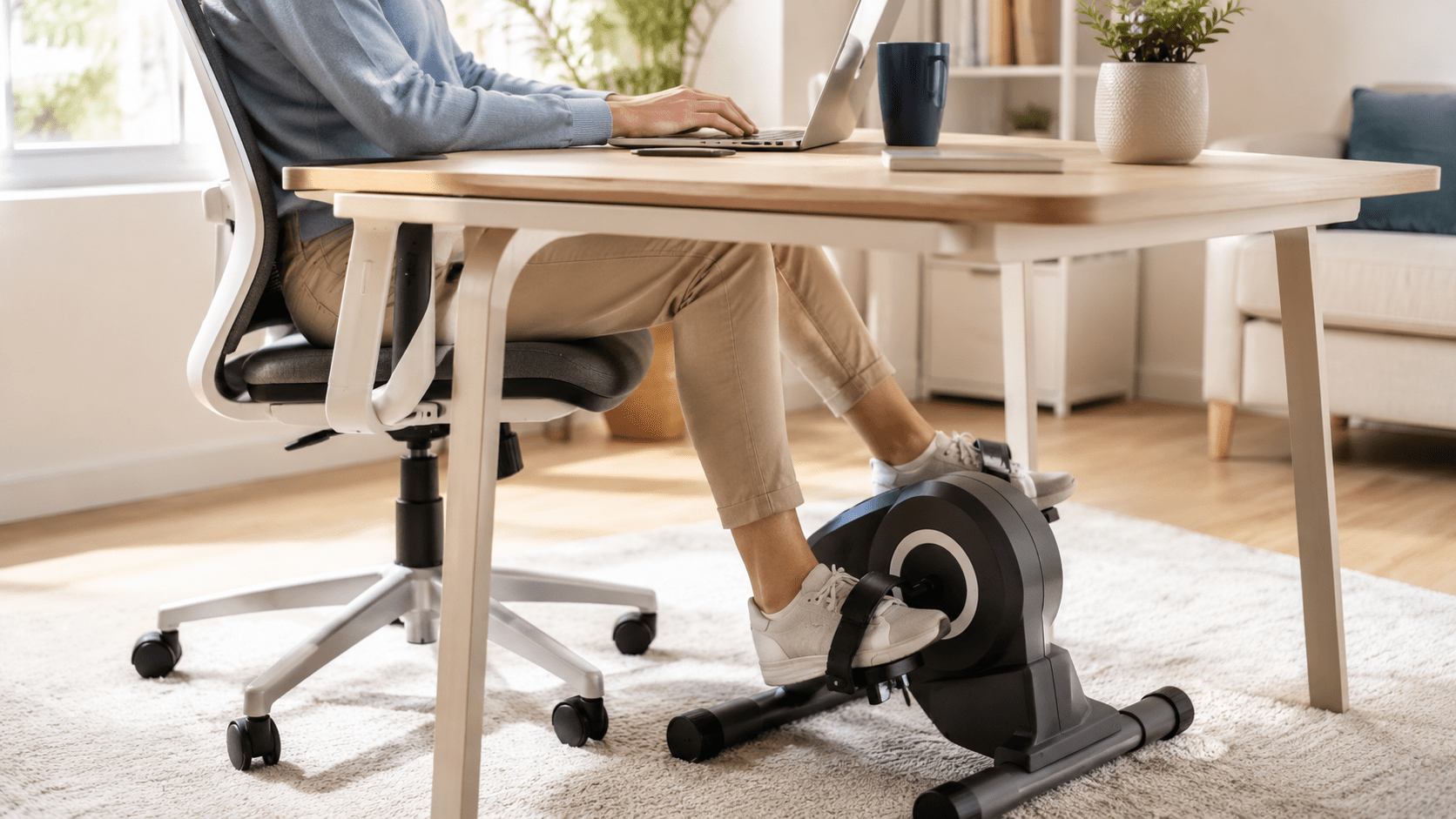
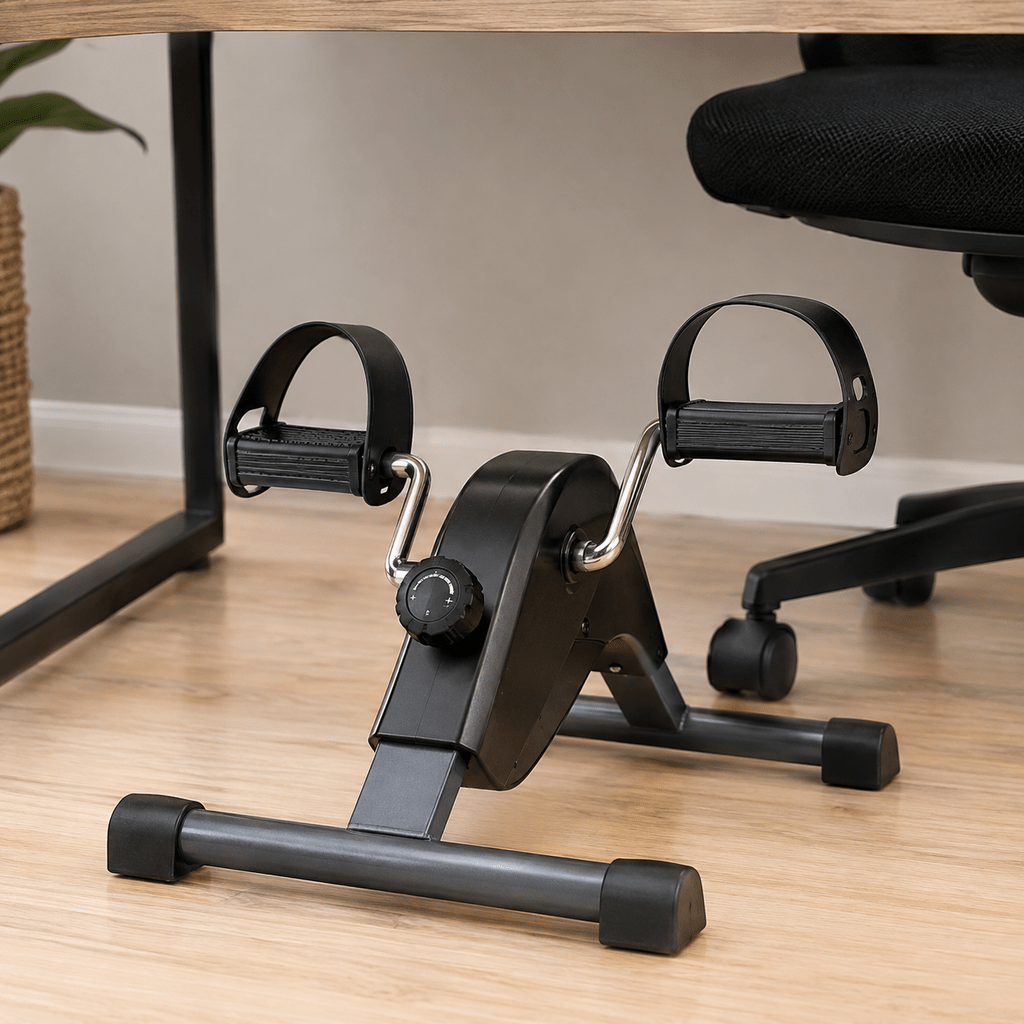
An under-desk bike (also called a desk cycle, pedal exerciser, or under-desk elliptical) is a compact, motor-free pedaling device that sits on the floor under your desk.
You pedal with your feet while sitting in your normal chair, typing, taking calls, or reading — no need to change clothes or leave your workstation.
Most models offer adjustable magnetic resistance, a small LCD display for tracking time, RPM, and estimated calories, and some fold flat or include a carry handle for moving between rooms.
They’re different from a full stationary bike or spin bike: there’s no seat, and you’re not meant to pedal hard enough to break a sweat. The whole point is compatibility with sitting and working at the same time.
Do Under-Desk Bikes Actually Burn Calories? What the Research Says
Yes — but the honest number depends heavily on intensity, and that’s where a lot of product marketing gets misleading.
The realistic range: light, work-compatible pedaling
At a pace you can actually sustain while typing or in a meeting, most research places the extra calorie burn at roughly 70–100 calories per hour above sitting still.
This is essentially a form of NEAT (non-exercise activity thermogenesis) — the same category as fidgeting, standing, or pacing — rather than a true cardio workout.
A frequently cited 16-week study of office workers published in the American Journal of Preventive Medicine is a good reality check here: participants using under-desk pedal exercisers burned an average of 107 extra calories per day (not per hour), adding up to roughly 500 extra calories a week.
That study also found measurable improvements in body fat percentage and waist circumference over the 16 weeks, which matters more than any single-session calorie number.
Where the bigger numbers come from — and why they’re misleading
You’ll see claims of 400–500 calories “burned per hour” or comparisons to biking 13.5 miles.
Those numbers are real for stationary cycling — but they describe a moderate-to-vigorous cycling pace (think spin class effort), not something you can sustain while typing an email or being on a video call. At that intensity, you’d be out of breath and unable to focus on work, which defeats the purpose of a desk bike.
Treat “up to 500 calories” marketing claims as the ceiling for an all-out session, not a realistic daily-work number.
A more grounded way to think about it: moderate pedaling intensities (compatible with light desk work) land in the 100–200 calorie per hour range, while genuinely light, “I forgot I was pedaling” intensity is closer to 70–100 calories per hour. Either way, done consistently across a work week, it adds up to a meaningful weekly deficit — just not a dramatic one.
Putting it in weekly and monthly terms
- 1 hour/day, 5 days/week at light intensity: ~350–500 extra calories/week
- 1 hour/day, 5 days/week at moderate intensity: ~500–1,000 extra calories/week
- Over a year: consistent use can add up to several pounds’ worth of extra energy expenditure — without changing anything else about your routine
That’s not nothing, but it’s also not a substitute for structured exercise. Think of an under-desk bike as tipping your daily energy balance slightly in your favor, not as your workout.
Other Health Benefits Beyond the Calorie Count
Calorie burn is what gets marketed, but it may not even be the main benefit. Several other effects show up consistently in the research:
- Cardiovascular health: Getting even 30–90 minutes of light pedaling per day helps you work toward the American Heart Association’s recommendation of 150 minutes of moderate activity per week — accumulated in the background of your workday rather than as a dedicated session.
- Blood sugar and insulin sensitivity: Light, frequent movement throughout the day is increasingly linked to better glucose control and insulin sensitivity, which matters more for long-term metabolic health than any single workout. This is one of the more evidence-backed arguments for interrupting long sitting blocks, even with low-intensity movement.
- Circulation and stiffness: Continuous leg movement helps counter the blood pooling and stiffness that comes from sitting still for hours, which is relevant for people at risk of deep vein issues from prolonged sitting.
- Energy and mood: Many users report less of an afternoon slump. This tracks with broader research showing that light aerobic movement can modestly improve alertness and mood without requiring intense exertion.
Does Pedaling Hurt Your Work Performance? Here’s the Honest Answer
This is the question most under-desk bike articles gloss over — and the research here is genuinely mixed, not uniformly reassuring.
- Several studies found no significant effect on reading comprehension or general cognitive tasks while pedaling at light-to-moderate wattage.
- However, more than one controlled study — including research on active workstations more broadly — found a measurable, statistically significant drop in typing speed and accuracy, and some found reduced mouse precision, especially at higher pedaling intensity or less stable seating.
- A 2023 randomized clinical trial on active workstations (published in the Journal of the American Heart Association) similarly noted that cycling workstations have been associated with reduced productivity and lower worker satisfaction in some study designs, even though cognitive test scores didn’t always suffer.
- On the more favorable side, research using a desk-compatible recumbent bike found that a light pace (around 17 watts, roughly 65–70 RPM) was the sweet spot for comfort and focus, with no meaningful difference by age, gender, or fitness level — but performance dropped off somewhat at higher wattage (around 25 W).
The practical takeaway: light, low-resistance pedaling is unlikely to meaningfully disrupt reading, calls, or thinking-heavy work, but it can measurably slow you down on precision typing or detailed mouse work — especially if you push the resistance up. If your job is typing-intensive, keep the resistance low and save it for reading-, call-, or meeting-heavy stretches of your day.
How to Get the Most Out of an Under-Desk Bike
- Start small. Ten to fifteen minutes at a time, a few times a day, is a realistic entry point. Build toward 30–90 total minutes daily rather than trying to pedal nonstop.
- Match intensity to the task. Keep resistance low during typing or detail work; save higher resistance for calls, reading, or passive screen time.
- Use interval bursts if you want more calorie burn. Alternating 30–60 seconds of faster pedaling with a few minutes at an easy pace increases total energy expenditure without requiring sustained high effort.
- Adjust the seat and desk height properly. Poor ergonomics — knees hitting the desk, an awkward hip angle — is the most common reason people quit early or develop discomfort.
- Pair it with diet and sleep, not instead of them. Every source of good evidence agrees: an under-desk bike shifts your calorie balance modestly, but nutrition, sleep, and overall activity level still do most of the heavy lifting for weight loss.
- Track consistency, not perfection. A basic app, smartwatch, or notebook log of daily minutes is more useful for motivation than obsessing over the (often inaccurate) calorie counter built into the bike — several tested models show inflated, unreliable calorie estimates on their displays.
Under-Desk Bike vs. Standing Desk vs. Walking Pad
| Feature | Under-Desk Bike | Standing Desk | Walking Pad |
|---|---|---|---|
| Extra calories/hour | ~70–150 | ~10–50 | ~150–300 |
| Compatible with typing | Yes, at low resistance | Yes | Difficult above slow speeds |
| Compatible with calls/reading | Yes | Yes | Yes |
| Noise | Low (quiet models ~35 dB) | Silent | Moderate |
| Space required | Minimal, fits under most desks | Requires adjustable desk | Largest footprint |
| Approx. cost | $50–$250 | $200–$700+ (desk) | $150–$500 |
| Best for | Steady background movement while seated | Reducing total sitting time | Higher calorie burn, less precision work |
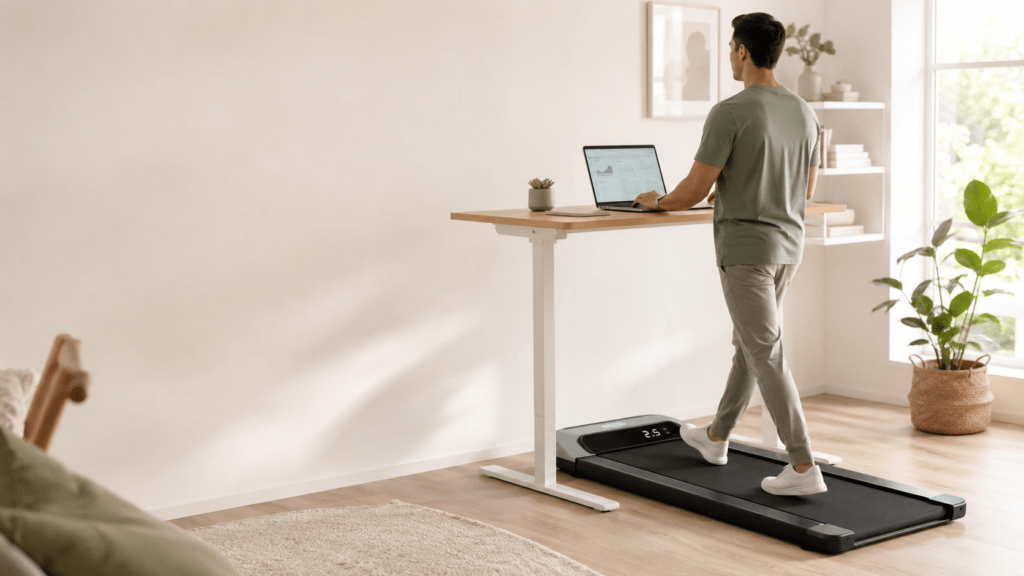
If your main goal is calorie burn and you can tolerate some movement while working, a walking pad generally out-performs a desk bike. If your priority is compatibility with focused, detail-heavy work — and staying seated — the under-desk bike is the more realistic daily habit.
Who Should (and Shouldn’t) Use One
Under-desk bikes are low-impact and generally well tolerated, including by older adults, people in physical rehab, and those with joint sensitivity, since there’s no impact on the knees or hips the way walking or running can have. That said, a few caveats are worth knowing:
- Check the weight capacity before buying — this varies widely between models (roughly 150 lbs on some compact ellipticals up to 500 lbs on heavier-duty models).
- If you have a knee, hip, or lower-back condition, check with a physical therapist or doctor first — most models are gentle, but resistance and range of motion still matter for some conditions.
- Don’t expect it to replace structured cardio. It’s a tool for reducing the harm of prolonged sitting and adding modest daily activity, not a substitute for a workout you’d get from real cycling, running, or strength training.
Best Under-Desk Bikes to Buy (2026)
A few models consistently come up as top picks across independent reviews and testing, based on build quality, noise level, resistance range, and reliability.
- DeskCycle Under Desk Bike — The most consistently recommended all-rounder. Smooth magnetic resistance, adjustable pedal height (down to 9″) for lower desks, and a high weight capacity make it a solid pick for most home and office setups.
- Cubii JR1 Under Desk Elliptical — Uses an elliptical motion instead of a circular pedal stroke, which some users find more comfortable for longer sessions. Extremely quiet, making it a good choice for shared offices or frequent video calls. Note the lower ~150 lb weight capacity.
- YOSUDA Under Desk Bike (16-Level Resistance) — More resistance levels than most competitors, which is useful if you want room to progress as your fitness improves. Includes Bluetooth app tracking and resistance bands for basic upper-body work.
- Sunny Health & Fitness Dual Function Pedal Exerciser — A budget-friendly, well-reviewed option from an established fitness brand, with dual-use pedals that also work as hand cranks for arm exercises.
Disclosure: the links above are Amazon affiliate links — add your own Associate tracking ID before publishing.
FAQ
Do under-desk bikes actually help you lose weight?
They can contribute to weight loss as part of an overall calorie deficit, but the effect from the bike alone is modest — typically a few hundred extra calories per week at realistic desk-work intensity. Diet and overall activity level matter far more.
Will pedaling make me sweaty at work?
Not at a light, desk-compatible pace (roughly 60–70 RPM with low resistance). You’d need to push into a moderate-to-vigorous effort to break a sweat, which isn’t realistic while typing.
How many calories does an under-desk bike burn per hour?
Roughly 70–100 calories per hour at a light pace, and up to 150–200 calories per hour at a moderate pace you can sustain during less detail-intensive tasks. Claims above that generally describe an intensity incompatible with working at the same time.
Do under-desk bikes hurt typing accuracy?
At low resistance, most people show little to no measurable impact on reading or general cognitive work. Some studies do find a small but statistically significant drop in typing speed and accuracy, particularly at higher resistance — so keep it light during typing-heavy stretches.
Are under-desk bikes good for seniors or people in rehab?
Generally yes — they’re low-impact and gentle on the joints, which is why they’re commonly recommended for older adults and physical therapy patients. Check weight capacity and consult a doctor or physical therapist for specific conditions.
The Bottom Line
Under-desk bikes do burn real calories — just not the dramatic numbers some marketing suggests.
At a work-compatible pace, expect somewhere around 70–150 extra calories per hour, which adds up to a genuinely useful few hundred calories a week if you’re consistent.
The bigger payoff is what steady movement does for circulation, blood sugar, and afternoon energy levels over the course of a sitting-heavy day. Used with reasonable expectations — and paired with decent nutrition and sleep — an under-desk bike is a low-effort way to make sitting all day a little less harmful.
Related Posts

Stay Informed With the Latest & Most Important News
Previous Post
Next Post










Advertisement