











Now Reading: Recovery Tools Compared: Percussion Guns vs Compression Boots vs Foam Rollers
-
01
Recovery Tools Compared: Percussion Guns vs Compression Boots vs Foam Rollers


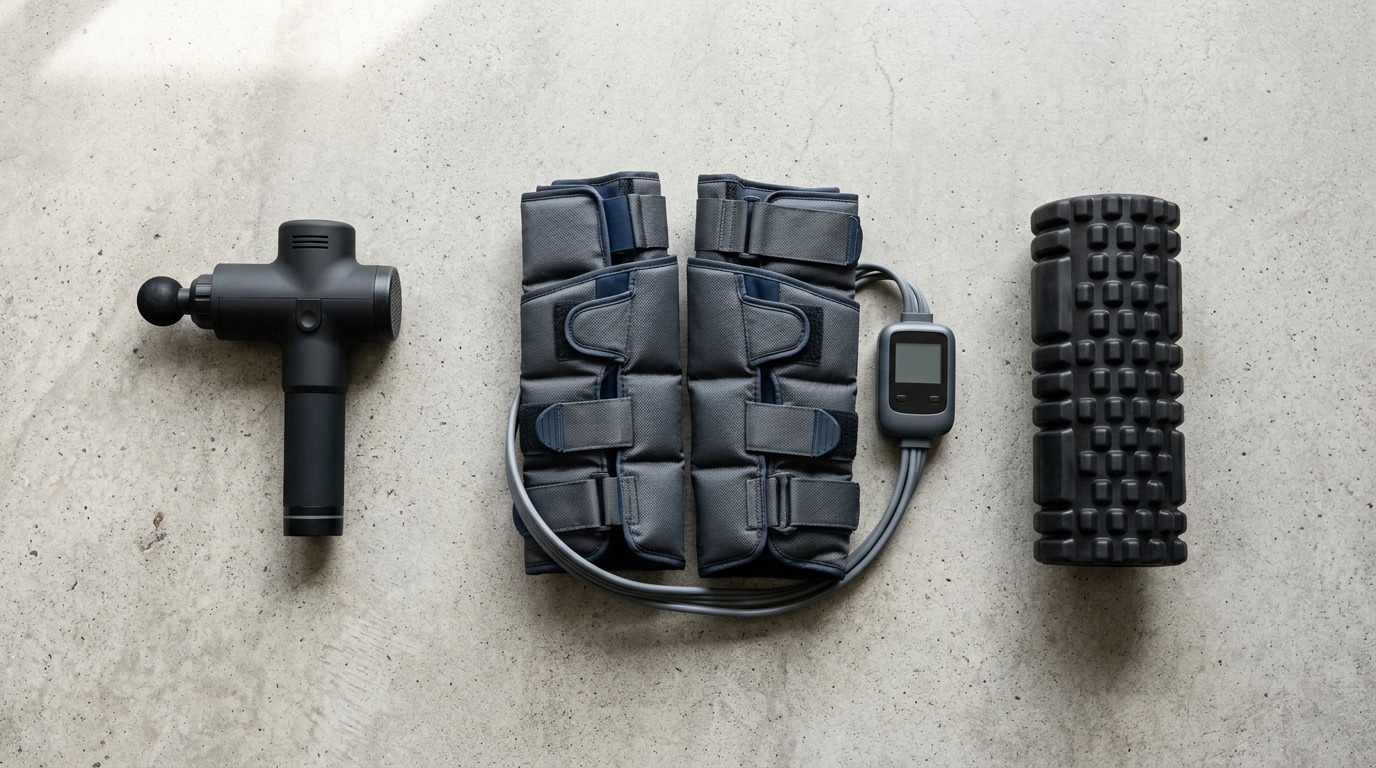
Walk into almost any serious home gym in 2026 and you’ll find all three sitting in the corner: a foam roller under the bench, a massage gun charging on a shelf, and a pair of compression boots folded next to the towel rack.
That’s not overkill. It’s a sign that these three recovery tools solve genuinely different problems, and the question “which one should I buy” is usually the wrong question to ask. The better question is: which recovery bottleneck am I actually trying to fix?
This guide breaks down how each tool works, what the current research actually supports, where each one falls short, and how to build a recovery routine (and shopping list) around your specific training instead of the marketing copy.
Table of contents
- Quick Comparison Table
- The Core Mechanical Difference
- Foam Rolling: Best for Mobility and Fascial Tension
- Percussion Massage Guns: Best for Targeted Trigger Points
- Compression Boots: Best for Whole-Limb, Passive Recovery
- Head-to-Head: Which One Wins for Which Scenario
- Building a Combined Recovery Stack
- The ROI Question: What’s Worth Buying First
- Frequently Asked Questions
- Bottom Line
Quick Comparison Table
| Foam Roller | Percussion (Massage) Gun | Compression Boots | |
|---|---|---|---|
| Best for | Broad myofascial release, general flexibility | Localized knots, trigger points, pre-workout activation | Whole-limb fatigue, post-endurance recovery |
| Effort required | Active (you apply body weight) | Active (you hold and aim it) | Passive (hands-free) |
| Session length | 5–10 minutes | 1–2 minutes per muscle group | 15–30 minutes |
| Coverage | Large muscle groups, one area at a time | Pinpoint, single spot | Entire leg, uniformly |
| Typical price (2026) | $15–$50 | $80–$650 | $300–$1,000+ |
| Portability | Bulky but simple | Highly portable | Bulky, needs an outlet or charge |
| Evidence strength | Moderate, longest track record | Limited but growing, mostly short-term effects | Modest, strongest for subjective soreness |
The Core Mechanical Difference
Each tool interacts with your body in a completely different way, which is why they’re not interchangeable.
Foam rollers rely on your own body weight to apply sustained pressure across a muscle, working through self-myofascial release (SMR) to loosen fascia — the connective tissue sheath around your muscles — and break up localized tightness.
Percussion guns fire rapid, repetitive pulses (typically 2,000–3,200 RPM) into a small area of tissue. The quick “punching” action is thought to override pain signals, increase local blood flow, and desensitize an overactive nervous system response around a knot faster than static pressure can.
Compression boots use intermittent pneumatic compression (IPC): sequential air chambers inflate and deflate along the leg from the foot upward, mechanically mimicking your calf muscles’ natural pumping action to push blood and lymphatic fluid back toward your heart.
None of these mechanisms replace another. A foam roller requires you to move and position your body. A massage gun requires you to hold and aim a device. Compression boots require nothing except putting them on — which is exactly why they’re the only truly passive option of the three, but also why they can’t replicate the deep, targeted pressure a massage gun or roller delivers to one specific spot.
Foam Rolling: Best for Mobility and Fascial Tension
Foam rolling has the longest track record of the three, and it’s the one with the most consistent research behind it.
Multiple systematic reviews and meta-analyses published between 2024 and 2026 have looked specifically at foam rolling’s effect on delayed-onset muscle soreness (DOMS) — the stiffness that shows up 24 to 72 hours after a hard session.
A 2024 meta-analysis found foam rolling produced small-to-moderate reductions in post-exercise soreness, and a 2025 review of elite volleyball athletes found foam rolling reduced soreness and accelerated lactate clearance to a degree comparable with active recovery, particularly in the 48–96 hour window after intense exercise.
Vibrating foam rollers appear to add a modest additional benefit for pain and perceived fatigue on top of static rolling, though the evidence there is still described as inconsistent for physiological markers like blood flow.
Best for: large muscle groups (quads, calves, back, IT band), general flexibility work, and pre-workout mobility routines.
Where it falls short: it’s physically demanding to sustain pressure, time-limited by discomfort tolerance, and awkward for certain angles (glutes, hips) where it’s hard to apply even pressure through self-positioning.
Buying tip: a firm, multi-density roller like the TriggerPoint GRID holds up better over time than cheap solid-foam versions, which flatten and lose density within months of regular use. <!– PRODUCT PLACEMENT: TriggerPoint GRID Foam Roller –>
TriggerPoint GRID Foam Roller, 13″ → The multi-density surface is designed to mimic a massage therapist’s hands, and the rigid hollow core keeps its shape long after cheaper solid-foam rollers have gone flat. A one-time purchase under $40 that covers nearly every large muscle group.
Percussion Massage Guns: Best for Targeted Trigger Points
Percussion guns are the newest and most heavily marketed of the three, but the evidence base is still catching up to the hype. Reviewers note that much of the existing science on percussive devices actually studies vibration therapy rather than true percussion, and the two mechanisms aren’t identical — percussion is designed to “punch” deeper into tissue, while vibration works more on the surface.
That said, several studies do support modest, short-term effects: vibration therapy has shown similar effectiveness to regular massage for reducing post-workout soreness, and vibrating foam rolling shows a bigger drop in perceived pain than static rolling.
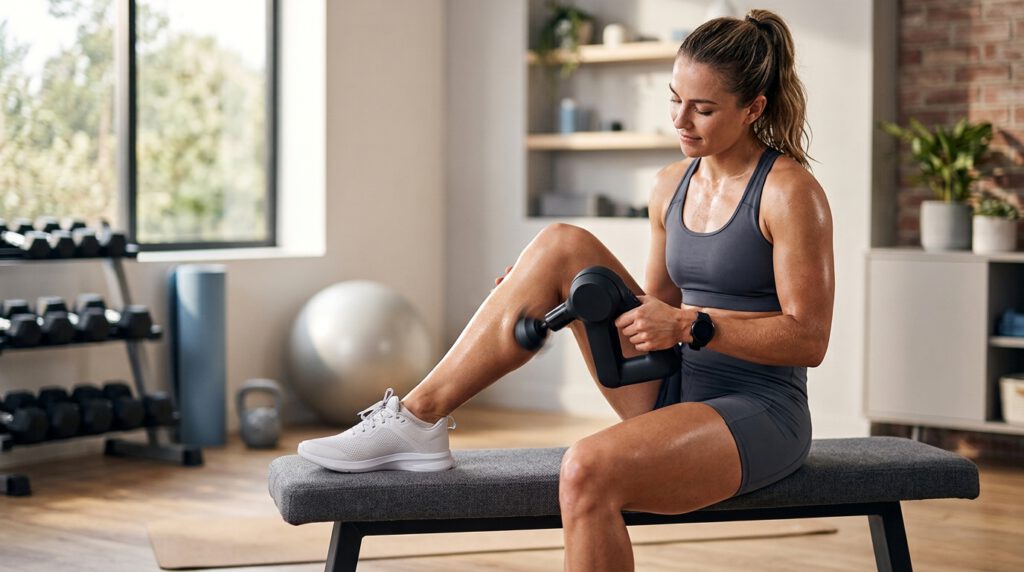
In practice, massage guns shine in a narrow, valuable window: 60–120 seconds of targeted work on a specific tight spot, either as a pre-workout activation tool or a quick post-workout spot treatment.
Best for: pinpoint muscle knots, stubborn trigger points, and fast pre-activity muscle activation.
Where it falls short: most manufacturers recommend limiting use to 1–2 minutes per muscle group — prolonged use on one spot risks bruising or tissue irritation. It also requires you to physically hold and maneuver the device, which gets tiring over a longer session, and it can’t be used passively while doing anything else.
Buying tip: amplitude (how deep the head travels, usually 10–16mm) and stall force (how much resistance it can push against before stalling) matter more than speed count. A 16mm amplitude with 80+ lbs of stall force is a genuinely “deep tissue” spec; anything under 10mm is closer to a vibration massager. <!– PRODUCT PLACEMENT: Premium massage gun –>
Therabody Theragun Prime Plus → Five speeds, three heat settings, and an ergonomic multi-grip handle that makes it easier to reach your own back — one of the most consistently top-rated massage guns for build quality and app-guided routines. <!– PRODUCT PLACEMENT: Budget massage gun –>
Bob and Brad D6 Pro Massage Gun → Matches (and on paper exceeds) premium-brand specs — 16mm amplitude, 85 lbs stall force, seven attachment heads — at roughly a third of the price. A strong pick if you want deep-tissue performance without the premium-brand markup.
Compression Boots: Best for Whole-Limb, Passive Recovery
Compression boots have the most clinically-established underlying mechanism (intermittent pneumatic compression has decades of use in vascular medicine for DVT prevention and lymphedema), but their evidence in healthy athletic recovery is more modest than the marketing suggests, and it’s worth being upfront about that.
A 2024 systematic review and meta-analysis covering 17 studies and 319 athletes found that compression boots provided real but modest benefits: soreness reduction 48 hours post-exercise was small but statistically significant, muscle-function recovery showed minor improvements that weren’t always significant, and physiological markers like blood lactate and inflammation showed mixed, inconsistent results.
Head-to-head comparisons also suggest pneumatic boots aren’t clearly superior to a well-fitted static compression sleeve or sock — the boots’ main advantage is convenience and hands-free use, not a bigger physiological effect.
A more recent 2025 study following competitive athletes over five weeks of daily use did find improved recovery and readiness scores, suggesting consistency of use may matter more than any single session.
Best for: diffuse, whole-limb fatigue after a long run, a heavy leg day, or a long day on your feet — and for anyone who wants a genuinely passive recovery option they can use while working, reading, or watching TV.
Where it falls short: they’re the most expensive of the three by a wide margin, they’re bulky to store and travel with, and they can’t address a single localized knot the way a massage gun or lacrosse ball can. <!– PRODUCT PLACEMENT: Premium compression boots –>
Hyperice Normatec 3 Legs → Seven compression levels, five overlapping treatment zones, and patented ZoneBoost targeting for calves, quads, or hamstrings specifically. The most established name in the category and the one most frequently used by professional teams. <!– PRODUCT PLACEMENT: Budget compression boots –>
RENPHO Cordless Leg Compression Massager → A genuinely capable entry point into pneumatic compression at a fraction of the premium price — cordless, zip-up full-leg coverage, and multiple pressure modes, though with less pressure precision than the Normatec line.
Head-to-Head: Which One Wins for Which Scenario
- Whole legs feel like dead weight after a long run or heavy leg day → compression boots. They cover the entire limb passively, which is exactly what you want when you’re too fatigued to actively work on your own muscles.
- One specific spot — a glute knot, a tight calf band — has been bothering you for days → a massage gun. It lets you dig into exactly the right spot in under two minutes.
- You’re about to train and want to wake a muscle up → a quick 60–90 second pass with a massage gun before you load up.
- You want to improve overall mobility, not just treat one sore spot → foam rolling. It requires more active effort, but that engagement is part of why it’s effective across a broader area.
- Budget is tight and you can only buy one tool → the foam roller wins. It’s the cheapest, has the deepest evidence base, and handles almost any muscle group you’ll ever need to work on.
Building a Combined Recovery Stack
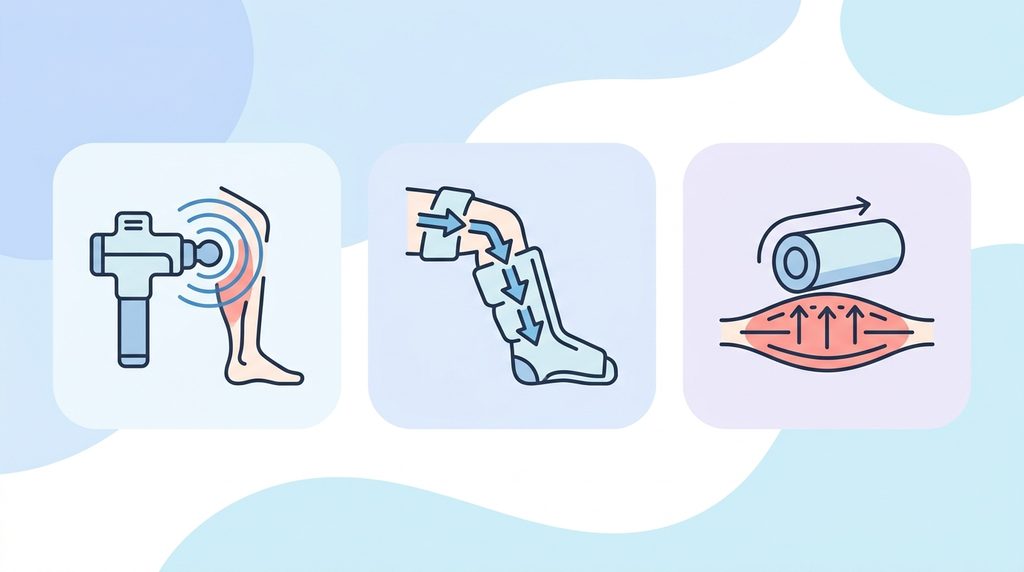
The strongest home recovery setups on the market in 2026 don’t pick one tool — they sequence all three, moving from targeted and active toward broad and passive, which roughly mirrors how physical therapists structure manual recovery work:
- Massage gun — 1–2 minutes on any specific tight spots
- Foam rolling — 5–10 minutes across major muscle groups
- Compression boots — 15–30 minutes, passive, while doing something else
The ROI Question: What’s Worth Buying First
If you’re building a recovery kit from scratch, the honest cost-to-benefit ranking looks like this:
- Foam roller — lowest cost (often under $40), the most versatile tool across body parts, and the strongest general evidence base.
- Massage gun — mid-cost ($80–$650), best for targeted relief and pre-workout activation once general mobility work isn’t cutting it anymore.
- Compression boots — highest cost ($300–$1,000+), worth adding once training volume increases to the point where whole-limb fatigue, not just localized tightness, becomes your limiting factor.
For most people starting out, a foam roller and a mid-tier massage gun cover the majority of recovery needs at a fraction of the cost of a full compression setup.
Frequently Asked Questions
Do I need all three recovery tools, or can I get by with one?
No single tool is strictly necessary — foam rollers alone can cover most general recovery needs. But each tool solves a different problem (broad mobility, pinpoint knots, or whole-limb passive recovery), so a combination covers more bases than any one tool alone.
Are massage guns or compression boots backed by strong scientific evidence?
The evidence for both is real but modest, not dramatic.
Studies generally show small-to-moderate improvements in perceived soreness and short-term recovery markers rather than large, consistent gains in objective performance. Foam rolling currently has the deepest and most consistent research base of the three.
How long should I use a massage gun on one spot?
Most manufacturers and physical therapists recommend limiting percussion treatment to 1–2 minutes per muscle group to avoid bruising or tissue irritation.
Are compression boots or massage guns eligible for HSA/FSA reimbursement?
Many models from major brands are registered in a way that makes them FSA/HSA eligible, but eligibility varies by product and provider — check the specific listing and confirm with your plan administrator before purchasing.
Which tool should I use before a workout versus after? Massage guns are best used briefly before training to activate a muscle group. Foam rolling works well either before (for mobility) or after (for soreness). Compression boots are best used after training, when you want passive, whole-limb recovery.
Bottom Line
Percussion guns, compression boots, and foam rollers aren’t competing purchases — they’re specialists.
Foam rolling and massage guns are active, targeted, lower-cost tools best suited to specific tightness and mobility work. Compression boots are a passive, higher-cost tool best suited to diffuse, whole-limb fatigue.
The right starting point is almost always the foam roller; the right next purchase depends on whether your recovery bottleneck is a stubborn knot (massage gun) or full-body fatigue (compression boots).
Related Posts
Stay Informed With the Latest & Most Important News
Previous Post
Next Post





Advertisement