













Now Reading: Functional Strength Training: Why ‘Everyday Movements’ Beat Isolated Lifts
-
01
Functional Strength Training: Why ‘Everyday Movements’ Beat Isolated Lifts


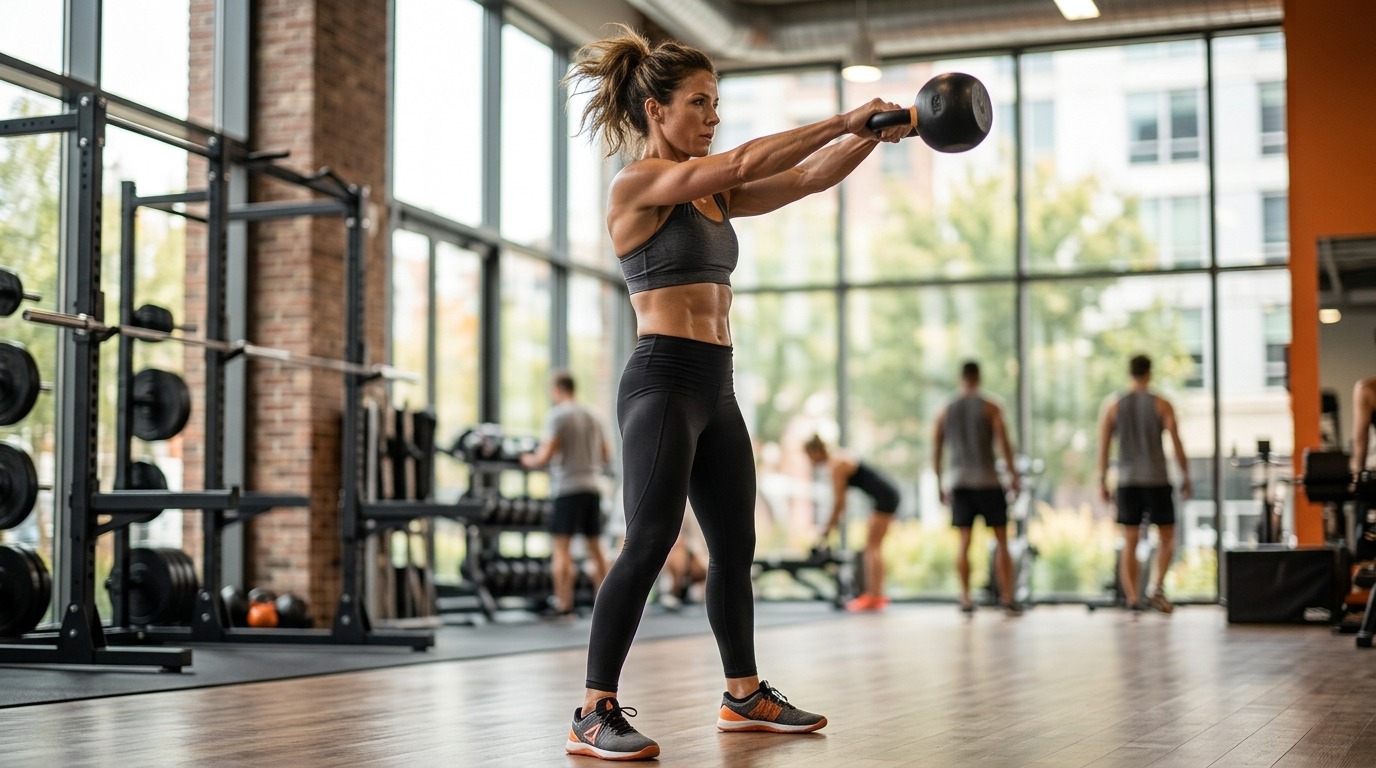
Picking up a suitcase. Carrying two bags of groceries up the stairs. Getting off the floor after playing with your kids.
None of these moments care whether your biceps are perfectly sculpted — they care whether your whole body can move as one coordinated unit under load.
That’s the entire premise behind functional strength training, and it’s why more people are walking away from machine circuits and single-muscle routines in favor of training that mirrors real life.
This guide breaks down what functional strength training actually is, how it stacks up against traditional isolated lifts, what the research says, and which exercises deserve a spot in your routine — whether you’re a beginner, a busy parent, an athlete, or someone rebuilding strength after an injury.
Table of contents
- What Is Functional Strength Training?
- Functional vs. Traditional (Isolated) Strength Training
- What the Research Actually Says
- Why Everyday Movements Beat Isolated Lifts
- Who Benefits Most From Functional Strength Training?
- 12 Functional Strength Exercises to Build Your Routine
- How to Build a Simple Functional Routine
- Common Mistakes to Avoid
- FAQs About Functional Strength Training
- The Bottom Line
What Is Functional Strength Training?
Functional strength training is a style of exercise built around movement patterns rather than individual muscles.
Instead of asking “which muscle am I working?” it asks “which real-world action am I preparing my body for?” That shift in focus changes almost everything about how a workout is designed.
According to a 2025 medical review, functional strength training exercises are designed to work several muscle groups at once while simulating everyday movements — such as lifting a bag of groceries or a small child — with the goal of improving core strength, mobility, and coordination so people can move freely and with less injury risk.<sup>[1]</sup>
In practice, functional training is organized around a handful of foundational patterns your body already uses every day:
- Squat — sitting down and standing up, getting off a chair or the floor
- Hinge — bending to lift something off the ground
- Push and pull — pushing a door open, pulling a suitcase, opening a drawer
- Carry — hauling groceries, luggage, or a laundry basket
- Rotate — twisting to reach something behind you or swing a golf club
Movement Over Muscles
Traditional strength training often isolates single muscles — think bicep curls or leg extensions. Functional training instead asks multiple muscles, joints, and your nervous system to cooperate at once, the same way they have to cooperate when you’re actually lifting a couch or catching your balance on an icy sidewalk.
Multi-Joint, Multi-Muscle Exercises
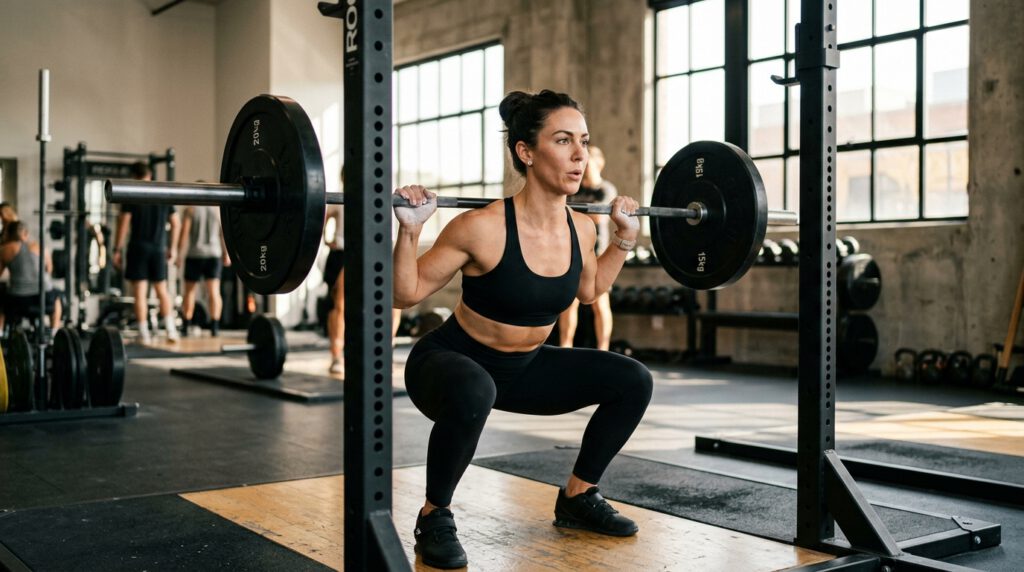
Most functional exercises are compound movements — they involve two or more joints working together. A kettlebell swing, for example, trains the hips, core, shoulders, and grip simultaneously, closely mimicking the mechanics of a real-life lift.
Core Integration and Stability
Every functional movement demands core stability to transfer force safely between the upper and lower body. That’s a large part of why functional training tends to double as core training, even when the core isn’t the stated focus of the exercise.
Real-Life Carryover
The defining feature of functional training is carryover — the strength you build actually shows up outside the gym: carrying groceries, lifting a child, moving furniture, climbing stairs, or getting up off the floor without needing a hand.
Functional vs. Traditional (Isolated) Strength Training
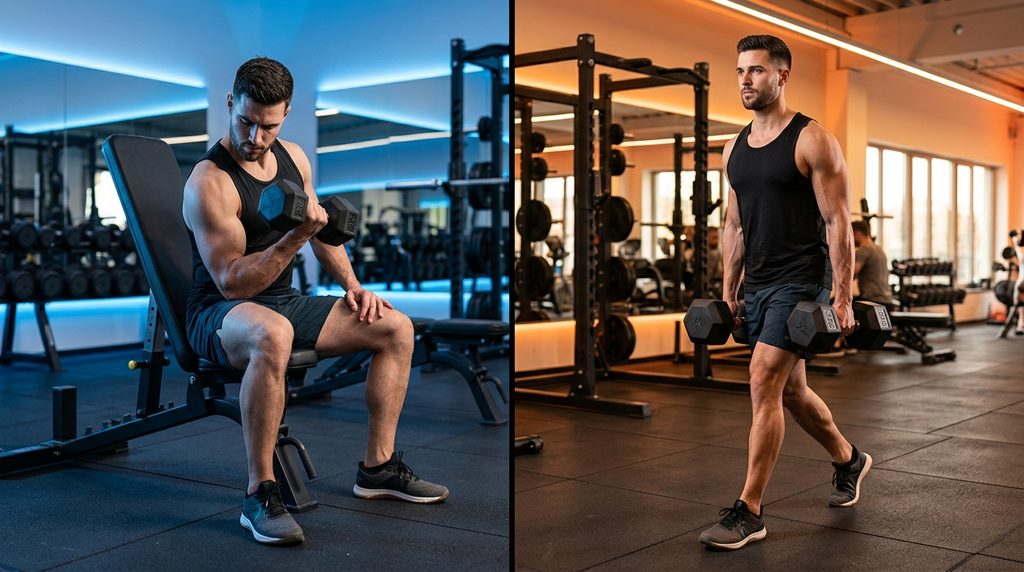
Both styles use resistance, and both build genuine strength — but the intent and the outcome differ.
| Traditional / Isolated Training | Functional Strength Training | |
|---|---|---|
| Focus | One muscle group at a time | Multiple muscle groups and joints together |
| Equipment | Often machines, fixed planes of motion | Free weights, kettlebells, bodyweight, resistance bands |
| Primary goal | Maximum strength or size in a specific muscle | Movement quality, coordination, and real-world strength |
| Typical examples | Bicep curls, leg extensions, lat pulldowns | Squats, deadlifts, lunges, carries, push-ups |
| Best for | Correcting muscle imbalances, targeted hypertrophy, rehab of a specific muscle | Balance, injury resilience, everyday task performance |
A balanced take: functional training isn’t a replacement for every isolation exercise.
Research on hypertrophy shows single-joint (isolation) movements can still outperform compound lifts for building specific regions of a muscle, since compound exercises are limited by whichever smaller muscle fatigues first.<sup>[2]</sup> If your goal is a specific aesthetic target or fixing a lagging muscle group, isolation work still has a place.
But if your goal is strength that holds up in daily life, functional patterns are hard to beat — and the two approaches combine well rather than compete.
What the Research Actually Says
Functional training isn’t just a marketing label — it has a growing evidence base behind it:
- An 8-week randomized controlled trial of university students found that a functional training program produced greater improvements in dynamic stability, core strength, and coordinated movement compared to a traditional training program.<sup>[3]</sup>
- A 2025 systematic review on older adults concluded that functional-style resistance training showed distinct advantages for balance, movement efficiency, and fall-risk reduction compared to traditional resistance training — critical factors for maintaining independence with age.<sup>[4]</sup>
- A network meta-analysis on fall prevention found strong evidence that functional exercise and combined balance-and-strength programs reduce fall rates in older adults, more consistently than isolated balance training alone.<sup>[5]</sup>
- A separate 2025 meta-analysis on core training specifically found significant improvements in dynamic balance, supporting its role as a standard part of fall-prevention programs for older adults.<sup>[6]</sup>
- High-intensity functional training (HIFT) — functional movements performed at higher intensity — has also been shown to meaningfully improve cardiorespiratory and muscular fitness in under an hour per session, according to ACE-supported research published in late 2025.<sup>[7]</sup>
The consistent thread across this research: functional-style training doesn’t just build strength on paper — it improves how well that strength actually transfers to balance, coordination, and daily function, particularly in populations where falls and mobility loss carry real consequences.
Why Everyday Movements Beat Isolated Lifts
1. Full-Body Efficiency
Compound, multi-joint movements recruit large and small muscles at the same time. A single squat or kettlebell swing does the work that would otherwise take three or four isolation exercises to replicate — which means shorter, more efficient workouts without sacrificing results.
2. Strength That Transfers to Real Life
The whole point of training a hinge pattern is that it makes picking up a box, a suitcase, or a child measurably easier. Isolated lifts build a stronger muscle; functional lifts build a body that knows how to use that strength together, under load, in awkward real-world positions.
3. Better Balance and Fewer Falls
Because functional exercises train multiple planes of motion at once — not just straight up and down like a machine — they challenge your stabilizing muscles and proprioception (your body’s sense of position in space). As the research above shows, this is one of the most well-supported benefits of functional training, especially for older adults.
4. Lower Injury Risk
When your body is trained to move as a coordinated system rather than a set of separate parts, you’re less likely to tweak your back lifting something awkwardly, roll an ankle stepping off a curb, or strain a shoulder carrying groceries. Functional training also strengthens the stabilizing muscles that isolated lifts tend to skip entirely.
5. Joint-Friendly and Accessible
Many functional exercises can be done with just bodyweight, a set of dumbbells, or a kettlebell — no machines required. That makes functional training genuinely accessible for home workouts, travel, and anyone without gym access.
Who Benefits Most From Functional Strength Training?
Beginners get a gentler, more intuitive entry point into strength training. Learning to squat, hinge, and push with bodyweight builds a movement foundation before adding load, which helps prevent bad habits from forming early.
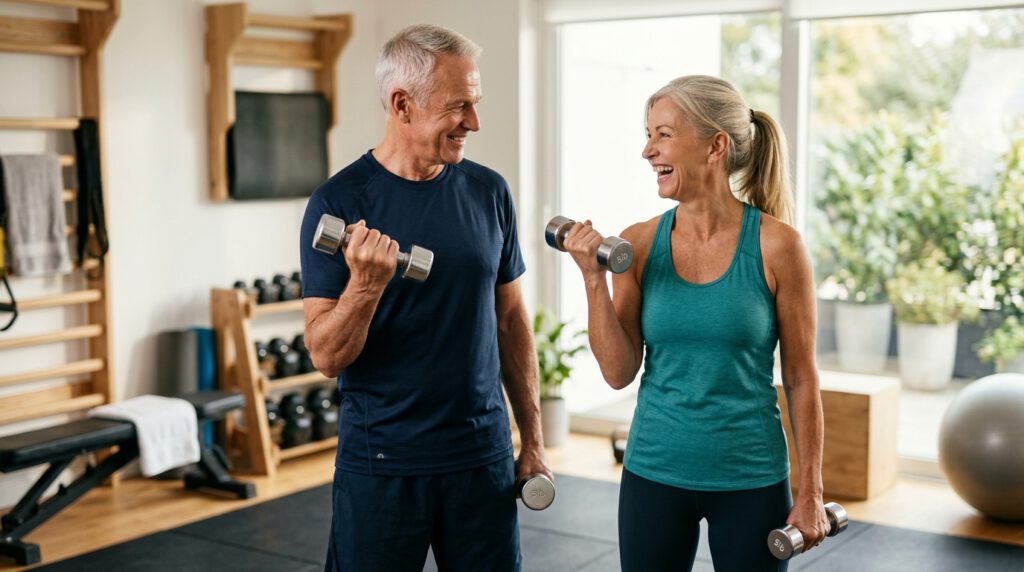
Older adults may see the clearest payoff. Functional training targets the exact skills that support independence — mobility, balance, and joint health — and the research above links it directly to reduced fall risk.
Athletes use functional training to translate strength into performance. Rotational core work, single-leg drills, and explosive hinge movements carry over into sprinting, jumping, and change-of-direction speed.
People with desk jobs often develop tight hips, a stiff upper back, and a weak posterior chain from long hours of sitting. Functional patterns like hip hinges and rows directly counteract that posture.
People in injury recovery can use functional training — ideally with guidance from a physical therapist or coach — to rebuild natural movement patterns, regain confidence, and reduce the risk of reinjury. Always get medical clearance before starting a new program after an injury or surgery.
12 Functional Strength Exercises to Build Your Routine
Balance your routine across lower body, core, and upper body/carry movements. Focus on slow, controlled form before adding weight.
Lower Body
- Squats — mimics sitting down and standing up; builds the quads, glutes, hamstrings, and core.
- Lunges — trains the single-leg stability used in walking, stairs, and stepping over obstacles.
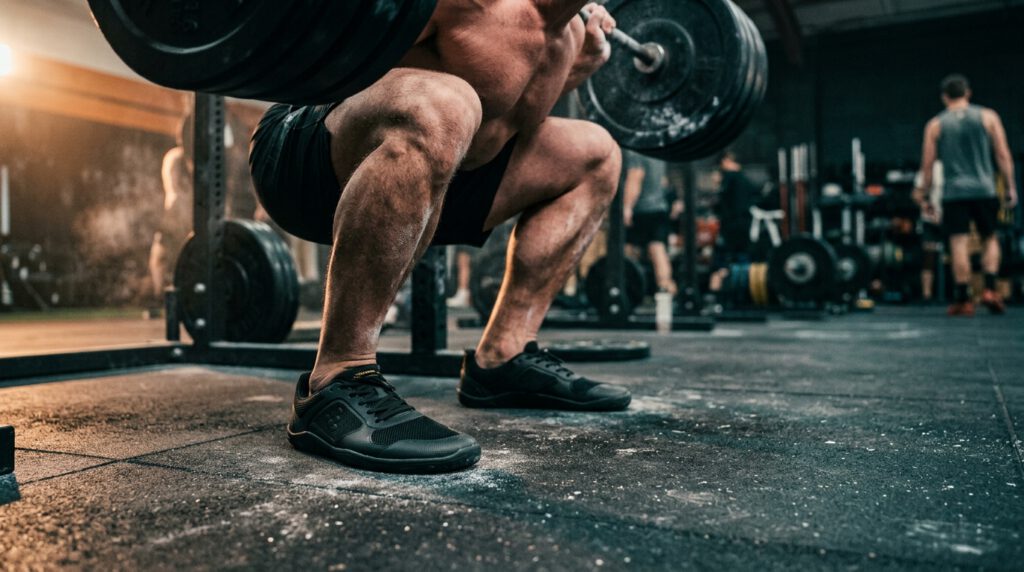
- Deadlifts — the gym version of picking up a laundry basket or a suitcase; strengthens the entire posterior chain.
- Step-ups — builds the single-leg strength and control needed for stairs and uneven ground.
Core 5. Planks — builds the core stability that protects your spine during almost every other movement. 6. Glute bridges — strengthens the glutes and core while reinforcing a safe hip-hinge pattern. 7. Bear crawls — challenges coordination, shoulder stability, and total-body control.
Upper Body and Full-Body Carries 8. Push-ups — trains the pushing pattern used for doors, furniture, and getting up off the floor. 9. Kettlebell swings — develops explosive hip power and grip strength in one movement. 10. Farmer’s carries — perhaps the most “everyday” exercise there is; builds grip, posture, and trunk endurance for carrying groceries or luggage. 11. Overhead presses — mirrors lifting something onto a high shelf; builds shoulder and core stability. 12. Wood chops — a rotational cable or band movement that trains the twisting motion used in sports and daily tasks like loading a car trunk.
How to Build a Simple Functional Routine
You don’t need an hour a day or a gym full of equipment to see results. A simple structure to start with:
- Frequency: 2–3 sessions per week, non-consecutive days
- Format: pick one exercise from each category above (squat/hinge, core, push/pull/carry) and perform 2–3 sets of 8–12 reps
- Progression: once bodyweight movements feel easy with good form, add dumbbells, a kettlebell, or resistance bands
- Rest: 45–90 seconds between sets is enough for most functional work
A sample beginner session might look like: bodyweight squats, glute bridges, push-ups, and a farmer’s carry — roughly 20–25 minutes, doable at home with minimal equipment.
Common Mistakes to Avoid
- Skipping the warm-up. Functional movements load multiple joints at once, so a few minutes of mobility work goes a long way toward preventing injury.
- Adding load before form is solid. Master the bodyweight pattern first; weight should make the movement harder, not messier.
- Training only in one plane of motion. Life doesn’t happen in straight lines — make sure rotational and lateral movements are part of your routine, not just forward-and-back exercises.
- Ignoring recovery. Functional training is still resistance training; your muscles and joints need rest between sessions to adapt.
FAQs About Functional Strength Training
What is considered functional strength training?
Any exercise that trains a real-world movement pattern — squatting, hinging, pushing, pulling, carrying, or rotating — using multiple joints and muscles together, rather than isolating a single muscle.
Is functional training better than weightlifting?
It’s not really a competition. Traditional weightlifting builds raw strength and muscle mass; functional training makes sure that strength is usable outside the gym. Most well-rounded programs include both.
Is functional strength training considered cardio?
Primarily, it’s resistance training. But because it uses large muscle groups together, it often raises your heart rate more than isolated lifting does — especially in circuit or high-intensity formats — giving it a hybrid strength-and-cardio effect.
How often should I do functional training?
Most research on functional and balance-based training uses two to three sessions per week as an effective baseline, with older adults or fall-prevention programs sometimes benefiting from three sessions of 45–60 minutes.<sup>[5]</sup>
Can beginners start with functional training?
Yes — functional training is often an easier entry point than traditional gym machines, since it starts with bodyweight movements and familiar, intuitive patterns like squatting and carrying.
The Bottom Line
Functional strength training isn’t about chasing a bigger number on a single lift — it’s about building a body that holds up under the actual demands of your life: the stairs, the suitcase, the toddler, the grocery bags, the get-up off the floor.
The research increasingly backs what this style of training has always promised: better balance, fewer injuries, and strength that actually shows up when you need it. Start with the basic patterns, stay consistent, and let the carryover into daily life be the real measure of progress.
Sources
- Medical News Today — Functional strength training: Benefits and how to do it (July 2025)
- Stronger by Science — Are compound exercises best for hypertrophy? (July 2025)
- Frontiers in Public Health — Effects of an 8-week functional training program on functional movement and physical fitness in male university students: a randomized controlled trial (August 2025)
- SAGE Open — Aging With Strength: Functional Training to Support Independence and Quality of Life (2025)
- ScienceDirect — Optimal type and dose of exercise to improve fall behavior in older adults: a systematic evaluation and network meta-analysis (October 2025)
- Frontiers in Public Health — Effects of core training on balance performance in older adults: a systematic review and meta-analysis (September 2025)
- ACE Fitness (Certified™) — ACE-Supported Research: Turning Up the Heat on High-Intensity Functional Training (December 2025)
Related Posts
Stay Informed With the Latest & Most Important News
Previous Post
Next Post









Advertisement