













Now Reading: Are Massage Guns Worth It for Muscle Soreness? (What Science Says)
-
01
Are Massage Guns Worth It for Muscle Soreness? (What Science Says)


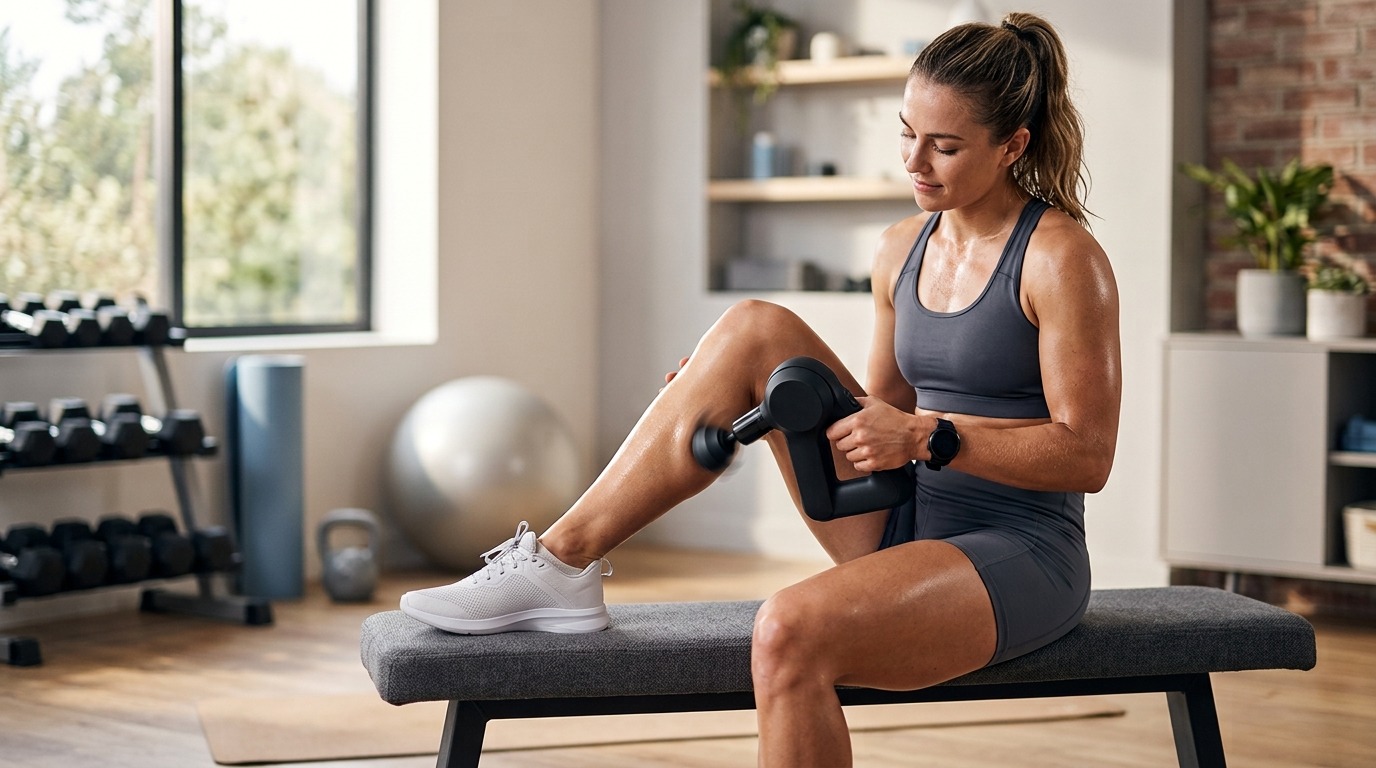
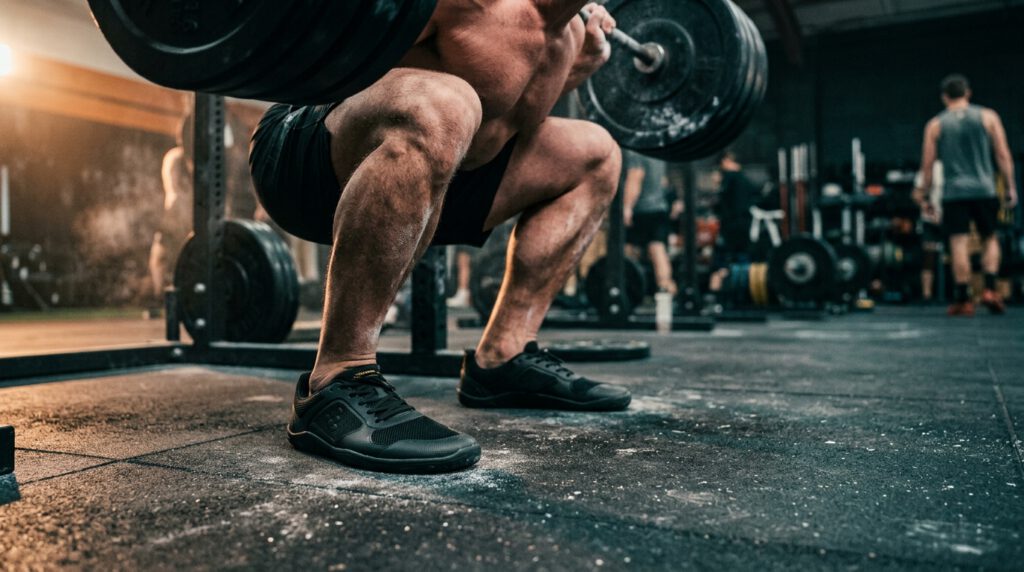
If your legs feel like concrete two days after leg day, you’ve probably wondered whether one of those buzzing, gun-shaped gadgets everyone at the gym is carrying around would actually help.
The short answer: massage guns are worth it if you want fast, short-term relief from muscle soreness and stiffness — but they won’t make you stronger, faster, or heal an injury any quicker.
They’re a recovery tool, not a miracle device. Here’s what the research actually says, how to use one without hurting yourself, and which models are worth your money in 2026.
Table of contents
- What Is a Massage Gun and How Does It Work?
- What Causes the Muscle Soreness a Massage Gun Is Supposed to Fix?
- Are Massage Guns Worth It? What the Research Actually Shows
- Massage Gun vs. Foam Rolling: Which Is Better?
- How to Use a Massage Gun Safely
- Areas to Avoid Completely
- Who Should Skip Massage Guns (Or Check With a Doctor First)
- How to Choose the Right Massage Gun (Buying Guide)
- Best Massage Guns of 2026 (Our Picks)
- Final Verdict: Are Massage Guns Worth It?
- FAQs
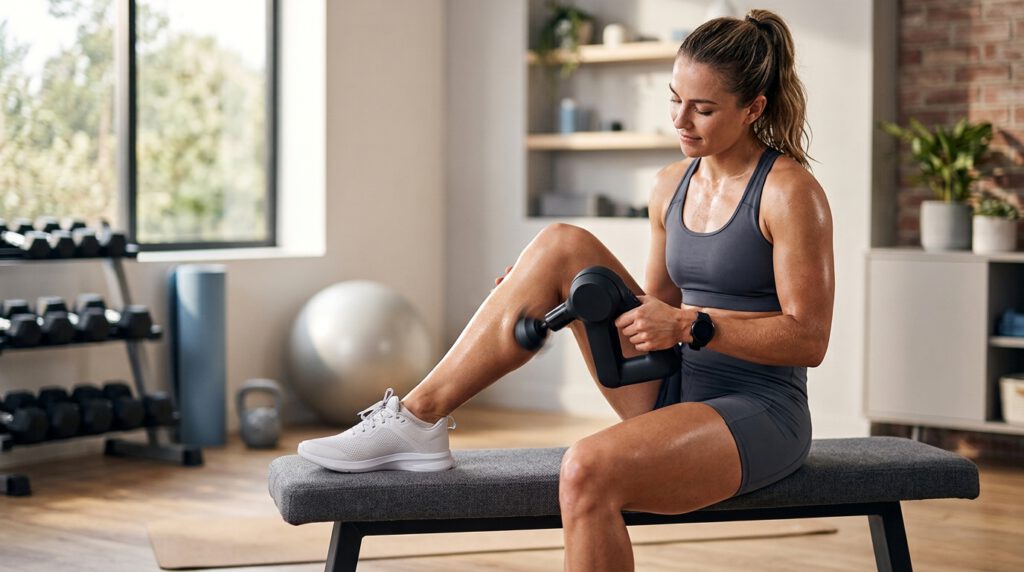
What Is a Massage Gun and How Does It Work?
A massage gun (also called a percussive therapy device) is a handheld tool that fires a spring-loaded head in and out of the skin dozens of times per second — usually between 1,750 and 3,200 percussions per minute, depending on the setting. That rapid tapping is thought to:
- Increase local blood flow to the muscle
- Stimulate nerve receptors that dial down the brain’s perception of pain (a mechanism similar to how shaking out a stubbed toe helps)
- Temporarily reduce tension in tight muscle fibers and fascia
It’s essentially a faster, more targeted version of a deep-tissue massage or foam rolling session, minus the need for a table or a second person.
What Causes the Muscle Soreness a Massage Gun Is Supposed to Fix?
The ache you feel a day or two after a hard workout is called delayed-onset muscle soreness (DOMS).
It happens after unfamiliar or intense exercise — think a new leg workout, your first trail run of the season, or a heavier-than-usual lifting session — and is caused by microscopic tears in muscle fibers followed by a localized inflammatory response. It usually peaks around 24–72 hours post-workout and fades on its own within a few days.
Massage guns don’t prevent this damage. What they can do is take the edge off the discomfort while your body does the actual repair work.
Are Massage Guns Worth It? What the Research Actually Shows
The Benefits That Are Backed by Evidence
They ease DOMS. A 2025 randomized controlled trial found that using a massage gun after exercise measurably reduced delayed-onset soreness compared to no treatment, likely by improving circulation and reducing tissue stiffness.
They give you a short-term flexibility boost. Several smaller studies show percussive therapy can temporarily increase range of motion, which is why a lot of people use it as part of their warm-up before stretching or lifting.
They increase blood flow. The rapid pulses push blood into tight tissue, which is the mechanism behind most of the other benefits — reduced stiffness, a feeling of “loosening up,” and mild pain relief.
They can help you relax. Even a few minutes on a low setting over the shoulders, neck, or lower back can ease tension, similar to a light massage.
What Massage Guns Cannot Do
They don’t build muscle or make you a better athlete. No study has shown that percussive therapy improves strength, speed, or power output. Any performance boost people report from pre-workout use is more likely from the temporary flexibility and “activation” effect than a physiological training adaptation.
They’re not dramatically better than foam rolling. Most of the research suggests massage guns produce broadly similar short-term benefits to standard foam rolling or self-massage — they’re just faster, more targeted, and require less effort. If you already have a foam roller you’re happy with, you’re not missing out on much by skipping a massage gun.
They can’t fix an actual injury. A massage gun can make a tight muscle feel better temporarily, but it does nothing to speed up healing of a strain, tear, or joint injury — and using one on a fresh injury can make things worse (more on that below).
The research base is still thin. Much of the existing evidence looks at vibration therapy generally rather than percussion specifically, and study sizes tend to be small. That doesn’t mean massage guns don’t work — it means the science hasn’t fully caught up to how popular they’ve become.
Massage Gun vs. Foam Rolling: Which Is Better?
| Massage Gun | Foam Roller | |
|---|---|---|
| Speed | Fast, targeted, hands-free effort | Requires more time and body positioning |
| Cost | $30–$600 | $10–$40 |
| Precision | Very high (great for specific knots) | Lower, works broader areas |
| Portability | Depends on size/battery | Bulky but no charging needed |
| Evidence of benefit | Similar short-term effect to foam rolling | Well-studied, similarly effective |
Bottom line: neither is objectively “better” for reducing soreness — a massage gun is just faster and more convenient, which is exactly what you’re paying the extra money for.
How to Use a Massage Gun Safely
Percussive therapy is generally safe when used correctly, but misuse is where most complaints (bruising, nerve irritation, worse soreness) come from.
- Start on the lowest speed setting. Higher isn’t better — a 2023 review found that lower frequencies (roughly 17–40 Hz) were just as effective for improving flexibility and recovery as high-intensity settings.
- Keep it moving. Never park the head in one spot. Glide it slowly over the muscle.
- Limit each area to 1–2 minutes. Most guidance caps a single muscle group at 10–30 seconds to start, and no more than about two minutes per session.
- Hold it perpendicular to the muscle for the most even, comfortable pressure.
- Let the device do the work. Don’t press down hard — added force increases bruising risk without adding benefit.
- Choose the right attachment. Flat and round heads for large muscle groups (quads, glutes, back); bullet tips for pinpoint knots and trigger points; fork attachments to straddle the spine (never go directly on it); soft dampener heads for bony or sensitive areas.
- Stop immediately if you feel sharp pain, numbness, or tingling — mild tenderness is normal, pain is not.
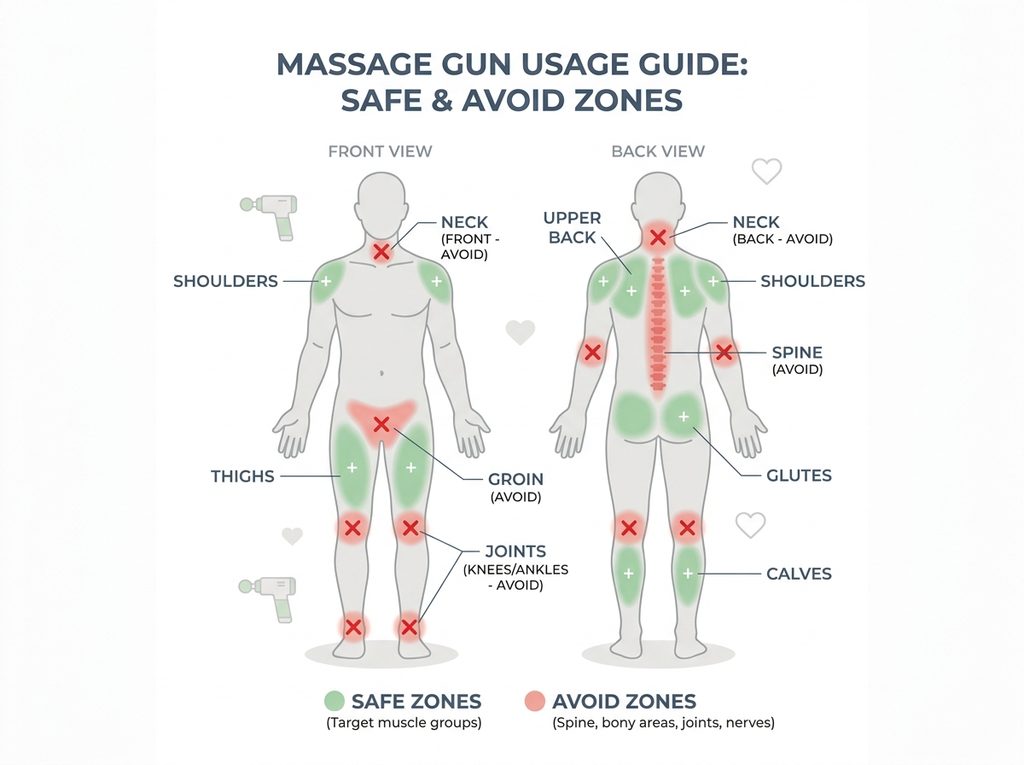
Areas to Avoid Completely
- The front of the neck (arteries, nerves, and veins sit close to the surface)
- The spine and other bony areas (shins, ankle bones, ribs, joints)
- The groin
- Any bruise, cut, abrasion, scab, or area of visible swelling
- Fresh strains, sprains, tears, or surgical sites — most guidance recommends waiting at least 3–5 days after an acute muscle strain before using percussive therapy on it, and only with a professional’s go-ahead
Who Should Skip Massage Guns (Or Check With a Doctor First)
Massage guns aren’t risk-free for everyone. Talk to a healthcare provider before using one if you have:
- Osteoporosis or a recent fracture — added force near fragile bone raises injury risk
- Deep vein thrombosis (DVT) or circulation problems like peripheral vascular disease
- Diabetes-related nerve damage, which can mask pain signals that would normally tell you to stop
- A joint replacement in the area you want to treat
- You’re pregnant — deep pressure and vibration near the abdomen or lower back should be avoided, especially with a risk of preterm labor, preeclampsia, clotting conditions, or placenta previa
- You take blood thinners (warfarin, Eliquis, Xarelto, etc.) — percussion increases the risk of deep bruising and bleeding under the skin
If you have persistent or worsening pain, a massage gun isn’t a substitute for seeing a physical therapist or doctor.
How to Choose the Right Massage Gun (Buying Guide)
Not all massage guns are created equal. Before you buy, pay attention to:
- Amplitude — how far the head travels (measured in mm). 10mm is fine for light, beginner use; 12–16mm reaches deeper muscle tissue and is better for larger or more experienced users.
- Stall force — how much pressure the motor can handle before it stalls out. Higher stall force (40+ lbs) means it keeps performing even under firmer pressure.
- Speed settings — 3–6 adjustable speeds cover most needs; app-controlled custom ranges are a nice-to-have, not a necessity.
- Noise level — anything under ~60 decibels is comfortable to use around others.
- Battery life — 2+ hours is standard for regular use; travel models trade battery life for size.
- Attachments — look for at least a round head, a flat head, and a bullet/pinpoint tip.
- Weight and grip — a lighter, well-balanced gun is much easier to use on your own back and shoulders.
Best Massage Guns of 2026 (Our Picks)
Note: this is where product links go once you have your Amazon Associate IDs. See the note at the end of this article for details.
| Pick | Best For | Approx. Price |
|---|---|---|
| Theragun Prime | Best overall / most well-rounded | ~$300–330 |
| Bob and Brad D6 Pro | Best value alternative to Theragun | ~$250 (often discounted) |
| Theragun Mini | Most portable / travel | ~$175–200 |
| Hyperice Hypervolt 3 | Premium runner-up, quiet motor | ~$300–350 |
| RENPHO Active Thermacool 2 | Best budget pick with heat/cold | ~$100–150 |
- Theragun Prime — A 16mm amplitude and up to 30 lbs of no-stall force put it well above entry-level guns, and its triangular handle makes it genuinely easy to reach your own back. It’s the safest “just buy this” recommendation for most people.
- Bob and Brad D6 Pro — Comes with more attachments than the Theragun Prime and a higher stall force, at a noticeably lower price point — a strong pick if you don’t need the brand name.
- Theragun Mini — Fits in a gym bag or carry-on. Less powerful than the full-size models, but plenty for everyday tightness and desk-job stiffness.
- Hyperice Hypervolt 3 — Very quiet for its power output, with a clean ergonomic design; a good alternative if you want something other than a Theragun at a similar price.
- RENPHO Active Thermacool 2 — A genuinely capable budget option with heat and cold attachments, popular on Amazon’s electric massager bestseller list.
Final Verdict: Are Massage Guns Worth It?
Yes — with the right expectations. A massage gun is a legitimate, research-supported way to take the edge off sore, tight muscles, loosen up before a workout, and unwind after a long day. It won’t build muscle, speed up serious injury recovery, or replace an actual physical therapist. If you’re regularly sore from training, sit at a desk all day, or just want a quicker alternative to foam rolling, it’s a worthwhile investment — just buy one that matches your budget rather than assuming the most expensive option is the only one that works.
FAQs
Do massage guns actually reduce muscle soreness, or is it a placebo?
Research, including a 2025 randomized controlled trial, shows a measurable reduction in DOMS after massage gun use, not just a subjective feeling — though the effect is short-term.
How long should you use a massage gun on one muscle?
Most guidance recommends 10–30 seconds per spot to start, capping any single muscle group at 1–2 minutes per session.
Is it better to use a massage gun before or after a workout?
Before: for a short-term flexibility boost as part of a warm-up. After: for reducing soreness and stiffness during recovery. Both uses are supported by the same basic mechanism — increased blood flow and reduced muscle tension.
Can a massage gun make soreness worse? Yes, if used with too much pressure, held in one spot too long, or used directly on an injury, bruise, or bony area. Used gently and briefly, it’s more likely to help than hurt.
Are cheap massage guns worth buying, or should I spend more?
A budget massage gun ($80–150) with decent amplitude and stall force can deliver the same basic soreness relief as a $300+ model. The extra money mainly buys you a quieter motor, longer battery life, more attachments, and app features — not a fundamentally different result.
This article is for general information and isn’t a substitute for individual medical advice. If you have an injury, chronic condition, or are pregnant, talk to a healthcare professional before using a massage gun.
Stay Informed With the Latest & Most Important News
Previous Post
Next Post









Advertisement