
























Now Reading: Is Creatine Safe to Take Every Day? What Research Shows
-
01
Is Creatine Safe to Take Every Day? What Research Shows


Yes, for most healthy adults, taking creatine monohydrate every day is safe.
The International Society of Sports Nutrition (ISSN) reviewed the evidence and concluded that short- and long-term supplementation, up to 30 g/day for 5 years, is safe and well-tolerated in healthy individuals.
A typical daily dose is only 3 to 5 grams. That is far below the amounts tested in the long-term studies.
That said, “safe for most people” isn’t “safe for everyone.”
Below you’ll find the dosage guidelines, what the research says about kidneys and hair loss, the side effects to expect, and who should talk to a doctor first.
Table of contents
- Quick Answer
- What Is Creatine, and Why Take It Every Day?
- How Safe Is Daily Creatine Use?
- How Much Creatine Should You Take Per Day?
- Should You Take Creatine on Rest Days?
- Does Creatine Damage Your Kidneys?
- Does Creatine Cause Hair Loss?
- Common Side Effects of Daily Creatine
- Do You Need to Cycle Creatine?
- Who Should Be Careful or Talk to a Doctor First?
- Is Creatine Safe for Women, Teens, and Older Adults?
- Which Type of Creatine Is Safest?
- Tips for Taking Creatine Safely
- The Bottom Line
- FAQ
Quick Answer
| Question | Short answer |
|---|---|
| Safe to take daily? | Yes, for healthy adults at standard doses |
| Best daily dose | 3–5 g of creatine monohydrate |
| Need a loading phase? | No, it’s optional |
| Harms healthy kidneys? | No evidence of harm in controlled research |
| Causes hair loss? | No proven link |
| Need to cycle off? | No |
| Who should ask a doctor first? | People with kidney disease, those on certain medications, pregnant or breastfeeding women, and anyone under 18 |
What Is Creatine, and Why Take It Every Day?
Creatine is a compound your body makes from amino acids and stores mainly in your muscles, where it helps regenerate quick energy during short, intense efforts like lifting or sprinting. You also get it from food, mainly meat and fish. According to the ISSN, about half of the daily creatine requirement comes from the diet.
Supplementing raises your muscle stores above what food alone provides.
That’s why creatine monohydrate is the most researched sports supplement for strength, power, and lean mass. Some evidence also suggests it can support brain function: a recent meta-analysis found possible benefits for memory, attention time, and information processing speed in adults.
Daily use matters because creatine works by saturation. Your muscles fill up gradually and stay full only if you keep topping them up.
How Safe Is Daily Creatine Use?
The safety record is strong. The ISSN position stand found no compelling scientific evidence that short- or long-term creatine monohydrate use (up to 30 g/day for 5 years) has detrimental effects on healthy individuals or clinical populations who may benefit from it.
Two points of context:
- The 30 g/day figure is the upper limit that has been studied, not a recommended dose.
- The ISSN authors disclose industry ties in their position stand. That doesn’t invalidate the findings, which are backed by many independent trials and meta-analyses, but it’s worth knowing.
How Much Creatine Should You Take Per Day?
- Standard maintenance dose: 3–5 g per day. The ISSN notes the quickest way to raise muscle stores is about 0.3 g/kg/day for 5 to 7 days, then 3–5 g/day to maintain.
- Weight-based option: some research uses a maintenance dose of about 0.03 g/kg of body weight per day.
- Loading phase (optional): roughly 20 g/day split into 4 doses for 5–7 days gets you saturated faster. Skipping it works too, you just take about 3–4 weeks to reach the same point.
Taking more than 5 g at once mainly increases the chance of stomach upset, not the benefits.
Should You Take Creatine on Rest Days?
Yes, in most cases. Your muscles don’t “use up” creatine only on workout days, and stopping for a few days slowly lets stores drift down. Studies comparing training-day-only use with daily use haven’t shown big differences in results, but daily dosing is simpler and keeps saturation consistent. Timing (before or after training) also doesn’t show a clear winner, so the best time is the one you’ll stick with.
Does Creatine Damage Your Kidneys?
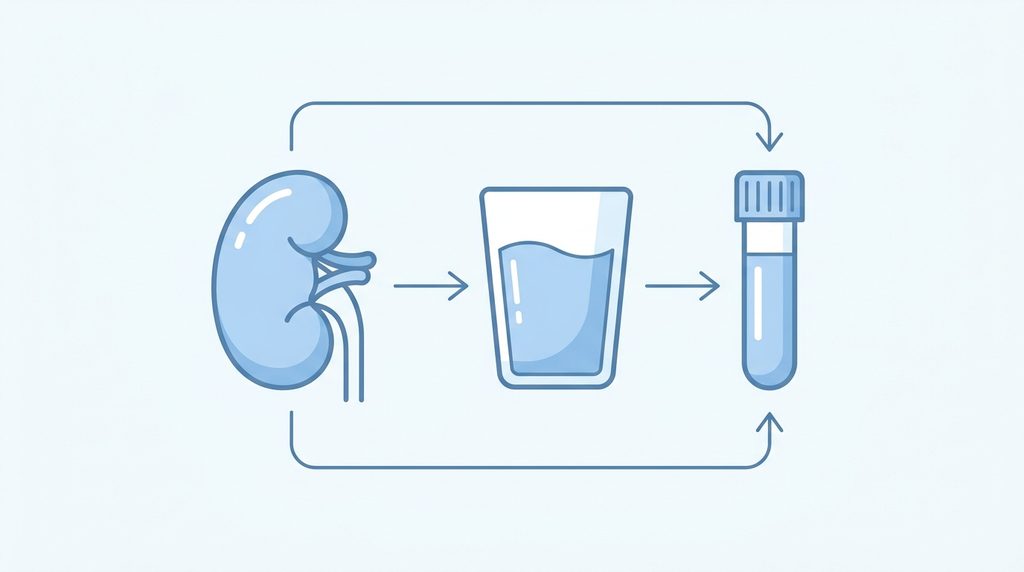
This is the most common worry, and it comes from a real lab quirk. Creatinine, a waste product of creatine, is what doctors measure in blood tests to estimate kidney function. Creatine supplements can raise it without any kidney damage.
A 2025 meta-analysis found that creatine is associated with a modest rise in serum creatinine but doesn’t adversely affect glomerular filtration rate (GFR).
A 2026 meta-analysis found the same rise in creatinine and lower creatinine-based GFR estimates. But when GFR was measured with a more precise method (Cr-EDTA), there was no change, suggesting altered creatinine metabolism rather than kidney injury.
This has caused real confusion: a BMJ article described how non-nephrologists can misdiagnose kidney disease in people taking creatine.
Practical takeaways:
- Tell your doctor you take creatine before any kidney blood test.
- If you have existing kidney disease, don’t start creatine without medical guidance. The research in these groups is more limited, and one review concluded further studies with people who have pre-existing kidney disease are still needed.
Controlled research in healthy people also hasn’t shown liver damage at standard doses.
Does Creatine Cause Hair Loss?
The worry traces back to one small 2009 study. In it, rugby players had a 41% rise in blood DHT after 3 weeks of creatine. DHT is a hormone linked to male pattern baldness. But that study didn’t measure hair, and the levels stayed within the normal range.
A 2025 randomized, placebo-controlled trial tested this directly over 12 weeks. It found no significant differences in DHT, the DHT-to-testosterone ratio, or hair growth parameters between creatine and placebo.
To be fair, critics note the trial was small (38 participants), didn’t screen for genetic hair-loss risk, and didn’t measure DHT activity at the scalp. So the honest summary: there’s no evidence creatine causes hair loss, but long-term data in people genetically prone to it is limited. If you’re worried, watch your hairline and talk to a dermatologist.
Common Side Effects of Daily Creatine
Most people notice nothing. When side effects do occur, they’re usually mild:
- Water weight: creatine draws water into muscle cells, so the scale may go up 1–2 kg early on. It’s usually temporary and isn’t fat gain.
- Stomach upset or diarrhea: most common with large single doses or loading. Splitting the dose or taking it with food helps.
- Nausea: usually from taking too much powder on an empty stomach.
- Cramps or heat discomfort: widely reported anecdotally, but controlled studies haven’t consistently backed it. Since creatine shifts fluid into muscle, skipping fluids could raise dehydration risk, so drink enough.
Do You Need to Cycle Creatine?
No. There’s no evidence that regular breaks improve results or safety, and the long-term studies used continuous supplementation. Some people take breaks to save money or “reset,” which is fine, but it’s optional. If you stop, muscle creatine levels gradually return to baseline over several weeks.
Who Should Be Careful or Talk to a Doctor First?
- People with kidney disease or reduced kidney function
- People on medications that affect kidneys or fluid balance: NSAIDs, diuretics, and drugs affecting kidney function warrant caution
- Pregnant or breastfeeding women: research is limited, so it’s best to avoid or ask your doctor
- Anyone with a chronic health condition or on multiple medications
Caffeine and alcohol: moderate caffeine isn’t a proven problem, and reviews report that recent research hasn’t confirmed an interaction at moderate doses (200–400 mg). Heavy drinking and very high caffeine intake can add to dehydration, so keep both reasonable.
Is Creatine Safe for Women, Teens, and Older Adults?
Women: yes. Women tend to have lower endogenous creatine stores than men (about 70–80% lower), and a review found creatine posed no greater adverse effects than placebo. Standard doses apply.
Teens (under 18): this is debated. The ISSN says labels warning against use under 18 are a legal precaution with no scientific evidence that adolescents shouldn’t take creatine.
A more cautious review says it should be neither routinely recommended nor categorically prohibited in adolescent athletes, since the evidence is underpowered. The sensible route is to talk to a pediatrician first and prioritize food, sleep, and training.
Older adults: creatine is studied for muscle and cognitive health with age. But older adults tend to have lower kidney and liver function, so more long-term research is needed. Get a doctor’s OK first.
Which Type of Creatine Is Safest?
Creatine monohydrate has the deepest safety and effectiveness evidence, and pricier “advanced” forms haven’t been shown to be better. To reduce contamination risk, choose a product with third-party testing (look for Informed Sport, NSF Certified for Sport, or a Creapure quality mark) and a short ingredient list.
Tips for Taking Creatine Safely
- Start with 3–5 g daily, and skip the loading phase if your stomach is sensitive.
- Drink water consistently, especially in hot weather or during hard training.
- Take it with a meal if it upsets your stomach.
- Tell your doctor you use it before blood tests.
- Stop and get medical advice if you notice unusual symptoms like swelling, very dark urine, or persistent pain.
The Bottom Line
For healthy adults, daily creatine monohydrate at 3–5 g is one of the best-studied and safest supplements available. The kidney and hair-loss fears aren’t supported by current controlled research, though the evidence is thinner for people with existing kidney disease, those on certain medications, and younger and older groups. Choose a quality product, stay hydrated, and check with your doctor if any of those apply to you.
FAQ
Is it OK to take creatine every day forever?
The longest formal safety monitoring is about 5 years, with no concerns in healthy people. That’s strong reassurance, though nobody has studied decades of use.
Is 5 grams of creatine a day too much?
No. It’s the standard maintenance dose.
Will creatine make me look bloated?
Some people gain a little water weight in the first weeks, mostly inside muscle. It usually settles.
Can creatine affect my blood test results?
Yes, it can raise serum creatinine. Tell your doctor so it isn’t mistaken for kidney disease.
Can I take creatine without working out?
It’s safe, but the performance benefits are mainly seen alongside training.
Should I take it before or after a workout?
Research hasn’t shown a clear winner. Consistency matters more than timing.
Sources
- ISSN position stand (2017): https://pmc.ncbi.nlm.nih.gov/articles/PMC5469049/
- Kidney function meta-analysis, BMC Nephrology (2025): https://link.springer.com/article/10.1186/s12882-025-04558-6
- Kidney health meta-analysis, Int Urol Nephrol (2026): https://pubmed.ncbi.nlm.nih.gov/42507286/
- Creatine and hair loss RCT (2025): https://www.tandfonline.com/doi/full/10.1080/15502783.2025.2495229
- Examine, creatine and hair loss: https://examine.com/faq/does-creatine-cause-hair-loss/
- Creatine in women’s health: https://pmc.ncbi.nlm.nih.gov/articles/PMC7998865/
- Creatine and cognition meta-analysis: https://www.ncbi.nlm.nih.gov/pmc/articles/PMC11275561/
Related Posts


Stay Informed With the Latest & Most Important News
Previous Post
Next Post









Advertisement