

























Now Reading: BCAA vs. EAA: Which Amino Acid Supplement Is Actually Worth It?
-
01
BCAA vs. EAA: Which Amino Acid Supplement Is Actually Worth It?


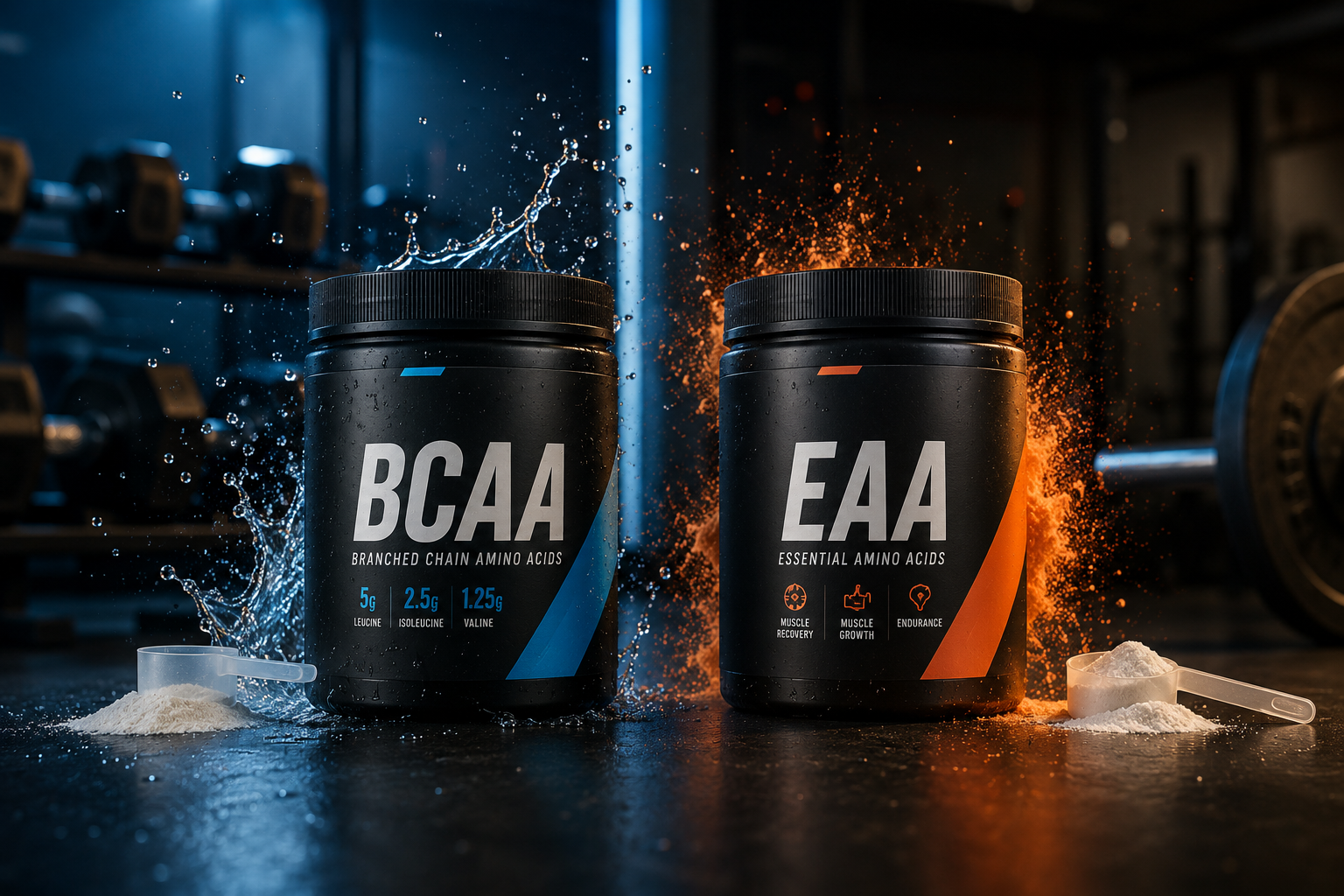
Walk into any supplement store — or scroll any fitness influencer’s page — and you’ll see two acronyms fighting for your money:
BCAA and EAA. Both promise better recovery, more muscle, and less soreness.
But they are not the same thing, and the newer research suggests one of them has a real edge over the other.
This guide breaks down exactly what BCAAs and EAAs are, what the science actually shows, and which one deserves a spot in your gym bag.
Table of contents
Quick Answer
If you had to pick just one: EAAs are the stronger overall choice for most people, because they contain everything BCAAs contain plus six more amino acids your body needs to actually complete muscle protein synthesis. BCAAs still have a narrow use case — mainly fasted training on a tight calorie budget — but for general recovery and muscle building, EAAs win the comparison for most lifters.
What Are BCAAs?
BCAA stands for Branched-Chain Amino Acids — a group of just three amino acids:
- Leucine
- Isoleucine
- Valine
These three share a unique branched molecular structure, and unlike most amino acids (which are processed in the liver), BCAAs are metabolized directly in skeletal muscle. That makes them fast-acting fuel and signaling molecules during and after training.
Leucine in particular is famous for triggering muscle protein synthesis (MPS) — it’s the “on switch” that tells your body to start building muscle.
What Are EAAs?
EAA stands for Essential Amino Acids — the nine amino acids your body cannot produce on its own and must get from food or supplements:
- Leucine, Isoleucine, Valine (the three BCAAs)
- Histidine
- Lysine
- Methionine
- Phenylalanine
- Threonine
- Tryptophan
The key relationship to understand: every BCAA is an EAA, but not every EAA is a BCAA. When you take an EAA supplement, you automatically get all three BCAAs plus six additional amino acids.
The Core Difference, Explained Simply
Think of leucine as a contractor shouting “start building!” — that’s the BCAA signal. But a contractor with no bricks can’t build anything. The other six essential amino acids in EAAs are the bricks. Without them, the “start building” signal has nothing to actually construct with, so the muscle-building process stalls out early.
This is essentially what shifted the sports nutrition industry’s thinking in recent years. For a long time, BCAAs dominated the market because leucine’s signaling role was so well understood. But newer research has shown that triggering muscle protein synthesis is only half the job — sustaining it requires the full set of essential amino acids.
What Does the Research Say?
- Research out of the University of Texas Medical Branch found that EAAs stimulated muscle protein anabolism in both young and older adults, while BCAA-only supplementation produced a more limited and shorter-lived response.
- A widely cited 2022 meta-analysis found that free-form EAA supplementation, combined with resistance training, produced synergistic improvements in muscle outcomes — an effect that was especially noticeable in older adults whose anabolic response tends to blunt with age.
- On the recovery side, BCAA research isn’t worthless: post-workout BCAA doses in the 5–6 gram range have been shown to meaningfully reduce delayed-onset muscle soreness (DOMS) compared to placebo.
The honest takeaway: BCAAs aren’t “bad,” but the science increasingly favors EAAs for anyone whose main goal is muscle protein synthesis and long-term growth.
When BCAAs Still Make Sense
BCAAs haven’t become completely obsolete. They still have a real niche:
- Fasted training on a calorie budget. BCAAs deliver a leucine signal for very few calories, which appeals to anyone training fasted and trying to avoid breaking a fast with a large amino acid load.
- Budget-conscious soreness relief. If DOMS reduction is your main goal and you’re not worried about maximizing MPS, BCAAs still do a reasonable job.
- Stacking with pre-workouts. Many BCAA products are formulated with caffeine and electrolytes for an energy + recovery combo.
Worth noting: despite marketing claims, both BCAAs and EAAs technically break a fast since both contain calories and trigger an insulin response. If strict fasting is your top priority, timing matters more than which one you pick.
When EAAs Make More Sense
EAAs are generally the better choice if:
- You want the most complete anabolic response available in supplement form.
- Your daily protein intake is on the lower side (many recommendations point to under ~120g/day as a threshold where EAAs help fill gaps).
- You train fasted but still want a full anabolic signal, not just the leucine trigger.
- You care about the “extra” benefits EAAs unlock beyond muscle: tryptophan supports serotonin and melatonin (mood and sleep), histidine supports carnosine production (muscle buffering during high-intensity efforts), and phenylalanine plays a role in dopamine production (focus and motivation).
BCAA vs. EAA: Side-by-Side Comparison
| Factor | BCAA | EAA |
|---|---|---|
| Amino acids included | 3 (leucine, isoleucine, valine) | 9 (includes all 3 BCAAs) |
| Muscle protein synthesis | Triggers it, limited sustain | Triggers and sustains it |
| Best for | Fasted training, low-calorie signal, soreness relief | Overall recovery, muscle growth, low-protein diets |
| Calories | Lower | Slightly higher (~4 cal/gram) |
| Extra benefits | Minimal beyond muscle | Mood, sleep, buffering, dopamine support |
| Price | Usually cheaper | Usually more expensive |
Do You Even Need Either One?
If you already eat enough high-quality protein daily — meat, eggs, dairy, whey protein, legumes — you’re likely getting sufficient EAAs (and BCAAs) from food alone. Amino acid supplements are a convenience and a fine-tuning tool, not a replacement for adequate total protein intake. They shine most for fasted training, travel days, or when whole food isn’t practical around a workout.
Our Recommendation
For most people who want one supplement to cover recovery, soreness, and long-term muscle growth, EAAs are the better all-around investment. If you’re specifically training fasted on a tight calorie ceiling, or you just want an affordable sipper for soreness, a quality BCAA still gets the job done.
Recommended Products
- 🥇 Transparent Labs EAA+ (Essential Amino Acids) — Full 9-amino-acid profile, no artificial sweeteners, great for post-workout or fasted training.
- 🥈 Naked Nutrition EAA Powder — Minimal-ingredient option for people who want a clean label.
- 🥉 EVL BCAA Energy — Budget-friendly BCAA with added caffeine, good as a pre-workout/recovery hybrid.
- ⭐ Momentous Amino Acid Complex — Third-party tested, a solid pick if purity/testing matters to you.
Frequently Asked Questions
Can I take BCAAs and EAAs together?
There’s no real benefit to stacking them, since EAAs already contain all three BCAAs. Doubling up just means extra leucine, isoleucine, and valine on top of what’s already in the EAA blend — not a new benefit.
Do BCAAs or EAAs break a fast?
Yes, both do. Both contain calories and trigger an insulin response, despite some marketing suggesting otherwise.
Are EAAs worth the higher price over BCAAs?
For most goals — especially long-term muscle growth and recovery — yes. The extra six amino acids are what let your body actually complete the muscle-building process that leucine starts.
Can EAAs replace whey protein?
Not entirely. Whey provides EAAs plus additional bioactive peptides and a fuller nutritional package. EAAs absorb faster and are lower in calories, making them a good complement — not a full replacement — for whole protein sources.
Related Posts

Stay Informed With the Latest & Most Important News
Previous Post
Next Post










Advertisement