
























Now Reading: Creatine Monohydrate: Complete Guide (Dosage, Timing, Side Effects, Myths)
-
01
Creatine Monohydrate: Complete Guide (Dosage, Timing, Side Effects, Myths)



Creatine monohydrate is the most researched supplement in sports nutrition history.
Over a thousand peer-reviewed studies, six decades of data, and the endorsement of virtually every major sports science organization on the planet — and yet it remains one of the most misunderstood supplements in any gym bag.
Some people think it’s a steroid. Some think it’s only for male bodybuilders. Others load it for a week, stop, and wonder why nothing changed. And plenty are spending twice the money on a “next-gen” formula that works no better than the plain white powder.
This guide covers everything: what creatine actually does, how much to take, when to take it, what side effects are real, and which myths you can officially put to rest.
Table of contents
- What Is Creatine Monohydrate?
- How Creatine Works in Your Body
- Benefits of Creatine Monohydrate
- Creatine Monohydrate vs. Other Forms
- Dosage: How Much Creatine Do You Need?
- The Loading Phase: Necessary or Not?
- Timing: When Should You Take Creatine?
- Side Effects of Creatine
- Common Creatine Myths — Debunked
- Myth #1: “Creatine damages your kidneys.”
- Myth #2: “Creatine causes hair loss.”
- Myth #3: “Creatine is a steroid.”
- Myth #4: “Creatine is only for male bodybuilders.”
- Myth #5: “You need to cycle off creatine.”
- Myth #6: “Creatine causes dehydration and cramping.”
- Myth #7: “You need to take it with grape juice or a sugar bomb.”
- Who Should (and Shouldn’t) Take Creatine?
- How to Know It’s Working
- How to Choose a Quality Creatine Supplement
- Final Takeaways
What Is Creatine Monohydrate?
Creatine is a naturally occurring compound your body synthesizes from three amino acids — glycine, arginine, and methionine — primarily in the liver, kidneys, and pancreas. It’s also present in red meat and fish, providing about 1–2 grams per day from diet alone.
Roughly 95% of your body’s creatine is stored in skeletal muscle, with the remaining 5% found in the brain and other vital organs.
Creatine monohydrate is simply creatine bonded to a single water molecule. It’s the form used in the vast majority of research studies and is considered the gold standard for supplementation.
How Creatine Works in Your Body
Creatine’s primary job is to recycle ATP (adenosine triphosphate) — the molecule your body uses for fast, explosive energy.
During a heavy set, a sprint, or any short burst of high-intensity effort, your muscles burn through ATP in seconds. Once ATP is depleted, performance drops sharply. This is where creatine steps in.
Inside your muscles, creatine bonds with a phosphate molecule to form creatine phosphate. When ATP runs low, creatine phosphate donates its phosphate group to ADP (adenosine diphosphate), instantly regenerating usable ATP.
Supplementing with creatine raises total muscle creatine stores by 20–40%, which translates directly into more fuel for high-intensity efforts.
Benefits of Creatine Monohydrate
1. Strength and Power Output
Research consistently shows a 5–15% improvement in strength in trained individuals over 4–12 weeks. If you’re squatting 300 lbs, that’s a potential jump to 315–345 lbs with consistent use and hard training.
2. Lean Muscle Mass
Creatine creates an anabolic environment in muscle cells through cell volumization (pulling water into the muscle). Combined with progressive resistance training, this supports 1–2 kg of additional lean tissue over a few months.
3. Sprint and Explosive Performance
Every explosive movement — sprinting, jumping, Olympic lifting — relies on the ATP-PC energy system. By increasing phosphocreatine stores, creatine gives your body the raw material to regenerate ATP faster between efforts.
4. Recovery Between Sets and Workouts
Creatine helps reduce fatigue between sets, supports faster muscle repair, and decreases training-related inflammation — meaning you can train harder, more frequently, and with greater quality.
5. Cognitive Function and Brain Performance
Your brain is, gram for gram, the most energy-hungry organ in your body, and it also uses creatine phosphate to buffer ATP during demanding cognitive tasks. Research shows creatine supplementation can:
- Improve short-term memory and reasoning, especially under sleep deprivation
- Support cognitive performance during high-stress periods
- Show early promise for mood support when combined with standard treatment
This benefit is especially notable for vegetarians and vegans, whose baseline creatine stores are meaningfully lower than those of meat-eaters.
6. Healthy Aging and Sarcopenia Prevention
Muscle loss begins earlier than most people expect. Research shows that creatine combined with resistance training slows sarcopenia (age-related muscle loss) more effectively than training alone, making it one of the top-recommended supplements for adults over 50 regardless of athletic goals.
Creatine Monohydrate vs. Other Forms
Walk into any supplement store and you’ll see creatine in at least six forms. Here’s the honest breakdown:
| Form | Research Backing | Dose Needed | GI Tolerance | Cost |
|---|---|---|---|---|
| Monohydrate | Strongest (decades) | 3–5 g/day | Good for most | Very low |
| HCL | Moderate | 1.5–3 g/day | Excellent | Higher |
| Kre-Alkalyn | Limited | 1.5–3 g/day | Good | Higher |
| Ethyl Ester | Poor | — | Variable | High |
| Liquid Creatine | Degrades in liquid | — | N/A | High |
The bottom line: No other form has consistently outperformed plain creatine monohydrate in head-to-head studies. It’s the most researched, most bioavailable at standard doses, and by far the most affordable.
Two quality markers to look for:
- Creapure® certification — a German-manufactured monohydrate with a strong purity track record
- Micronized — finer particles that mix more easily and are gentler on the stomach
If monohydrate causes GI discomfort (uncommon, but possible with large single doses), split the dose or consider creatine HCL — not because it’s superior, but because it’s easier on the gut for some people.
Dosage: How Much Creatine Do You Need?
For the vast majority of people, the answer is simple:
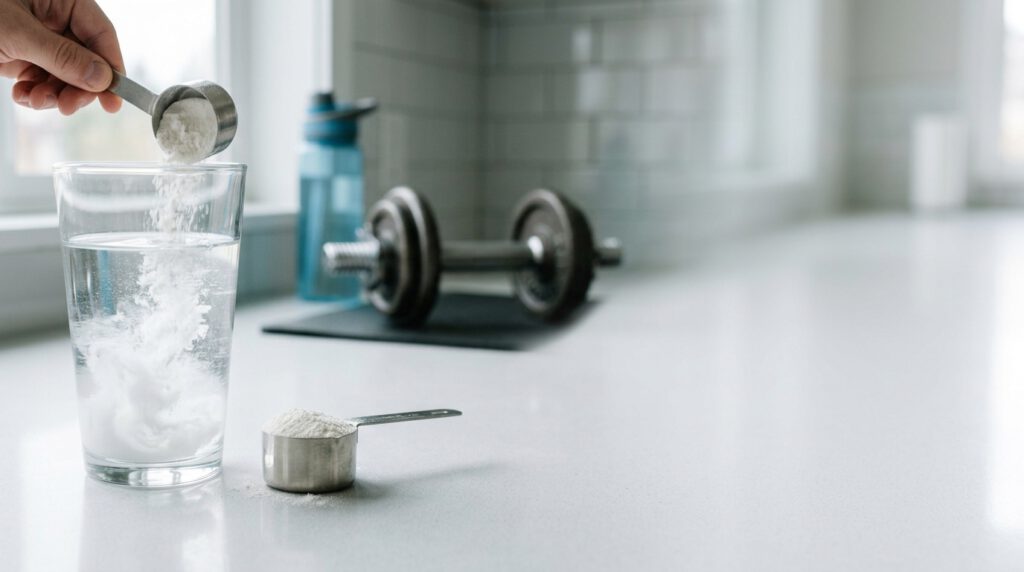
3–5 grams of creatine monohydrate per day.
Body weight influences the exact amount:
- Around 60 kg (130 lbs): 3 g/day is sufficient
- Around 100 kg (220 lbs): 5 g/day or slightly more
- Athletes over 200 lbs training at high volume: up to 6–10 g/day to maintain full saturation
That’s it. One small scoop. Every single day.
The Loading Phase: Necessary or Not?
The traditional loading protocol is:
- 20 grams/day (split into 4 × 5 g doses) for 5–7 days
- Followed by a maintenance dose of 3–5 g/day
This saturates muscle stores in about one week.
Skipping the loading phase and starting directly at 3–5 g/day achieves the same level of saturation — it just takes 3–4 weeks instead of one.
Should you load?
- Yes, if you want faster results and tolerate larger doses without GI issues
- No, if you experience bloating, cramping, or stomach discomfort on high doses — just start at maintenance and be patient
The end state is identical either way.
Timing: When Should You Take Creatine?
Short answer: whenever you’ll reliably remember to take it.
Longer answer: timing matters far less than consistency. Research suggests a modest edge for taking creatine post-workout on training days (likely because insulin from a post-workout meal enhances uptake), but the effect size is small.
What matters most is taking it every single day — training day or not.
Practical guidelines:
- Take it with food. A small insulin response from a mixed meal enhances creatine uptake into muscle cells. No special sugar drink needed.
- Prioritize daily consistency over perfect timing. Missing a day occasionally won’t hurt. Missing three days a week regularly will slowly erode your saturation levels.
- No need to cycle. Creatine does not cause tolerance the way stimulants do. Take it year-round.
Side Effects of Creatine
Creatine monohydrate is one of the most extensively safety-tested supplements available. For healthy adults, it is considered very safe. Side effects that do occur are typically mild and manageable.
Water Weight Gain
Expect a 1–3 lb increase in body weight within the first 1–2 weeks. This is intracellular water — stored inside muscle cells, not under the skin. It makes muscles look fuller and more hydrated, not puffy or soft. It stabilizes once muscle stores are saturated and does not continue to climb.
Who this matters for: athletes in weight-class sports or those approaching a specific aesthetic window. For everyone else, it’s either neutral or a welcome sign that the supplement is working.
Bloating and GI Discomfort
Most common during a loading phase (20 g/day). Your gut has a limited absorption capacity; excess creatine can pull water into the intestines and cause bloating or cramps.
How to avoid it:
- Skip the loading phase and start at 3–5 g/day
- Split your dose across two smaller servings
- Take it with food, not on an empty stomach
- Choose micronized creatine for better solubility
Nausea or Loose Stools
Rare, and usually the result of taking too much at once or not drinking enough water. Creatine draws fluid into muscle cells, so your body needs adequate hydration to process it properly.
Fix: lower the single-dose amount, take with food, and increase daily water intake.
Common Creatine Myths — Debunked
Myth #1: “Creatine damages your kidneys.”
False. Every large-scale, long-term study on creatine — including multi-year studies at high doses — has found no impact on kidney function in healthy adults.
The confusion stems from a mix-up between creatine (what you supplement) and creatinine (a metabolic waste product that increases when you take creatine). Elevated creatinine on a blood test during supplementation is expected and does not indicate kidney damage — it simply means your body is processing more creatine than usual.
Important caveat: Anyone with pre-existing kidney disease or impaired kidney function should consult a doctor before supplementing.
Myth #2: “Creatine causes hair loss.”
Not supported by evidence. This myth originates from a single 2009 study in rugby players that found elevated DHT (a hormone linked to male pattern baldness) — but reported zero cases of actual hair loss among participants. The study was never replicated, and larger studies have not confirmed any link between creatine supplementation and hair loss.
If you have a family history of male pattern baldness, creatine is not meaningfully altering your trajectory.
Myth #3: “Creatine is a steroid.”
Completely false. Anabolic steroids are synthetic hormones that bind to androgen receptors and alter gene expression — they’re Schedule III controlled substances for a reason. Creatine is a naturally occurring compound your body already produces. It doesn’t change your hormones, doesn’t affect your DNA, and is classified by the FDA as Generally Recognized as Safe (GRAS). It’s available over the counter and widely used across all age groups in research.
Myth #4: “Creatine is only for male bodybuilders.”
False. Women respond to creatine just as effectively as men in studies measuring strength, body composition, and performance. Because women tend to have lower baseline muscle creatine stores, the relative benefit is often slightly larger. For women over 40, creatine combined with resistance training is one of the most evidence-backed strategies for maintaining muscle and bone density. Older adults, endurance athletes, students, and vegetarians all have strong reasons to consider it.
Myth #5: “You need to cycle off creatine.”
No evidence supports this. Cycling is a holdover from anabolic steroid protocols, where the body does downregulate receptors over time. Creatine doesn’t work that way. Long-term studies show no loss of effectiveness with continuous daily use. Take it year-round.
Myth #6: “Creatine causes dehydration and cramping.”
Not accurate. Studies consistently show creatine does not dehydrate you — the intracellular water shift doesn’t rob fluid from the rest of your body. Cramping, when it does occur, is almost always a result of general dehydration, not creatine itself. Drink adequate water (at minimum 12 oz per 5 g dose) and this is a non-issue.
Myth #7: “You need to take it with grape juice or a sugar bomb.”
Outdated. Early research suggested a large sugar spike helped creatine uptake. More recent understanding shows that any regular mixed meal produces a sufficient insulin response. There’s no need for a sugary drink.
Who Should (and Shouldn’t) Take Creatine?
Who benefits most:
- Strength and power athletes — the clearest, most direct benefits for anyone doing compound lifts, sprints, or explosive movements
- Recreational gym-goers — more reps, better recovery, greater lean muscle over time
- Older adults (50+) — one of the most evidence-supported supplements for slowing muscle and strength decline
- Vegetarians and vegans — baseline creatine stores are significantly lower, so the relative gain from supplementation is largest
- People with cognitively demanding lives — sleep-deprived students, high-stress professionals, and anyone who needs sustained mental sharpness
- Women — equal benefit to men; particularly valuable for women over 40 focused on muscle and bone health
Who should talk to a doctor first:
- Anyone with chronic kidney disease or a history of kidney issues
- Anyone on medications that affect kidney function (certain NSAIDs, diuretics, ACE inhibitors)
- Anyone on a physician-prescribed low-protein diet due to liver disease, gout, or renal concerns
- Pregnant or breastfeeding women (not because of known danger, but because the evidence base in this population is thinner)
- Teenagers under 18 (reasonable safety data, but worth discussing with a pediatrician)
How to Know It’s Working
Creatine is not a stimulant — you won’t “feel” it the way you feel caffeine. The effects are cumulative and quiet.
Realistic timeline at 3–5 g/day:
| Timeframe | What to Expect |
|---|---|
| Week 1–2 | Small body weight increase (water shift). Performance effects usually not yet noticeable. |
| Week 3–4 | Noticeable improvement in strength, extra rep or two on working sets, faster set-to-set recovery. |
| Month 2–3 | Visible improvements in muscle fullness and lean mass, especially with consistent progressive training. |
| Ongoing | Stable performance ceiling lift with no diminishing returns beyond normal training limits. |
If you’re not training hard, creatine will still saturate your muscles — but there’s nothing to amplify. It’s a performance enhancer for effort, not a replacement for it.
How to Choose a Quality Creatine Supplement
What to look for:
- Creatine monohydrate as the primary (or only) ingredient
- Micronized for better mixability
- Creapure® certification for verified purity (optional but a good trust signal)
- Third-party testing — look for NSF Certified for Sport or Informed Choice certification to confirm the product is free of contaminants and banned substances
What to avoid:
- Liquid creatine — creatine degrades in liquid over time; by the time you drink it, much of the active compound is already broken down
- Underdosed “mega blends” — proprietary pre-workout or recovery formulas that include creatine as a minor ingredient at a fraction of the effective dose
- Exotic forms with no additional proven benefit — creatine ethyl ester, for example, has consistently underperformed monohydrate in comparison studies
The simple truth:
Creatine monohydrate is one of the cheapest effective supplements available. A month’s supply typically costs less than a single specialty coffee drink. There is no need to spend more.
Final Takeaways
Creatine monohydrate earns its reputation as the most evidence-backed supplement in existence. After six decades of research across thousands of studies:
- 3–5 grams per day is the effective maintenance dose for most people
- Loading is optional — same result in 3–4 weeks without it
- Timing matters less than daily consistency
- Monohydrate outperforms every more expensive “advanced” form in head-to-head research
- Kidney damage, hair loss, dehydration — none of these are supported by the evidence in healthy adults
- It works for everyone — not just male bodybuilders, but women, older adults, vegetarians, and anyone who needs more from their body and brain
The supplements that deliver results are rarely the exotic ones. They’re the boring, well-dosed, consistently taken ones. Creatine, taken daily, over months, is as close to a guaranteed return as the supplement world offers.
This article is for educational purposes and does not constitute medical advice. Consult a qualified healthcare provider before starting any new supplement, especially if you have a medical condition or take prescription medications.
Related Posts

Stay Informed With the Latest & Most Important News
Previous Post
Next Post










Advertisement