
























Now Reading: Wearable Tech Comparison 2026: What a Smart Ring Tracks That a Watch Doesn’t
-
01
Wearable Tech Comparison 2026: What a Smart Ring Tracks That a Watch Doesn’t


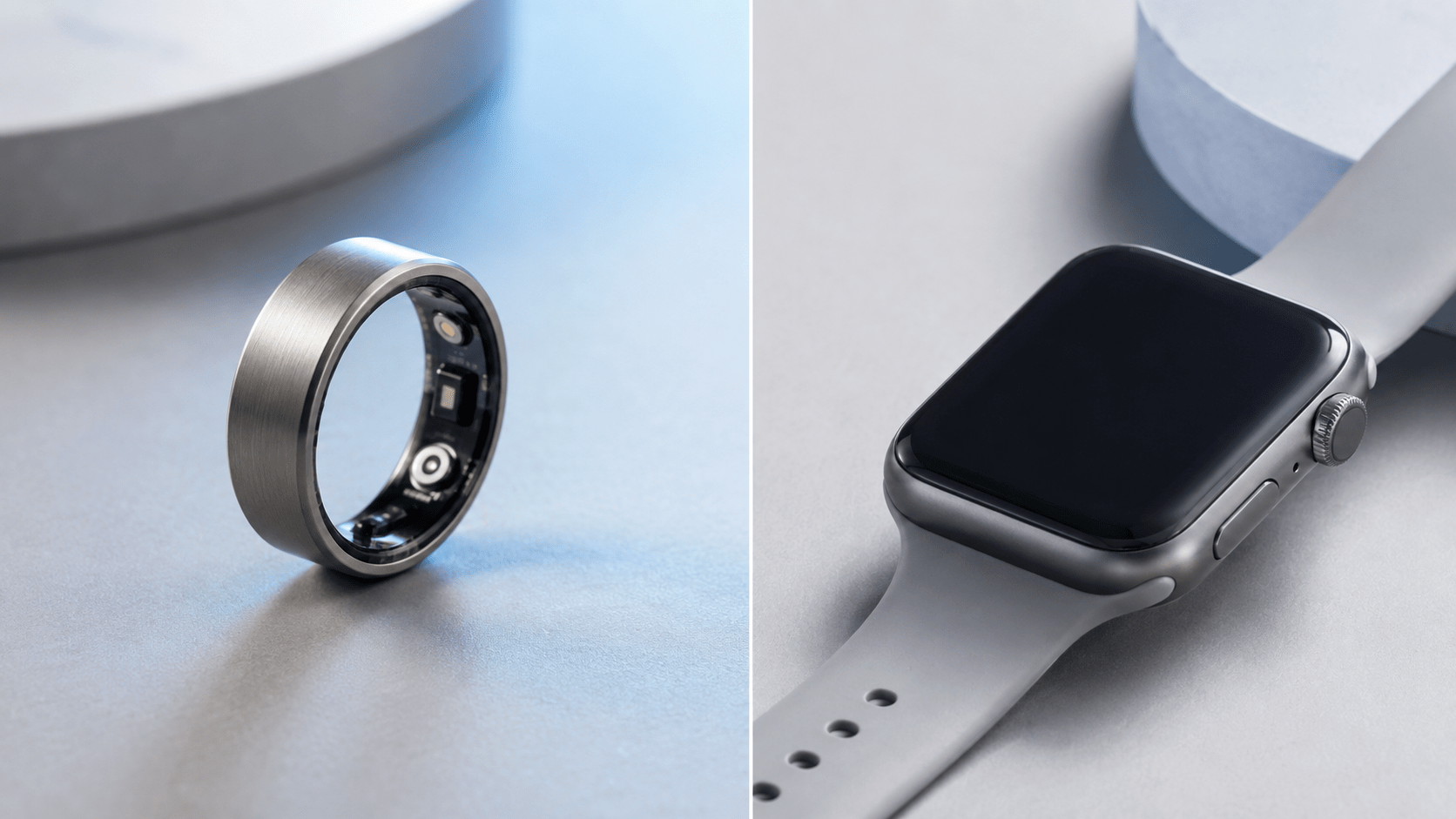
Wearable tech has quietly split into two camps. One lives on your wrist, has a screen, and wants to run your whole day. The other slides onto your finger, has no screen at all, and just… watches. Quietly. All night.
In 2026, that second camp — smart rings — is no longer a niche gadget for biohackers.
The category is projected to jump from roughly $519 million in 2026 toward $3.77 billion by 2034, and Oura, the company that popularized the format, has grown large enough to file confidentially for an IPO at an $11 billion valuation.
Meanwhile Samsung, which entered the ring race in 2024 with real momentum, has reportedly pushed its Galaxy Ring 2 back to early 2027 — leaving Oura’s newly launched Ring 5 with an unusually open field.
So the question people actually search for isn’t “which wearable is better.” It’s narrower and more useful: what does a ring see on your body that a watch physically cannot — and vice versa?
That’s what this guide answers.
Table of contents
- The Quick Answer
- Why Finger Placement Actually Matters: The Science in Plain English
- What a Smart Ring Tracks That a Watch Doesn’t
- 1. True, Uninterrupted Nocturnal Skin Temperature Trends
- 2. Cleaner, Artifact-Free Overnight HRV
- 3. Passive, Low-Friction Symptom and Readiness Radar
- 4. 2026’s New Frontier: Overnight Blood Pressure Trends and Breathing Analysis
- 5. GLP-1 and Health Records Integration
- 6. On-Finger ECG and FDA-Cleared AFib Detection — Without a Screen
- 7. Women’s Health Signals With Less Noise
- What a Smartwatch Tracks That a Smart Ring Doesn’t
- Head-to-Head: Accuracy by Metric
- Battery Life and Charging Habits
- Price and Subscriptions in 2026
- The 2026 Market Snapshot
- Which Should You Actually Buy?
- Where to Buy the Devices in This Guide
- Frequently Asked Questions
The Quick Answer
A smart ring is built around your finger’s digital artery, which sits close to the skin and barely moves while you sleep.
That gives rings a real edge in three areas: overnight skin temperature trend tracking, clean heart rate variability (HRV) data, and sleep-stage accuracy — largely because people actually keep rings on overnight, while many people take a bulky smartwatch off before bed.
A smartwatch, on the other hand, wins on anything that requires a screen, GPS, or active movement: real-time workout stats, route mapping, live notifications, fall detection, and (on most models) a wrist-based ECG you can trigger on demand.
If you want both advantages, the fastest-growing pattern in 2026 is wearing one of each — more on that below.
Why Finger Placement Actually Matters: The Science in Plain English
Both device types use the same underlying sensor technology — photoplethysmography, or PPG, which shines light into your skin and reads the tiny color changes caused by blood flow.
The difference is where that sensor sits.
The finger’s digital arteries carry a strong, close-to-the-surface blood flow signal, and fingers barely move once you fall asleep. The wrist’s blood vessels are a bit deeper, wrist skin is more exposed to temperature swings, and — critically — your wrist moves constantly, even in light sleep.
That constant, low-level motion is “noise” that a device has to filter out before it can report a clean number.
The practical result:
- Resting heart rate accuracy: both device types are excellent here (98–99% for rings, 97–98% for watches, when compared against clinical ECG chest straps), because the body is still.
- Active/exercise heart rate: wrist devices pull decisively ahead (90–98% depending on intensity) because they’re engineered and positioned for motion; most rings aren’t designed to track it at all.
- Sleep tracking overall accuracy: rings lead at roughly 92–95% against clinical polysomnography, versus 84–88% for typical smartwatches — driven less by the sensor itself and more by the fact that people actually wear rings to bed. Independent testing has found overnight compliance around 98% for rings versus about 67% for watches, simply because a watch feels bulkier under a pillow than a thin metal band.
What a Smart Ring Tracks That a Watch Doesn’t
This is the part most comparison articles skip past. Here’s specifically where the finger’s placement — plus 2026’s newest ring hardware — gives you data a watch structurally can’t match.
1. True, Uninterrupted Nocturnal Skin Temperature Trends
Because a snug ring never leaves your finger overnight, it can log a continuous temperature curve for eight-plus hours without a single gap. That steady baseline is what lets a ring flag a 0.3–0.5°C deviation tied to illness, ovulation, or overtraining — often a day or more before you feel anything. Watches can measure temperature too on premium models, but the data has holes wherever the device came off to charge or felt too warm to sleep in.
2. Cleaner, Artifact-Free Overnight HRV
Heart rate variability is one of the most useful recovery signals a wearable can capture, but it’s also one of the easiest to corrupt with motion. A loose watchband sliding around your wrist during a restless night introduces noise that algorithms have to smooth over or discard. A form-fitted ring barely shifts, so its overnight HRV curve tends to be less “guessed at” and more directly measured.
3. Passive, Low-Friction Symptom and Readiness Radar
Oura’s Health Radar feature (an expanded version of the earlier Symptom Radar) continuously cross-references body temperature, respiratory rate, and HRV to flag physiological strain before you notice symptoms yourself. It’s a background feature that only works well if the sensor never comes off — which is precisely the ring’s advantage.
4. 2026’s New Frontier: Overnight Blood Pressure Trends and Breathing Analysis
The Oura Ring 5, launched June 4, 2026, at $399, introduced two features that simply weren’t available in consumer wearables a year earlier: nighttime blood pressure trend monitoring, aimed at flagging early cardiovascular risk signals, and nighttime breathing pattern analysis, which looks for disturbances tied to sleep-disordered breathing. Both lean on the same stable, low-motion overnight window that makes ring-based sleep tracking accurate in the first place.
5. GLP-1 and Health Records Integration
Also new with Ring 5: GLP-1 medication tracking for people on drugs like semaglutide, plus a Health Records feature that lets you pull lab results and diagnosed conditions from your healthcare provider directly into the app, alongside your wearable data. That’s a ring-first feature; no mainstream smartwatch currently offers an equivalent.
6. On-Finger ECG and FDA-Cleared AFib Detection — Without a Screen
This one used to be a watch-exclusive advantage, and it isn’t anymore. The Circular Ring 2 puts physical ECG electrodes on the ring band itself: touch the outer electrode with a finger from your other hand for about 30 seconds, and it records a single-lead ECG with an FDA-cleared algorithm for atrial fibrillation, tachycardia, and bradycardia — priced at $349 with no subscription. It’s a meaningful shift, because AFib detection was previously something only Apple Watch and Galaxy Watch could do.
7. Women’s Health Signals With Less Noise
Because ring-based temperature and resting heart rate readings are cleaner overnight, cycle and ovulation prediction tends to be more reliable on rings than on watches, which struggle with the same overnight-compliance problem described above.
What a Smartwatch Tracks That a Smart Ring Doesn’t
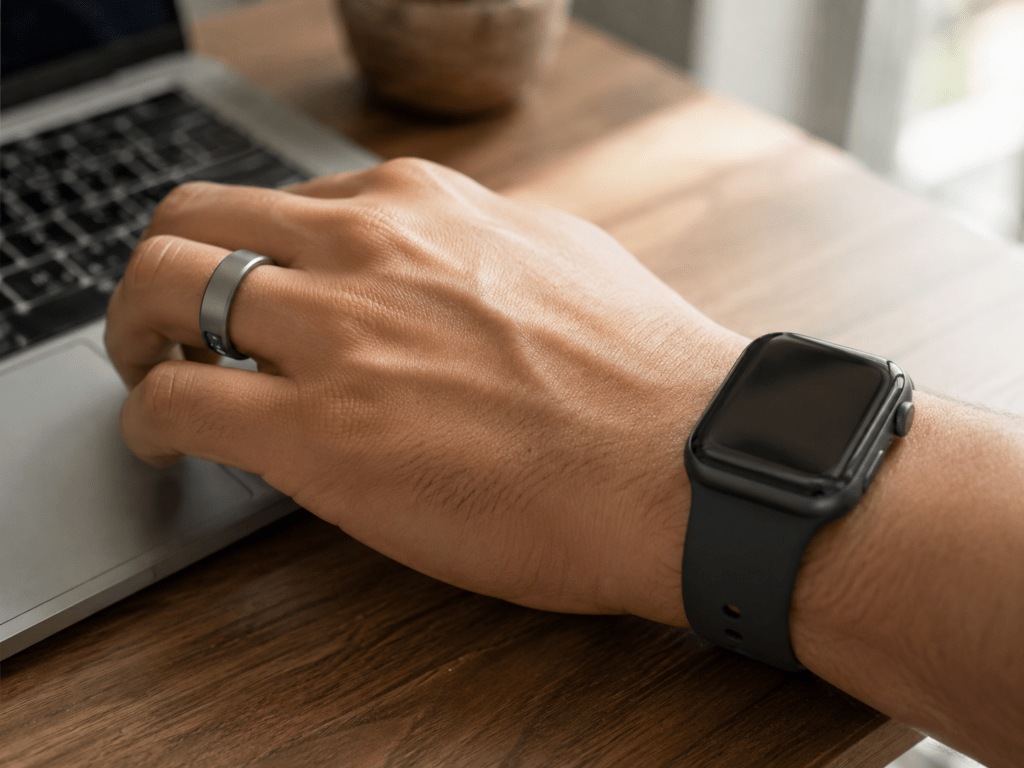
To keep this fair: rings give up a lot in exchange for that finger-placement advantage.
- Built-in GPS. No mainstream smart ring has it. If you want route mapping, pace, and distance without your phone, you need a watch.
- Real-time, in-the-moment stats. A ring has no display. You can’t glance at your current heart rate zone mid-run; you check it later, in an app.
- Gyroscope-based exercise recognition. Watches can tell a squat from a bench press because they track orientation and rotation, not just acceleration. Rings generally can’t.
- On-demand wrist ECG (Apple Watch / Galaxy Watch). Apple Watch Series 11 lets you take an ECG anytime, plus it monitors for irregular rhythm and can flag possible hypertension by analyzing how blood vessels respond to each heartbeat — a slightly different approach from the Circular Ring 2’s touch-based ECG, but available on far more mainstream hardware.
- Fall detection, crash detection, and SOS. Series 11 can detect a hard fall or severe car crash and automatically loop in emergency services and contacts — a genuine safety net that’s simply not part of the ring form factor yet.
- Notifications, calls, and payments. If you want your wrist to replace glancing at your phone, only a watch does that.
- Step-counting accuracy. Wrist accelerometers read arm swing, the actual signal that makes step counting reliable (96–98% for watches and bands vs. roughly 85–92% for rings).
Head-to-Head: Accuracy by Metric
| Metric | Smart Ring | Smartwatch |
|---|---|---|
| Resting heart rate | 98–99% | 97–98% |
| Active exercise heart rate | Not designed for this | 91–98% |
| Sleep tracking (overall) | 92–95% | 84–88% |
| Step counting | 85–92% | 95–98% |
| SpO2 during sleep | ±1–2% | ±2–3% |
| GPS distance | Not available | ±5–15m |
| Overnight wear compliance | ~98% of users | ~67% of users |
(Figures reflect independent lab and field testing against clinical-grade references; individual models vary.)
Battery Life and Charging Habits
| Smart Ring | Smartwatch (tech-focused) | |
|---|---|---|
| Typical battery life | 5–12 days | 18 hours – 2 days |
| Charge time | 60–90 minutes | 30–60 minutes |
| Risk of missing a night of sleep data | Low | High |
This gap matters more than it looks on paper. A device that needs charging every single night creates predictable data gaps — miss one charge and you lose that night’s sleep data entirely. A ring that runs a full week between charges rarely puts you in that position.
Price and Subscriptions in 2026
| Device | Price | Subscription |
|---|---|---|
| Oura Ring 5 | $399 | $5.99/month required for full insights |
| RingConn Gen 2 Air | ~$200–$300 | None — all features included |
| Samsung Galaxy Ring | ~$399 | None — all features included |
| Circular Ring 2 | $349 | None — all features included |
| Apple Watch Series 11 | Starts around $399 | None (Apple Intelligence features tied to iPhone, not a fee) |
| Garmin Venu 4 | Starts around $450 | None |
Run the math over three to five years before you buy: a $399 ring plus a mandatory $5.99/month subscription adds roughly $215 over three years — sometimes making a “cheaper” subscription-required device the more expensive option long-term compared with a pricier, subscription-free alternative.
The 2026 Market Snapshot
A few developments changed the competitive picture this year and are worth knowing before you buy:
- Oura Ring 5 (launched June 4, 2026) is 40% smaller than the Ring 4, calling itself the smallest smart ring on the market, with repositioned, more powerful LEDs aimed at improving accuracy across more skin tones.
- Samsung Galaxy Ring 2 has reportedly slipped to early 2027, nearly two years after the original Galaxy Ring launched with no subscription fee and strong retail distribution. That leaves current Galaxy Ring buyers on now-aging hardware for a while longer.
- The Circular Ring 2 is the first smart ring with a genuine on-finger ECG and FDA-cleared AFib detection, closing a gap that used to be a hard advantage for smartwatches.
- The wearables market overall keeps growing fast, with fitness bands and smartwatches still outselling rings in raw volume, even as rings post the sharpest year-over-year growth of any wearable category.
Which Should You Actually Buy?
Choose a smart ring if: sleep quality and passive recovery tracking are your top priority, you don’t want a screen buzzing on your wrist all day, and you’re fine checking your data in an app rather than in real time.
Choose a smartwatch if: you train with GPS, want live stats mid-workout, rely on notifications and calls from your wrist, or want fall/crash detection built in.
Wear both if: you can justify the cost. This is an increasingly common setup — ring for sleep and recovery, watch for workouts and notifications — and several ecosystems now let you merge data from both into one dashboard.
Where to Buy the Devices in This Guide
- Oura Ring 4 (Silver, Size 9): https://www.amazon.com/Oura-Ring-Tracking-Wearable-Fitness/dp/B0D9WWB3WX
- RingConn Gen 2 Air (Dune Gold, subscription-free): https://www.amazon.com/RingConn-Ultra-Thin-Standard-Features-Compatible/dp/B0DWJDFLT8
- Samsung Galaxy Ring (Titanium Silver, no subscription): https://www.amazon.com/SAMSUNG-Subscription-Monitoring-Titanium-Manufacturer/dp/B0D3JDPB11
- Apple Watch Series 11 (46mm GPS, Space Gray): https://www.amazon.com/Apple-Cellular-Smartwatch-Aluminum-Always/dp/B0FQFJ23XP
- Garmin Venu 4 (41mm, Advanced GPS fitness watch): https://www.amazon.com/Garmin-Advanced-Smartwatch-Flashlight-Periwinkle/dp/B0FSNRMJV1
Frequently Asked Questions
Can a smart ring replace a smartwatch entirely?
No. It covers passive health tracking exceptionally well but has no display, no GPS, and no notifications. For most people it works better as a companion device than a full replacement.
Is a smart ring more accurate than a smartwatch for health data?
For resting metrics — HRV, resting heart rate, and sleep — yes, generally. For anything involving movement, a watch is more reliable.
Do all smart rings require a subscription?
No. Oura is the main holdout requiring one for full functionality ($5.99/month). RingConn, Samsung’s Galaxy Ring, and the Circular Ring 2 currently include all features with the purchase price.
Which is better for detecting heart problems like AFib, a ring or a watch?
Until 2025 this was a clear watch advantage (Apple Watch, Galaxy Watch).
The Circular Ring 2 now offers an FDA-cleared, on-finger ECG for AFib detection, so it’s no longer watch-exclusive — though watch-based ECG remains available on far more models.
What’s the single biggest reason rings beat watches on sleep data?
Compliance, not sensors. People simply keep a thin ring on overnight far more consistently than a bulkier watch, so the ring collects a more complete dataset night after night.
Disclosure: This article contains affiliate links. If you buy through them, we may earn a commission at no extra cost to you.
Stay Informed With the Latest & Most Important News
Previous Post
Next Post










Advertisement