

























Now Reading: Muscle Hypertrophy: The Science of Mechanical Tension vs. Metabolic Stress
-
01
Muscle Hypertrophy: The Science of Mechanical Tension vs. Metabolic Stress


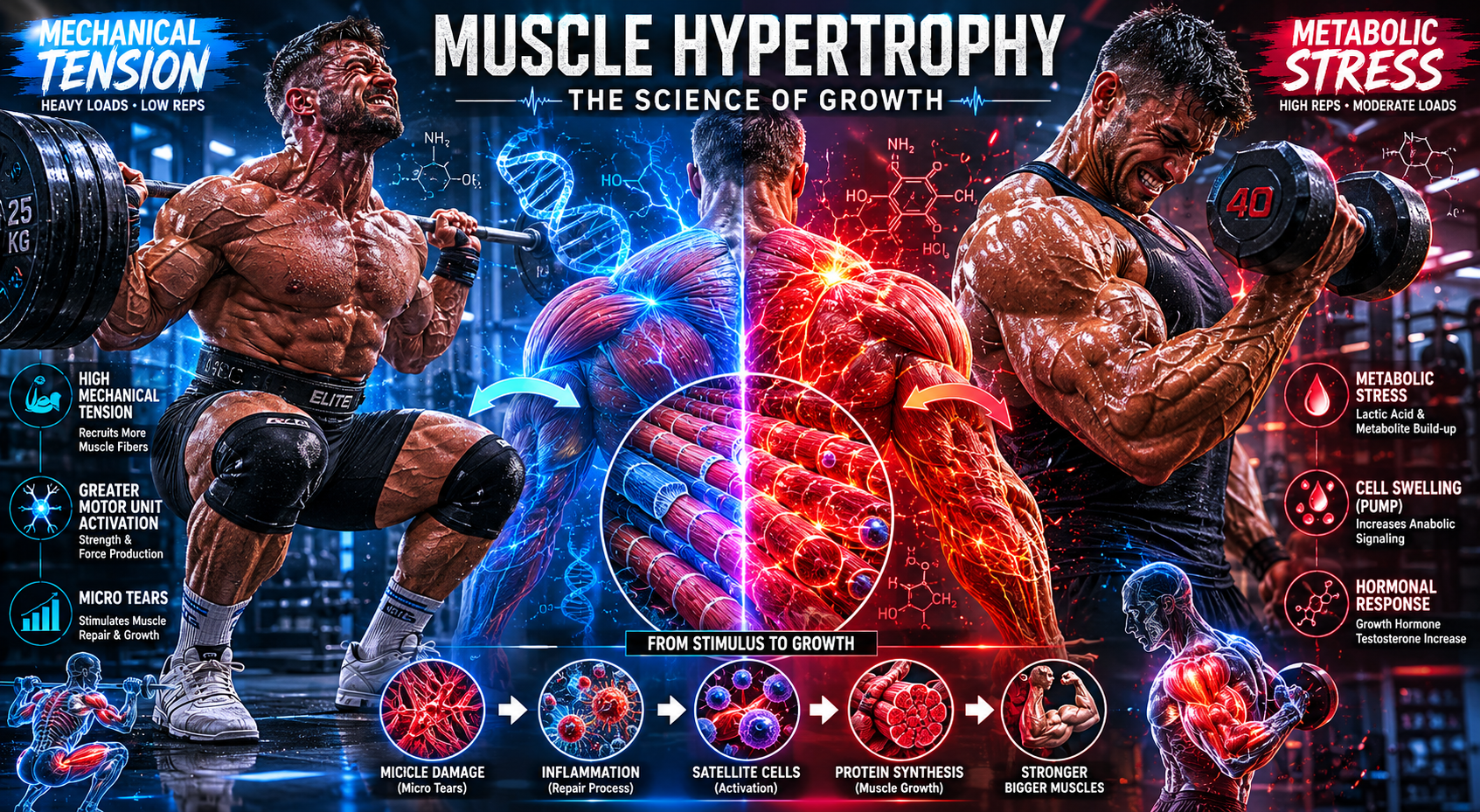
The pursuit of lean muscle mass has become one of the primary goals for athletes, bodybuilders, and fitness enthusiasts worldwide. Yet one question continues to dominate the strength-training world: what actually drives muscle hypertrophy?
For decades, bodybuilders and powerlifters have used dramatically different training styles to build impressive physiques. Bodybuilders typically rely on moderate weights, high repetitions, and short rest intervals that create the intense muscular “pump” and fatigue their training is known for. Powerlifters, on the other hand, focus on heavy loads, low repetitions, and long recovery periods between sets.
Both methods clearly work — just through different physiological mechanisms.
Modern hypertrophy research points to two major factors behind muscle growth: mechanical tension and metabolic stress. Rather than competing against each other, these two processes appear to work together to maximize muscle growth, strength, and adaptation.
What Is Muscle Hypertrophy?
Muscle hypertrophy is the increase in skeletal muscle size through the enlargement of muscle fibers. It happens when resistance training stimulates muscle protein synthesis at a rate greater than muscle protein breakdown.
The hypertrophic process is shaped by three physiological mechanisms: mechanical tension, metabolic stress, and muscle damage. Recent research increasingly points to mechanical tension as the primary driver of hypertrophy — while excessive muscle damage may actually impair recovery and long-term growth.
Mechanical Tension: The Primary Driver of Muscle Growth
Mechanical tension is the force generated when muscles contract against resistance, and it’s widely considered the most important stimulus for hypertrophy.
When muscles experience high levels of tension, mechanoreceptors inside the muscle fibers activate anabolic signaling pathways that stimulate muscle protein synthesis and cellular growth.
How It Works
Heavy resistance training places stress directly on muscle fibers. That tension disrupts cellular structures and signals the body to repair and rebuild the tissue stronger and thicker than before. The process also recruits high-threshold motor units — particularly fast-twitch Type II muscle fibers, which have the greatest growth potential of any fiber type.
Key mechanisms activated by mechanical tension:
- Increased muscle protein synthesis
- Activation of anabolic signaling pathways
- Recruitment of fast-twitch muscle fibers
- Neural adaptations
- Greater motor unit activation
How to Train for It
To maximize mechanical tension, training should emphasize heavy compound lifts, progressive overload, full range of motion, and controlled eccentric movements.
| Variable | Recommendation |
|---|---|
| Load | 80%+ of 1RM |
| Repetitions | 3–6 reps |
| Rest periods | 2–3 minutes |
| Focus | Strength and tension production |
Interestingly, newer research shows that lighter loads (40–60% of 1RM) can also generate substantial hypertrophy if sets are taken close to muscular failure. This suggests that muscular effort and motor unit recruitment may matter more than the load itself.
Metabolic Stress: The “Muscle Pump” Effect
Metabolic stress refers to the buildup of metabolites — lactate, hydrogen ions, and inorganic phosphate — that typically occurs during high-repetition resistance training with short rest periods. The resulting cellular swelling creates the “pump” sensation associated with bodybuilding-style workouts.
How It Stimulates Hypertrophy
Metabolic stress contributes to muscle growth through several mechanisms: increased cellular swelling, elevated anabolic hormone responses, greater muscle fiber recruitment during fatigue, reduced protein breakdown, and enhanced muscular endurance adaptations.
While metabolic stress alone likely isn’t the primary driver of hypertrophy, it significantly enhances the muscle-building environment.
How to Train for It
Training for metabolic stress typically involves moderate-to-high repetitions, short rest intervals, continuous muscular tension, and high training volume.
| Variable | Recommendation |
|---|---|
| Load | 50–70% of 1RM |
| Repetitions | 10–20+ reps |
| Rest periods | 30–60 seconds |
| Focus | Pump, fatigue, volume |
Effective techniques: drop sets, supersets, blood flow restriction (BFR) training, high-volume circuits, and slow tempo training.
Mechanical Tension vs. Metabolic Stress: Which Wins?
The debate between heavy training and pump-style training has run for years, but current evidence suggests the best hypertrophy results come from combining both mechanisms strategically.
Mechanical tension benefits: maximizes fast-twitch fiber recruitment, builds strength efficiently, produces long-term hypertrophy adaptations, and improves neural efficiency.
Metabolic stress benefits: enhances cellular swelling, increases training volume, improves muscular endurance, and amplifies anabolic signaling.
The most effective hypertrophy programs blend both approaches to stimulate every pathway involved in muscle growth.
The Role of High-Threshold Motor Units
One of the most important discoveries in hypertrophy science is the recruitment of high-threshold motor units — which primarily contain Type II muscle fibers, the ones with the highest potential for growth.
According to the size principle, low-threshold motor units are recruited first, and high-threshold motor units activate only as force demands increase. Training close to muscular failure appears to maximize recruitment of these powerful fibers, even when lighter loads are used — which explains why both heavy low-rep training and lighter high-rep training can build muscle, as long as enough effort is applied.
Is Muscle Damage Necessary for Growth?
For years, soreness was treated as proof that a workout had been effective. But modern research suggests excessive muscle damage may actually interfere with growth, since the body has to prioritize repairing that damage over building new muscle.
Excessive muscle damage can:
- Reduce recovery capacity
- Impair performance
- Increase fatigue
- Limit training frequency
The goal is enough stimulus to trigger adaptation — without excessive tissue destruction.
Advanced Hypertrophy Techniques
Drop Sets
Drop sets involve reducing the weight immediately after reaching failure and continuing the set with minimal rest.
Benefits: increase metabolic stress, extend time under tension, enhance muscle fatigue, and efficiently boost training volume.
Example: Perform 6–8 reps of bench press with a heavy weight, reduce the load by 20–30%, continue immediately for more reps, and repeat 2–3 times.
Cluster Sets
Cluster sets break a traditional set into smaller mini-sets with brief rest periods.
Example: Instead of 8 continuous reps, perform 2 reps, rest 20 seconds, and repeat until all reps are completed.
Benefits: maintains high mechanical tension, reduces excessive fatigue, allows heavier loading, and improves overall training quality. Cluster training is especially effective for building strength and hypertrophy at the same time.
Neural Stimulus and Muscle Recruitment
Emerging research highlights the nervous system’s role in hypertrophy. Exercises that maximize neural drive may enhance motor unit recruitment, force production, muscle coordination, and hypertrophic signaling. This is why explosive training methods — plyometrics, heavy compound lifts, HIIT, and Olympic lifting variations — may indirectly contribute to muscle growth.
How to Combine Both Mechanisms
For optimal hypertrophy, most evidence supports a hybrid approach:
1. Heavy compound work — squats, deadlifts, bench press, pull-ups. Goal: maximize mechanical tension.
2. Moderate-to-high volume accessory work — isolation exercises, drop sets, supersets, short rest periods. Goal: increase metabolic stress.
This combination lets athletes maximize motor unit recruitment, cellular swelling, training volume, and progressive overload all at once.
Practical Recommendations for Maximum Muscle Growth
- Prioritize progressive overload — muscles need continually greater demands over time.
- Train close to failure, especially when using lighter loads.
- Manage fatigue carefully — excessive soreness and fatigue can reduce long-term progress.
- Maintain proper form — poor technique alters muscle recruitment patterns and reduces targeted tension.
- Optimize recovery — nutrition, sleep, and recovery determine whether your training stimulus actually turns into growth.
Conclusion
The science of muscle hypertrophy continues to evolve, but current evidence strongly suggests mechanical tension remains the primary driver of muscle growth, while metabolic stress serves as a powerful complementary mechanism.
Rather than choosing between heavy, strength-focused training and high-volume, pump-style workouts, the most effective hypertrophy programs strategically combine both. To maximize muscle growth: prioritize progressive mechanical tension, use metabolic stress techniques intelligently, recruit high-threshold motor units, avoid excessive muscle damage, and balance intensity, volume, and recovery.
Ultimately, hypertrophy isn’t about choosing one training philosophy over another — it’s about understanding how the body adapts and using every available mechanism to stimulate growth efficiently.
FAQ
Is mechanical tension more important than metabolic stress?
Yes. Current research suggests mechanical tension is the primary driver of hypertrophy, while metabolic stress enhances the overall muscle-building response.
Related Posts


Stay Informed With the Latest & Most Important News
Previous Post
Next Post










Advertisement