





















Now Reading: What Is RPE and How to Use It to Train Smarter (Not Harder)
-
01
What Is RPE and How to Use It to Train Smarter (Not Harder)



If you’ve ever heard a coach say “push until it feels tough,” you’ve already brushed up against RPE. RPE (Rate of Perceived Exertion) is a simple 1–10 scale that measures how hard an exercise feels, letting you adjust your training intensity based on how your body feels that day — instead of blindly chasing numbers on a spreadsheet.
Unlike percentage-based programming, RPE is subjective by design.
Two people lifting the exact same weight can rate the effort completely differently, depending on sleep, stress, nutrition, and recovery.
That’s exactly what makes it powerful: it accounts for real life, not just the number on the bar. Instead of grinding through every workout at all costs, RPE auto-regulates your training, helping you avoid overtraining and burnout while still getting the stimulus you need.
Table of contents
A Quick Bit of History
RPE isn’t a new fitness trend. The original scale was developed in the 1960s by physiologist Gunnar Borg and ranged from 6 to 20, loosely correlating with heart rate — an RPE of 14, for example, roughly lines up with a heart rate of 140 bpm. Because Borg noticed that effort isn’t perfectly capped at a fixed ceiling, a simplified 0–10 version became more popular for everyday use, where 0 represents sitting still and 10 represents near-maximal effort. Some athletes even use decimals (6.5, for instance) to describe effort more precisely.
The RPE Scale, Explained
The modern 1–10 scale breaks down roughly like this:
| RPE | Feels Like | Reps in Reserve (RIR) |
|---|---|---|
| 10 | Maximum effort | 0 reps left |
| 9 | Very hard | 1 rep left |
| 8 | Hard but manageable | 2 reps left |
| 7 | Moderate, confident | 3 reps left |
| 5–6 | Comfortable to lightly challenging | 4+ reps left |
| 1–4 | Very easy to minimal effort | Warm-up territory |
The Reps in Reserve (RIR) concept is what makes RPE actionable rather than a vague feeling. If you bench 225 lbs for 8 reps and could only squeeze out one more, that’s roughly an RPE 9. If two more reps felt possible, that’s closer to RPE 8. This turns a subjective sensation into something you can track and compare week to week.
Using RPE in Strength Training
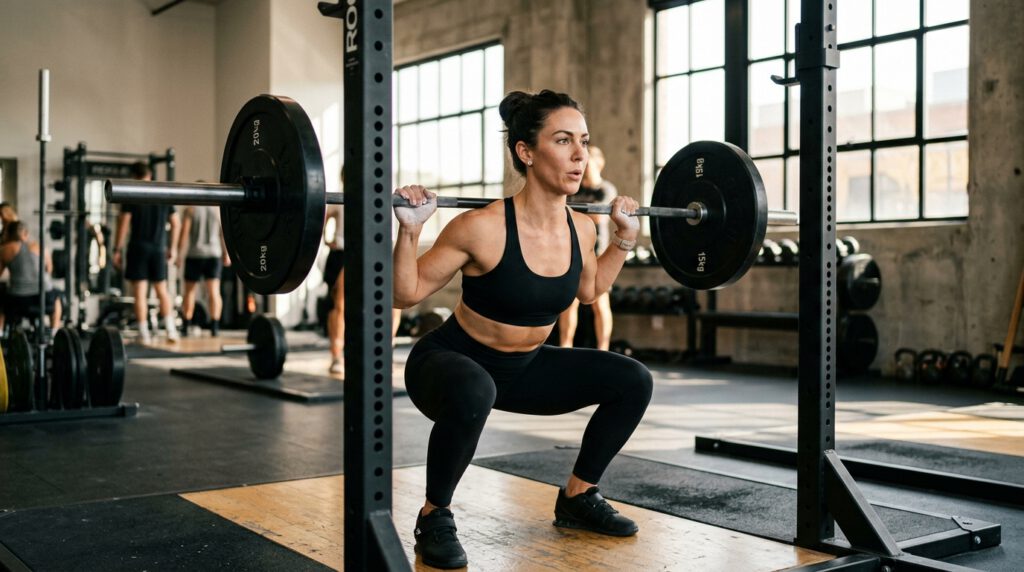
For strength or hypertrophy work, aim for an RPE of 7–9 on your top sets — hard enough to drive progress without grinding to failure every session. Accessory or back-off sets usually sit around 6–7, building volume without unnecessary fatigue.
The key is rating your last working set consistently, rather than every set in a workout. Over time, this builds a feedback loop: if a weight that used to feel like an RPE 8 now feels like a 6, that’s a clear sign of progress. A useful way many coaches apply this in practice is by prescribing both a percentage and a target RPE — for example, “lift 83% of your max, but it should feel like an RPE 8.” If the weight feels too easy or too hard relative to that target, you adjust the load in real time instead of forcing a number that doesn’t match how you feel that day.
Using RPE in Cardio: The Talk Test
For running, cycling, or any endurance work, the Talk Test is the easiest way to gauge RPE without a heart rate monitor:
- RPE 0–1: Little to no effort — you can talk freely, breathing through your nose.
- RPE 3–4: Active recovery to a comfortable “cruising” pace — full conversations, no problem.
- RPE 5–6: Aerobic tempo pace — you can still talk, but in shorter sentences.
- RPE 7–8: Lactate threshold territory — only short phrases between labored breaths.
- RPE 9–10: Time trial or all-out sprint effort — a word here, a grunt there.
Interestingly, on the 0–10 scale, the number you choose multiplied by 10 tends to correlate closely with the percentage of VO2 max you’re maintaining at that moment — which is part of why RPE holds up surprisingly well even without any tech strapped to your wrist.
Why RPE Helps You Train Smarter
Percentages assume your body performs identically every day — but sleep, stress, and fatigue all shift how heavy a weight or how fast a pace actually feels. RPE lets your training adapt in real time: push harder when you’re fresh, ease off when you’re not, all while still hitting the intended training stimulus.
This is also why RPE tends to be a better early-warning system for fatigue than heart rate monitors or power meters alone. Your central nervous system and muscles respond not just to the load itself, but to your cumulative stress — poor sleep, emotional strain, and prior training sessions all factor in. So when your numbers and your RPE stop matching up — say, your heart rate is unusually low but the effort feels sky-high, or your power output is high while your legs feel like they’re moving through wet cement — that mismatch is valuable information your gear alone can’t give you. In those moments, it’s often smarter to trust how you feel over what the display says.
RPE is also a two-way communication tool. As a coach, prescribing a target RPE (rather than just a rigid number) lets an athlete self-regulate. As an athlete, reporting an honest RPE after a session gives your coach a clearer picture than the raw numbers alone, especially in remote coaching relationships where they can’t watch the set happen live.
RPE vs. Percentages: Which Should You Use?
Neither wins outright. Percentage-based training gives structure and long-term measurability — it’s easy to plan progressive overload when everything is tied to a known number. But percentages assume consistent performance, which isn’t realistic across weeks of real life. RPE fills that gap with flexibility: what’s programmed as 70% of your max might feel like a smooth RPE 7 one day and a grinding RPE 9 the next, depending on recovery.
The most effective programs use both. Percentages set the framework for volume and progression; RPE fine-tunes the actual load, session by session, based on real-time feedback. That hybrid approach keeps training structured without ignoring how your body actually shows up that day.
Common Mistakes When Using RPE
RPE is simple in theory, but a few habits can quietly undermine it:
- Being dishonest with your rating. Inflating your RPE to make a session look tougher — or downplaying it to seem stronger — breaks the feedback loop that makes RPE useful in the first place.
- Ignoring long-term trends. RPE isn’t just about one workout; it’s about the pattern over weeks. If the same weight keeps feeling harder than it used to, that’s a signal worth investigating, not ignoring.
- Misjudging intensity as a beginner. New lifters often haven’t yet experienced true near-failure, so almost anything challenging can feel like a 10. This calibration improves with experience and good coaching feedback.
- Only trusting RPE on bad days. Report it consistently — on your best sessions and your worst — so you build an accurate, honest picture of how your perceived effort correlates with real performance over time.
Key Takeaways
- RPE is a 1–10 scale measuring perceived effort, closely linked to Reps in Reserve (RIR).
- Aim for RPE 7–9 on strength work, and use the Talk Test for cardio.
- RPE auto-regulates training around real-life factors like sleep, stress, and fatigue.
- It works best paired with percentages, not as a replacement for them.
- Track it consistently and honestly — that’s what makes the feedback loop actually useful.
Train by feel as well as by the numbers, and you’ll build not just strength, but the kind of self-awareness that keeps you progressing for the long run.
Related Posts

Stay Informed With the Latest & Most Important News
Previous Post
Next Post










Advertisement