















Now Reading: Ashwagandha for Fitness: Does It Actually Boost Strength and Reduce Cortisol?
-
01
Ashwagandha for Fitness: Does It Actually Boost Strength and Reduce Cortisol?


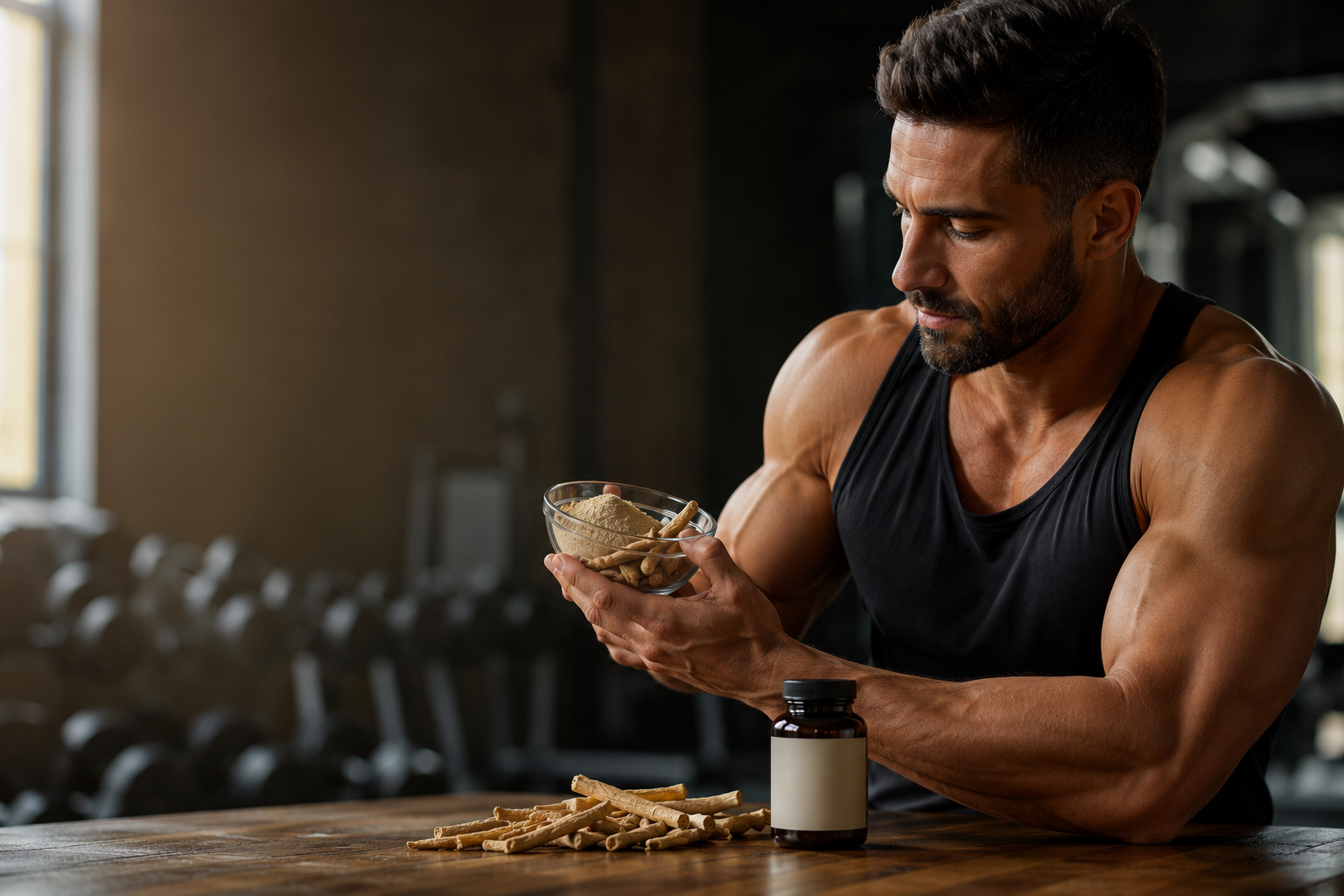
If you spend any time in gym culture right now, you’ve probably heard someone credit their PR to ashwagandha.
It’s become one of the most talked-about supplements in strength and recovery circles — right up there with creatine and magnesium.
But unlike a lot of trending supplements, ashwagandha actually has a growing body of clinical research behind it.
So is it hype, or does this ancient Ayurvedic herb genuinely help you lift heavier and stress less? Here’s what the science says.
Table of contents
What Is Ashwagandha, Exactly?
Ashwagandha (Withania somnifera) is a small shrub native to India and parts of Southeast Asia, and it’s been a staple of Ayurvedic medicine for centuries.
It’s classified as an adaptogen — a category of plant compounds believed to help the body regulate its response to physical and mental stress.
Most modern research uses standardized root extracts, with KSM-66 and Sensoril being the two most studied and commercially available forms.
Root-only extracts are generally considered the gold standard, since the leaf of the plant contains higher concentrations of compounds linked to potential liver strain at high doses.
Does Ashwagandha Actually Lower Cortisol?
Short answer: for many people, yes — though the effect is more nuanced than “ashwagandha crushes your cortisol.”
Cortisol is your body’s primary stress hormone, released via the hypothalamic-pituitary-adrenal (HPA) axis.
It’s not inherently bad — you need some cortisol response to adapt to training — but chronically elevated cortisol from overtraining, poor sleep, or life stress can interfere with recovery, sleep quality, and muscle repair.
Here’s what the research shows:
- A widely cited 2012 randomized controlled trial found that participants taking 300 mg of ashwagandha root extract twice daily for 60 days saw significantly greater reductions in serum cortisol compared to a placebo group.
- A 2019 double-blind study reported meaningful drops in perceived stress and cortisol levels in healthy adults taking daily doses between 250–600 mg over eight weeks.
- A 2026 randomized, placebo-controlled trial in semi-professional rugby, football, and water polo athletes found something interesting: instead of dramatically lowering cortisol, 600 mg/day of KSM-66 ashwagandha for 42 days helped stabilize cortisol and cortisone during intense pre-season training — while the placebo group’s stress hormones climbed significantly. The effect was most pronounced in female athletes for cortisol and male athletes for cortisone.
The takeaway: ashwagandha may not necessarily crush your cortisol to rock-bottom levels, but it appears to help prevent the training-related spikes that come with heavy pre-season or high-volume blocks — which is arguably more useful for an athlete than blanket suppression.
Does Ashwagandha Boost Strength and Performance?
This is where things get more interesting for lifters specifically.
The STAR Trial (2018) — one of the most frequently cited studies in this space — had resistance-trained men take 600 mg/day of ashwagandha root extract for eight weeks. Compared to placebo, the ashwagandha group saw significantly greater increases in:
- Bench press and leg extension 1-rep max strength
- Muscle size (arm and chest circumference)
- Recovery markers, including lower exercise-induced muscle damage
A 2021 systematic review and meta-analysis pooling 12 studies (doses ranging from 120–1,250 mg/day) concluded that ashwagandha supplementation was associated with improvements in physical performance, including strength output and oxygen utilization during exercise.
VO2 max improvements have also shown up across multiple trials, suggesting benefits that extend beyond pure strength into aerobic capacity — relevant for anyone doing conditioning work alongside lifting.
The 2026 team-sport athlete trial mentioned above found a significant improvement in countermovement jump (CMJ) height — a standard marker of lower-body power and neuromuscular readiness — in the male ashwagandha group after 42 days, something the placebo group didn’t show. Female athletes in that same study reported significantly better subjective recovery scores (less fatigue, less muscle soreness) versus placebo, even though their strength numbers didn’t shift as dramatically.
In other words: the performance benefits seem to show up differently depending on the metric and, in some cases, the sex of the athlete — but the overall direction across studies leans positive.
How Does It Actually Work?
The proposed mechanism centers on ashwagandha’s effect on the HPA axis — the communication loop between your brain and adrenal glands that governs the stress response.
By helping modulate this pathway, ashwagandha may:
- Reduce the perception of physical and psychological stress from intense training
- Support more consistent sleep quality, which indirectly supports hormonal recovery
- Help preserve a more stable catabolic/anabolic balance during periods of high training load, rather than blunting the stress response athletes actually need to adapt
It’s worth noting: some inflammation and cortisol response after training is necessary for adaptation. The current evidence suggests ashwagandha helps keep that response from running away with your recovery, rather than shutting it off entirely.
How Much Should You Take?
Most of the clinical research supporting strength and cortisol benefits uses:
- 300–600 mg per day of a standardized root extract (KSM-66 or Sensoril)
- Taken consistently for 8–12 weeks to see meaningful effects
- Often split into one or two daily doses, though single daily dosing has also shown benefits
Effects generally aren’t immediate — most studies show results building over several weeks, not days.
Safety Considerations
Ashwagandha is generally well tolerated in healthy adults over short-to-medium term use (up to about 12 months in some safety trials), but it’s not for everyone. You should talk to a doctor before use if you:
- Are pregnant or breastfeeding
- Have a thyroid condition or autoimmune disorder
- Have liver problems
- Take medications like benzodiazepines, thyroid medication, immunosuppressants, or sedatives (ashwagandha may affect how your liver metabolizes certain drugs)
- Are scheduled for surgery
Reported side effects are typically mild — drowsiness, digestive upset, or headache — but choosing a reputable, third-party-tested, root-only extract matters, since leaf extracts and poorly manufactured products have been linked to rare cases of liver injury.
Best Ashwagandha Supplements for Fitness (KSM-66 Root Extract)
If you want to try ashwagandha for training support, look for a root-only extract standardized to KSM-66, ideally third-party tested and dosed at 600 mg. These are consistently well-reviewed options built specifically around that clinically studied dose:
- Transparent Labs KSM-66 Ashwagandha — A go-to in the sports nutrition space, delivering the full 600 mg clinical dose per serving with third-party purity testing and no filler ingredients.
- Nutricost KSM-66 Ashwagandha — A budget-friendly option that still hits the 600 mg KSM-66 dose, paired with black pepper extract (BioPerine) for better absorption.
- Physician’s CHOICE KSM-66 Ashwagandha — Marketed specifically toward athletic and stress-recovery use, with a higher 1,000 mg dose per serving plus black pepper extract for absorption.
- DailyNutra KSM-66 Ashwagandha — A clean-label, U.S.-made option at the clinically studied 600 mg dose.
As an Amazon Associate, [Your Site Name] earns from qualifying purchases.
Frequently Asked Questions
Does ashwagandha really increase testosterone?
Some studies show modest testosterone increases, mostly in men with low baseline levels or existing fatigue. In healthier or athletic populations, testosterone changes have been less consistent, so it shouldn’t be viewed as a testosterone-boosting supplement first and foremost.
How long does it take to see results?
Most positive strength and cortisol findings come from studies running 8–12 weeks of daily use. Don’t expect same-day or same-week effects.
Can I take ashwagandha with creatine or protein powder?
Yes — there’s no known interaction, and many lifters stack it alongside standard training supplements.
Is ashwagandha safe for long-term use?
Emerging safety data supports use up to 12 months in healthy adults, though most clinical trials only run 8–12 weeks. Cycling off periodically and choosing a reputable, root-only, third-party-tested product is a reasonable approach.
The Bottom Line
Ashwagandha isn’t a magic strength pill, but it’s one of the few “trendy” supplements with genuine clinical support behind it. The research consistently points to two real benefits for people who train hard: better regulation of training-related stress hormones, and modest but measurable gains in strength, power, and recovery — particularly when paired with a structured resistance program and taken consistently over 8+ weeks.
If you’re dealing with high training stress, inconsistent sleep, or feel like your recovery is lagging behind your training volume, a standardized 600 mg/day KSM-66 extract is a reasonable, well-researched addition to consider — just loop in a healthcare provider first if you’re on medication or managing a health condition.
Related Posts
Stay Informed With the Latest & Most Important News
Previous Post
Next Post









Advertisement