











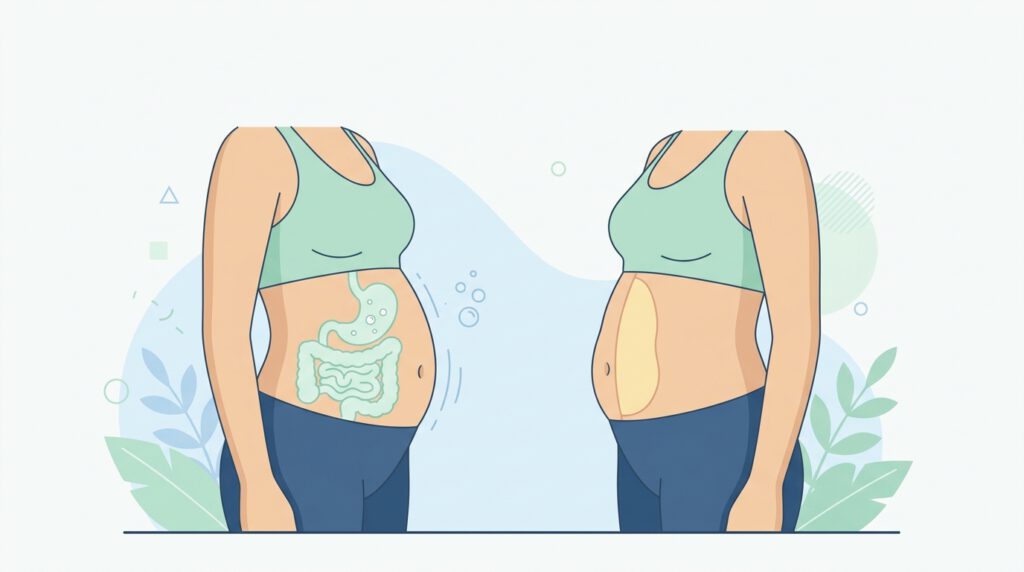













Now Reading: Cortisol Belly Fat: Is It Real or Just a Wellness Myth?
-
01
Cortisol Belly Fat: Is It Real or Just a Wellness Myth?


Scroll through wellness content for more than five minutes and you’ll probably run into a version of this claim: “You don’t have a belly fat problem. You have a cortisol problem.”
The videos come with before-and-after photos, 30-day “cortisol reset” plans, and promises that cutting caffeine or trying a cold plunge will melt stubborn belly fat and even slim down a puffy face.
So is “cortisol belly” real, or is it just repackaged diet culture with a hormonal spin? The honest answer sits in the middle. Cortisol genuinely does influence where your body stores fat — but the dramatic, fast, spot-reducible version sold online isn’t how human physiology actually works.
Table of contents
- What Is “Cortisol Belly,” Exactly?
- What Cortisol Actually Does in Your Body
- The Real Science Behind Stress and the Midsection
- What the Actual Research Shows
- Myth vs. Reality: A Quick Reference
- Cortisol Belly vs. Cushing’s Syndrome: Know the Difference
- What Else Actually Shapes Belly Fat (Besides Cortisol)
- Why “Cortisol Belly” Went Viral in the First Place
- A Related Myth Worth Debunking: “Adrenal Fatigue”
- When to Actually Get Your Cortisol Tested
- What Actually Helps: Evidence-Based Steps
- The Bottom Line
- FAQ
What Is “Cortisol Belly,” Exactly?
“Cortisol belly” (also called “hormonal belly” or “stress belly”) is not a medical diagnosis.
You won’t find it in a textbook or hear a doctor use it as a formal term. It’s internet shorthand for abdominal weight gain that gets attributed to chronically high cortisol, the hormone your adrenal glands release in response to stress.
As Sonia Gibson, MD, a board-certified endocrinologist, has noted, this isn’t an official clinical label — but the underlying pattern it describes, fat accumulating around the midsection during periods of chronic cortisol excess, does have a real physiological basis. The issue isn’t that cortisol is irrelevant to belly fat.
The issue is that social media treats it as the only explanation, when in reality it’s one contributor among many.
What Cortisol Actually Does in Your Body
Before blaming cortisol for anything, it helps to remember that you need it. Produced by the adrenal glands, cortisol is central to your fight-or-flight response and to basic day-to-day function:
- Energy regulation – it stimulates the liver to release glucose so you have fuel available when needed
- Blood pressure control – it helps keep cardiovascular function stable
- Immune regulation – it keeps inflammation in check
- Sleep-wake cycle – cortisol naturally peaks shortly after waking and gradually drops through the day, dipping lowest at night
Short-term cortisol spikes — the kind you get from a near-miss in traffic or a tight work deadline — are adaptive and harmless. The trouble starts when stress doesn’t resolve, and cortisol stays elevated for months or years instead of spiking and returning to baseline.
The Real Science Behind Stress and the Midsection
Here’s where the wellness-trend version of this story and the actual research start to diverge — the mechanism is real, but it’s more indirect and more complicated than “stress equals belly fat.”
1. Abdominal fat cells are more cortisol-sensitive
Visceral fat — the deep fat that surrounds your organs, as opposed to the pinchable subcutaneous fat under your skin — has a higher density of glucocorticoid (cortisol) receptors than fat elsewhere in the body. That makes the abdominal region uniquely responsive to cortisol signaling compared to, say, your arms or thighs.
2. Cortisol can trigger the creation of new fat cells, not just bigger ones
In adulthood, your total number of fat cells stays relatively stable; when you gain weight, it’s mostly through existing cells expanding (hypertrophy), not new cells forming (hyperplasia). Cortisol is one of the few signals that can override that and activate hyperplasia. Laboratory research going back to Hauner and colleagues (1987) found that cortisol, especially alongside insulin, can dramatically accelerate the maturation of pre-adipocytes — dormant precursor cells — into fully functioning fat cells. Later work by Peckett and colleagues (2011) confirmed that glucocorticoids’ dominant long-term effect is promoting this new fat-cell formation, particularly in visceral tissue, while Lee and Fried (2014) documented the higher receptor density in visceral fat that makes this depot especially reactive.
3. Insulin resistance and blood sugar swings
Chronic cortisol elevation pushes the liver to keep producing glucose (a process called gluconeogenesis) and encourages the body to become more insulin resistant. Cells stop responding to insulin as efficiently, so insulin levels climb — and high insulin alongside high cortisol is a strong combination for driving fat storage, specifically in the visceral depot.
4. Appetite, cravings, and the reward system
Insulin resistance makes it harder for cells to access glucose for energy, which drives hunger and cravings — particularly for quick, high-calorie “comfort foods.” Cortisol also interacts directly with the brain’s reward circuitry, reinforcing stress-eating patterns.
5. Sleep disruption
Because cortisol is supposed to taper off at night, dysregulation can keep it elevated when it should be falling, making it harder to fall or stay asleep. Poor sleep, in turn, worsens insulin resistance the next day — a feedback loop that compounds over time.
What the Actual Research Shows
This isn’t a brand-new idea invented by TikTok. Researchers have studied stress-related abdominal fat for decades:
- A landmark 2000 Yale study (Epel et al., published in Psychosomatic Medicine) found that lean, pre-menopausal women who carried more fat around the abdomen showed a stronger cortisol response to repeated lab stressors than lean women who stored fat elsewhere on their bodies — suggesting cortisol reactivity, not just cortisol level, matters for where fat lands.
- A larger 2021 study of roughly 1,800 adults found that higher chronic stress was associated with both visceral and subcutaneous fat, adding population-level support to the stress–belly fat link outside of clinical hypercortisolism.
That said, researchers are also clear about the limits: an acute stress response — the kind you get from a single stressful event — doesn’t appear to directly cause weight gain.
It’s prolonged cortisol exposure that matters, and even then it works through the indirect pathways above (appetite, sleep, insulin) rather than a direct “cortisol equals fat” switch.
Importantly, most people with abdominal fat have completely normal cortisol levels. For them, weight distribution has more to do with genetics, diet, activity level, and other metabolic factors than with stress hormones specifically.
Myth vs. Reality: A Quick Reference
| The Claim | What the Evidence Actually Shows |
|---|---|
| Stress alone causes belly fat | Chronic stress raises cortisol, but fat gain typically happens through indirect effects — more insulin, more appetite, worse sleep. Without a calorie/insulin surplus, stress alone generally doesn’t create fat. |
| Cortisol specifically targets the belly | Abdominal fat does have more cortisol receptors, but genetics, sex hormones, age, and overall body fat play a bigger role in fat distribution overall. |
| “Cortisol belly” is a medical diagnosis | It’s social media slang. The closest real diagnosis is Cushing syndrome, which involves cortisol levels far beyond what everyday stress produces. |
| Visible belly fat means high cortisol | Most people with abdominal fat have normal cortisol. You can’t diagnose hormone levels by looking in a mirror. |
| You can spot-reduce “cortisol belly” with core workouts | Fat loss happens across the whole body; where it comes off first is determined by genetics, not which muscle group you train. |
| Supplements or detox teas can “melt” cortisol belly | Cortisol-targeted supplements generally lack strong clinical evidence. Sleep, stress management, diet, and exercise have far more support. |
Cortisol Belly vs. Cushing’s Syndrome: Know the Difference
There is one condition where cortisol dramatically and visibly reshapes the body: Cushing’s syndrome, caused by prolonged, excessive cortisol exposure — sometimes from long-term steroid medication, sometimes from a pituitary or adrenal tumor (Cushing disease). It’s rare, affecting roughly 10–15 people per million each year, but its symptoms are distinct and go well beyond a bit of extra belly fat:
- Weight gain concentrated in the belly, upper back (“buffalo hump”), and face (“moon face”)
- High blood pressure and high blood sugar
- Muscle weakness and loss
- Thin, fragile, easily-bruised skin
- Purple-red stretch marks
- Osteoporosis
- Mood changes, depression, or brain fog
- Excess facial hair in women
If you notice several of these together — not just stubborn belly fat — that’s a reason to see a doctor, not a wellness influencer.
What Else Actually Shapes Belly Fat (Besides Cortisol)
Belly fat shifts for plenty of reasons that have nothing to do with your stress levels:
- Aging – natural muscle loss and fat redistribution over time
- Menopause – the hormonal transition shifts fat storage toward the waist and away from the hips and thighs
- PCOS (polycystic ovary syndrome) – linked to insulin resistance, which independently drives abdominal fat
- Prediabetes and type 2 diabetes – both rooted in insulin resistance
- Genetics – a major determinant of where your body tends to store fat in the first place
This is worth repeating: cortisol is one input among many, not a standalone explanation for a changing midsection.
Why “Cortisol Belly” Went Viral in the First Place
It’s worth asking why this particular framing caught on so widely. Wellness content built around “cortisol belly” and “cortisol face” tends to repackage familiar beauty ideals — a flat stomach, a sculpted jawline — as hormone optimization rather than dieting. That reframing can feel more forgiving (“it’s not about willpower, it’s your hormones”), but it also risks reducing a complex physiological process to a purely cosmetic problem, and nudging people toward unproven supplements, extreme protocols, or unnecessary hormone testing.
Managing stress is genuinely good for you — for your immune system, sleep, mood, and cardiovascular health. It’s just not a guaranteed shortcut to a flatter stomach in 30 days.
A Related Myth Worth Debunking: “Adrenal Fatigue”
You may also see “cortisol belly” content reference adrenal fatigue — the idea that chronic stress “wears out” your adrenal glands, leaving them unable to produce enough cortisol.
This is not a recognized diagnosis in mainstream endocrinology.
Chronic stress absolutely affects wellbeing, but labeling vague symptoms as “adrenal fatigue” can delay diagnosis of real underlying issues — thyroid disorders, sleep apnea, depression, or genuine adrenal disease — and lead people toward unproven supplement protocols instead of proper care.
When to Actually Get Your Cortisol Tested
Most people with stress-related weight gain do not need a cortisol test. Cortisol naturally fluctuates throughout the day in response to everyday stressors, and testing is generally reserved for suspected clinical conditions. Consider asking a doctor about testing if, alongside abdominal weight gain, you notice:
Signs of excess cortisol (possible Cushing’s):
- Rapid, unexplained weight gain, especially in the face or upper back
- Easy bruising, thinning skin, purple stretch marks
- Muscle weakness
- High blood pressure or blood sugar
- Irregular periods or erectile dysfunction
- Unusual fatigue or mood swings
Signs of low cortisol (possible adrenal insufficiency):
- Extreme fatigue
- Unexplained weight loss (not gain)
- Dizziness on standing
- Skin darkening
- Salt cravings
If belly fat is your only concern and none of the above apply, lifestyle changes are the appropriate first step — not a lab panel.
What Actually Helps: Evidence-Based Steps
None of this is a “flush the cortisol out” quick fix — there isn’t one. But these habits are genuinely supported by research for both lowering chronic cortisol elevation and improving body composition over time:
- Prioritize sleep. Aim for 7–9 hours consistently. Poor sleep raises cortisol and ghrelin (hunger hormone) while lowering leptin (satiety hormone).
- Build in real stress management. Walking outdoors, breathwork, meditation, or therapy all activate the parasympathetic nervous system and measurably lower cortisol — not as a spot-reduction hack, but as a foundation.
- Eat balanced, regular meals. Skipping meals destabilizes blood sugar and intensifies cravings; a modest, sustainable calorie deficit (roughly 300–500 calories/day if fat loss is a goal) is more effective than restriction.
- Move consistently, without overtraining. Around 150 minutes of moderate cardio plus two strength-training sessions a week supports healthier body composition — strength training in particular helps offset cortisol-driven muscle breakdown.
- Watch caffeine and alcohol, both of which can independently affect cortisol rhythm and sleep quality.
The Bottom Line
“Cortisol belly” isn’t pure fiction, but it isn’t the tidy, fast-fix story sold online either.
Chronic stress can raise cortisol, and elevated cortisol can contribute to visceral fat — through insulin resistance, cravings, disrupted sleep, and even the creation of new fat cells in the abdomen.
But it does this indirectly, alongside genetics, age, diet, activity level, and — for a small number of people — a genuine medical condition like Cushing’s syndrome.
If you’re dealing with stubborn belly fat, the most useful question probably isn’t “how do I lower my cortisol.”
It’s “how’s my sleep, my stress load, my diet, and my activity level, together.” Improve those, and you’re addressing cortisol’s role in the process anyway — without needing a supplement, a detox tea, or a diagnosis you probably don’t have.
FAQ
Is “cortisol belly” a real medical condition?
No. It’s a non-medical, social-media term for abdominal fat attributed to stress. The closest real diagnosis is Cushing’s syndrome, which involves cortisol levels far beyond what everyday stress produces.
Can you tell if belly fat is caused by cortisol just by looking at it?
No. Visceral fat isn’t visually distinguishable from other abdominal fat, and most people with belly fat have completely normal cortisol levels. The only way to know is through medical evaluation.
Can you flush cortisol out of your body?
No — cortisol is a necessary, ongoing hormone, not a toxin to eliminate. If levels are genuinely dysregulated, that’s addressed medically, not “flushed.”
Can specific exercises spot-reduce cortisol belly fat?
No. Fat loss occurs across the whole body based on genetics, not the muscle group you’re training. Core exercises build core strength but won’t preferentially burn abdominal fat.
Do cortisol-lowering supplements actually work for belly fat?
Most marketed supplements lack strong clinical evidence for meaningful fat loss. Sleep, stress management, diet, and exercise have far more research support.
Related Posts

Stay Informed With the Latest & Most Important News
Previous Post
Next Post










Advertisement