

















Now Reading: Micro-Workouts: How 10 Minutes a Day Can Replace a 1-Hour Gym Session
-
01
Micro-Workouts: How 10 Minutes a Day Can Replace a 1-Hour Gym Session


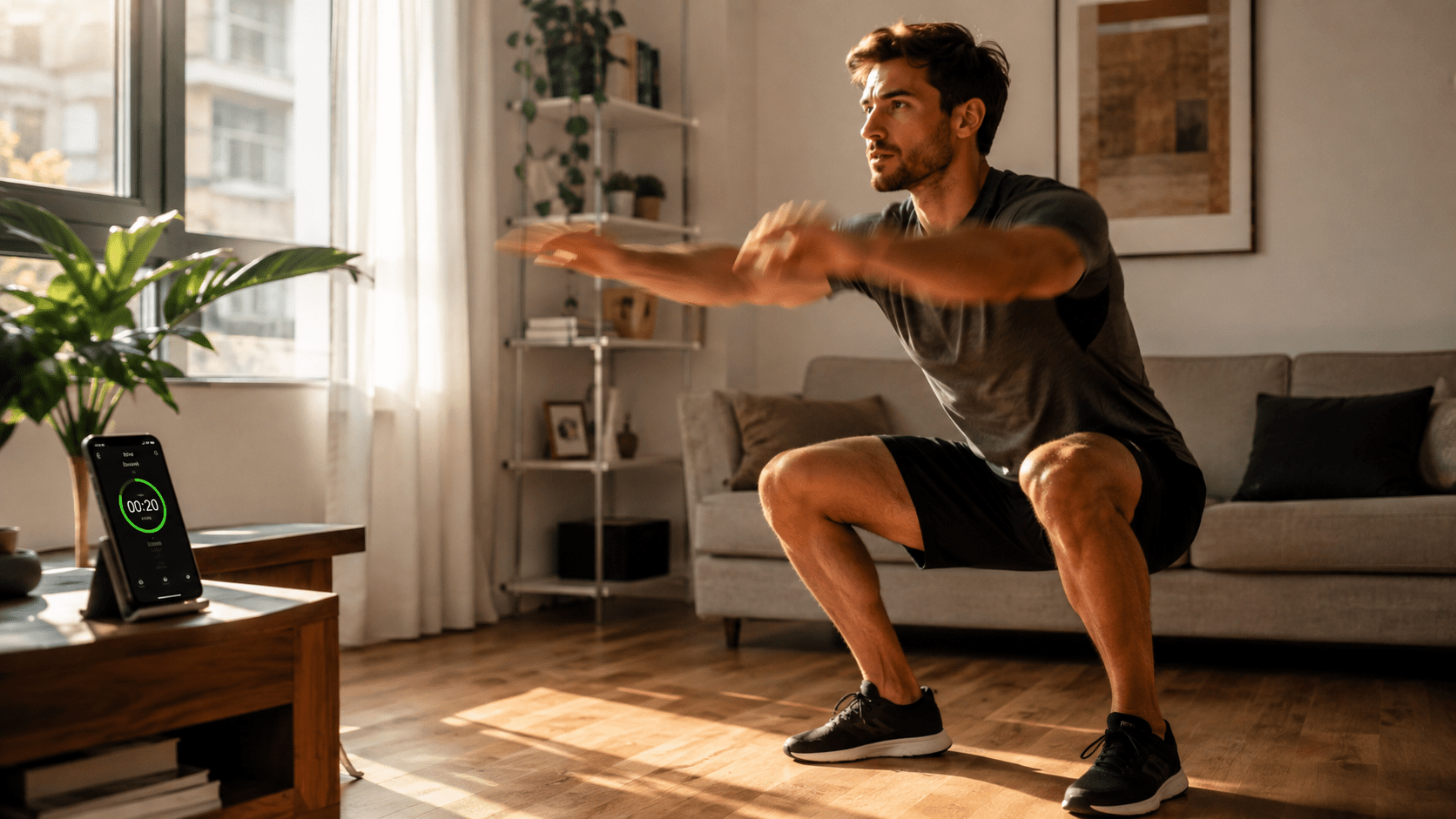
You don’t need a free hour, a gym membership, or a change of clothes to get real, measurable fitness results.
That claim used to sound like marketing. Now it’s backed by more than a decade of exercise science — including a 2022 study of 25,000 adults that found bursts of activity lasting as little as one minute were linked to a sharp drop in mortality risk.
This is the idea behind micro-workouts: short, high-intensity bursts of exercise — typically 1 to 10 minutes — spread across the day instead of packed into one long gym session.
And for the millions of people who’ve written off exercise because “I don’t have time,” the research suggests the time was never really the problem. The 60-minute workout was.
Here’s what the science actually says, how micro-workouts stack up against a traditional gym session, and exactly how to build a 10-minute habit that sticks.
Table of contents
- What Are Micro-Workouts?
- The Research Behind Micro-Workouts
- Micro-Workouts vs. the Traditional Gym Session: The Honest Math
- What Makes a Micro-Workout Actually Effective
- A Sample 10-Minute Full-Body Micro-Workout
- Building the 10-Minute Habit (Without Relying on Motivation)
- Who Benefits Most From Micro-Workouts
- Where Micro-Workouts Fall Short — Honestly
- FAQ
- The Bottom Line
What Are Micro-Workouts?
A micro-workout is a short bout of vigorous physical activity — usually somewhere between 1 and 10 minutes — performed with enough intensity to elevate your heart rate and challenge your cardiovascular system and major muscle groups at once. Researchers also use the terms exercise snacks and VILPA (vigorous intermittent lifestyle physical activity) to describe versions of this same idea.
The common thread across all of them isn’t duration. It’s intensity. A 10-minute walk is not a micro-workout in the sense researchers study — it’s light activity, which is valuable for different reasons. A 10-minute circuit of squats, push-ups, and jumping jacks that leaves you breathless is a micro-workout, because it crosses the intensity threshold where measurable cardiovascular and metabolic adaptation happens.
The Research Behind Micro-Workouts
The Guidelines Changed — and Almost Nobody Noticed
For decades, public health guidance implied that exercise only “counted” if it happened in blocks of at least 10 minutes. That requirement is gone. When the World Health Organization updated its global physical activity guidelines in 2020, it formally removed the minimum-bout-length rule, stating that moderate-to-vigorous activity of any duration now counts toward the weekly target. The U.S. Physical Activity Guidelines made the same change. This wasn’t a minor technical footnote — it reflected a genuine shift in how exercise scientists understand dose and duration.
VILPA: What a Landmark 2022 Study Found
The most striking evidence for very short bursts of activity comes from a 2022 study published in Nature Medicine, which tracked over 25,000 adults who did not exercise during their leisure time, using wrist-worn activity monitors. Researchers measured their incidental vigorous activity — things like sprinting for a bus, carrying groceries up a hill, or climbing stairs quickly — and followed the group for nearly seven years.
The results: people who accumulated just three to four bursts of vigorous activity a day, each lasting only one to two minutes, showed roughly a 38–40% lower risk of all-cause and cancer mortality, and close to a 48–49% lower risk of cardiovascular disease mortality, compared with people who did none. Even the sample’s median amount — about 4.4 minutes of vigorous activity spread across the day — was linked to meaningfully lower mortality risk. None of this activity was structured “exercise.” It was daily movement performed with enough effort to count.
The Afterburn Effect: Why 10 Minutes Keeps Working After You Stop
Part of why short, intense sessions punch above their weight comes down to EPOC — excess post-exercise oxygen consumption, often called the afterburn effect. After a high-intensity bout, your body needs extra oxygen to restore itself: replenishing energy stores, clearing metabolic byproducts, and bringing your heart rate and temperature back to baseline. That recovery process elevates your calorie burn for a period afterward — sometimes just 30 minutes, sometimes several hours, depending on effort.
Research comparing high-intensity interval exercise to steady, moderate-intensity exercise has repeatedly found that HIIT-style sessions produce a larger EPOC response, even when the calories burned during the workout are similar. In practical terms, a demanding 10-minute session doesn’t stop working the moment you do.
Exercise Snacks: What the Clinical Trials Show
Researchers at the University of British Columbia have run some of the most direct tests of this idea. In a widely cited 2019 study, sedentary adults performed three separate one-minute bouts of vigorous stair climbing before meals, spread across the day, for six weeks. Total daily exercise time: under six minutes. The result was a measurable improvement in cardiorespiratory fitness (VO2 max), while a no-exercise control group showed no change.
Since then, the evidence base has grown substantially. A 2024 randomized controlled trial published in Applied Physiology, Nutrition, and Metabolism found that stair-climbing exercise snacks improved cardiorespiratory fitness about as effectively as longer, continuous moderate-intensity training. A 2025 systematic review pooling 11 clinical trials — conducted across Australia, Canada, China, and the UK — concluded that exercise snacking produced consistent, moderate-certainty improvements in cardiorespiratory fitness among inactive adults. A separate 2024 workplace study comparing short stair-climbing snacks to a traditional HIIT session found participants rated the snack-style approach as more enjoyable and less strenuous-feeling, despite similar physiological demand — a detail that matters enormously for long-term adherence.
The short answer: yes, micro-workouts work. Multiple peer-reviewed trials, from single-session lab studies to multi-week randomized controlled trials, show that a few minutes of vigorous activity performed consistently produces real improvements in cardiovascular fitness, blood sugar regulation, and blood pressure.
Micro-Workouts vs. the Traditional Gym Session: The Honest Math
Ask someone why they don’t work out and they’ll usually say “no time.” Ask them how long a gym session takes, and they’ll say “an hour.” Those two answers don’t actually agree with each other — because a “one-hour” gym session rarely takes one hour.
Factor in the commute there, changing clothes, the workout itself, showering, and the commute back, and a single gym visit typically consumes somewhere between 1.5 and 2.5 hours of your day. For anyone working a full-time job, that window doesn’t reliably exist — which is a large part of why gym attendance data looks the way it does. Industry membership data has repeatedly shown that a majority of people who sign up for a gym membership use it fewer than twice a week within a few months, and that a large share of January sign-ups have already stopped attending by February.
Here’s how the two approaches compare when you account for real-world consistency, not just the workout itself:
| Approach | Typical Time Cost | Realistic Weekly Frequency | 90-Day Adherence |
|---|---|---|---|
| Traditional gym session | 1.5–2.5 hrs (incl. commute, changing, showering) | 1–2x/week (actual average, despite 3x intentions) | Low — a large share of members stop attending regularly within 3 months |
| Micro-workout (10 min, home/office) | 10 minutes, zero setup | 5–7x/week | Substantially higher — no commute or scheduling barrier to overcome |
| Brisk 30-minute walk | 30 minutes | 3–4x/week | Moderate |
The point isn’t that the gym is ineffective — a well-programmed gym routine, especially one built around progressive resistance training, still offers things a 10-minute bodyweight circuit can’t fully replicate (more on that below).
The point is that a workout you actually do, five days a week, tends to outperform a “better” workout you do once every two weeks. A well-known analysis in Preventive Medicine, following over 64,000 adults for a decade, found that the strongest predictor of long-term health outcomes wasn’t workout intensity or session length — it was frequency.
What Makes a Micro-Workout Actually Effective
Not every 10-minute activity qualifies. A relaxed 10-minute walk and a 10-minute circuit of jump squats, push-ups, and mountain climbers produce very different physiological responses, even though both take exactly 10 minutes.
Hit the Intensity Threshold
Exercise scientists generally define vigorous intensity as activity that pushes your heart rate above roughly 70% of its maximum and makes holding a full conversation difficult. Below that threshold, short movement is still good for you — it reduces sedentary time and supports general health — but it’s unlikely to drive meaningful changes in cardiovascular fitness or body composition on its own.
A simple way to check yourself mid-workout: the talk test. If you can speak in full, comfortable sentences, you’re not working hard enough for a micro-workout to do its job. You should be able to get a few words out between breaths — not hold a normal conversation.
Engage Multiple Muscle Groups at Once
The most efficient micro-workouts use compound, full-body movements — squats, push-ups, burpees, lunges, jumping jacks — rather than isolated exercises. The more muscle mass involved, the more oxygen your body demands, the faster your heart rate climbs, and the larger the EPOC response afterward. For people with desk jobs specifically, movements that also engage the glutes, hamstrings, and core do double duty by counteracting the effects of prolonged sitting.
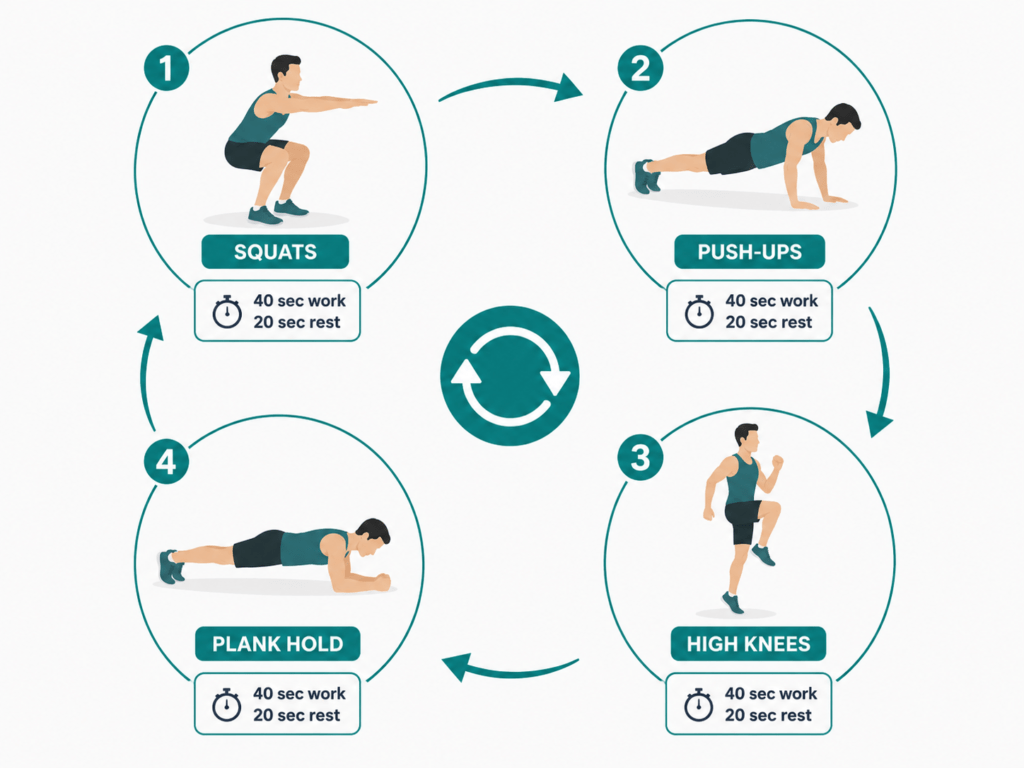
A Sample 10-Minute Full-Body Micro-Workout
No equipment needed — just floor space and comfortable clothing.
Format: Work for 40 seconds, rest for 20 seconds. Complete the circuit twice (roughly 10 minutes total).
- Bodyweight squats — sit the hips back, chest up
- Push-ups (standard, or hands-elevated on a wall/counter for beginners)
- High knees or jumping jacks — keep the pace brisk
- Plank hold — forearms down, body in a straight line
- Glute bridges — squeeze at the top of each rep
Beginner modification: Reduce the work interval to 30 seconds and extend rest to 30 seconds. Focus on completing the movement with good form rather than maximum speed — intensity will build naturally as your fitness improves.
Two More Formats to Rotate In
Lower-Body Focus (glutes, quads, hamstrings) Squats → reverse lunges (alternating legs) → wall sit → sumo squats → glute bridges. 40 seconds on, 20 seconds off, two rounds.
Core & Standing Circuit (good for a midday break — no floor time needed) Standing oblique crunches → standing bicycle twists → woodchops → standing leg raises → marching with a core brace. 45 seconds on, 15 seconds off, two rounds.
Rotating between formats across the week hits different muscle groups and helps prevent the routine from feeling stale — which matters more for long-term adherence than most people expect.
Building the 10-Minute Habit (Without Relying on Motivation)
Motivation is an unreliable foundation for any new habit — it fluctuates with stress, sleep, and mood, and it tends to be lowest exactly when you need it most. Habits work differently: they’re automatic responses triggered by a cue, not decisions you have to make fresh every day.
Habit stacking — attaching a new behavior to one you already do automatically — is one of the most consistently supported strategies in behavioral science for making a routine stick. Instead of “I’ll exercise sometime today,” the instruction becomes “after I make my morning coffee, I do my 10-minute workout.” The existing habit becomes the trigger; the new one follows without requiring a decision.
Research on habit formation (notably the work of Phillippa Lally at UCL) also indicates that consistency, not perfection, is what locks a routine into place — missing one day here or there doesn’t meaningfully derail habit formation, but skipping the trigger cue repeatedly does.
For most people, three natural “anchor points” exist in a typical day: first thing in the morning, a midday break, and the early evening before dinner. Attaching your session to the morning or midday anchor tends to work better than an evening one, since willpower and decision-making capacity naturally decline as the day goes on.
Who Benefits Most From Micro-Workouts
- Busy professionals and parents who genuinely cannot carve out 90 minutes for the gym-and-commute round trip
- Fitness beginners who find the idea of an hour-long gym session intimidating enough to avoid starting at all
- People returning after a long break from exercise — starting small reduces injury risk and rebuilds the habit before adding volume
- Frequent travelers, since micro-workouts require no equipment and no gym access
- Anyone with a sedentary desk job looking to counteract long stretches of sitting between conventional workouts
Where Micro-Workouts Fall Short — Honestly
Micro-workouts are not a full substitute for every kind of training, and the research doesn’t claim otherwise. Two areas in particular where a 10-minute bodyweight circuit has real limits:
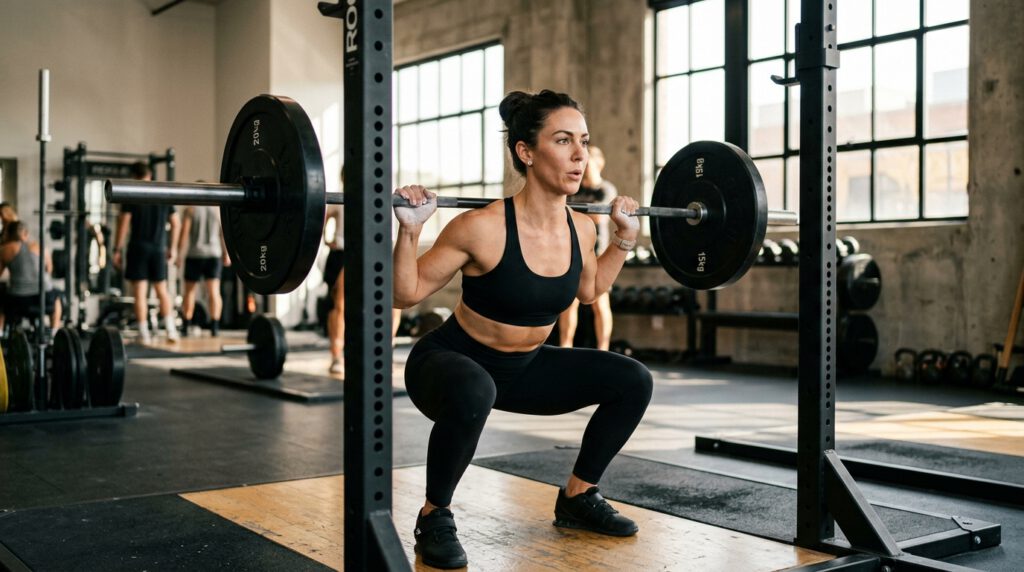
- Maximal strength and significant muscle growth. Building substantial muscle mass generally requires progressive overload — gradually increasing resistance over time — which is difficult to achieve with bodyweight movements alone once you pass a beginner-to-intermediate fitness level. A loaded barbell or dumbbell program still outperforms bodyweight circuits for this specific goal.
- Skill-based or sport-specific training. If your goal involves technical skill development — Olympic lifting form, swimming technique, structured endurance training for a race — that requires dedicated, often longer, practice sessions.
For general cardiovascular health, metabolic health, fat loss support, mood, and building a consistent movement habit, the evidence for micro-workouts is strong. For maximal strength or sport-specific performance, they’re a valuable complement to — not a full replacement for — more structured training.
FAQ
For cardiovascular and metabolic outcomes, research consistently shows that short bouts of vigorous exercise produce improvements comparable to longer, moderate-intensity sessions — provided the short bouts actually reach vigorous intensity.
For maximal strength gains and significant muscle building, longer, progressively loaded sessions still have an edge.
Most of the research showing meaningful benefit involves one to three sessions of roughly 1 to 10 minutes each. Starting with a single daily session and building consistency before adding a second tends to work better than attempting multiple sessions from day one.
A vigorous 10-minute session, combined with its afterburn (EPOC) effect, can burn a meaningful number of calories relative to the time invested. On its own it’s unlikely to produce major weight loss without attention to diet, but as part of a broader routine — and especially compared to no exercise at all — it’s a legitimate contributor.
No. Bodyweight circuits, stair climbing, and sprint intervals are all effective and require nothing beyond a small amount of space.
Yes — for someone returning from a long period of inactivity, a short, vigorous session is actually the safer and more sustainable starting point. It reduces injury risk while the body adapts, and it builds the habit before volume is added.
Whichever time you’ll actually stick to. Morning sessions tend to have the highest long-term adherence because decision fatigue hasn’t built up yet, but the physiological benefits occur regardless of when the session happens.
The Bottom Line
The old model of fitness assumed you needed a free hour and a gym membership to see results.
The research over the past several years — from the WHO’s own guideline change to large cohort studies on incidental vigorous activity — points in a different direction: intensity and consistency matter more than duration. A 10-minute session, done most days, tends to beat an hour-long session done once every few weeks.
You don’t need to overhaul your schedule to start. You need one 10-minute window tomorrow, and something you’re willing to attach it to.
Stay Informed With the Latest & Most Important News
Previous Post
Next Post










Advertisement