























Now Reading: High-Protein Snacks You Can Actually Buy at the Supermarket
-
01
High-Protein Snacks You Can Actually Buy at the Supermarket


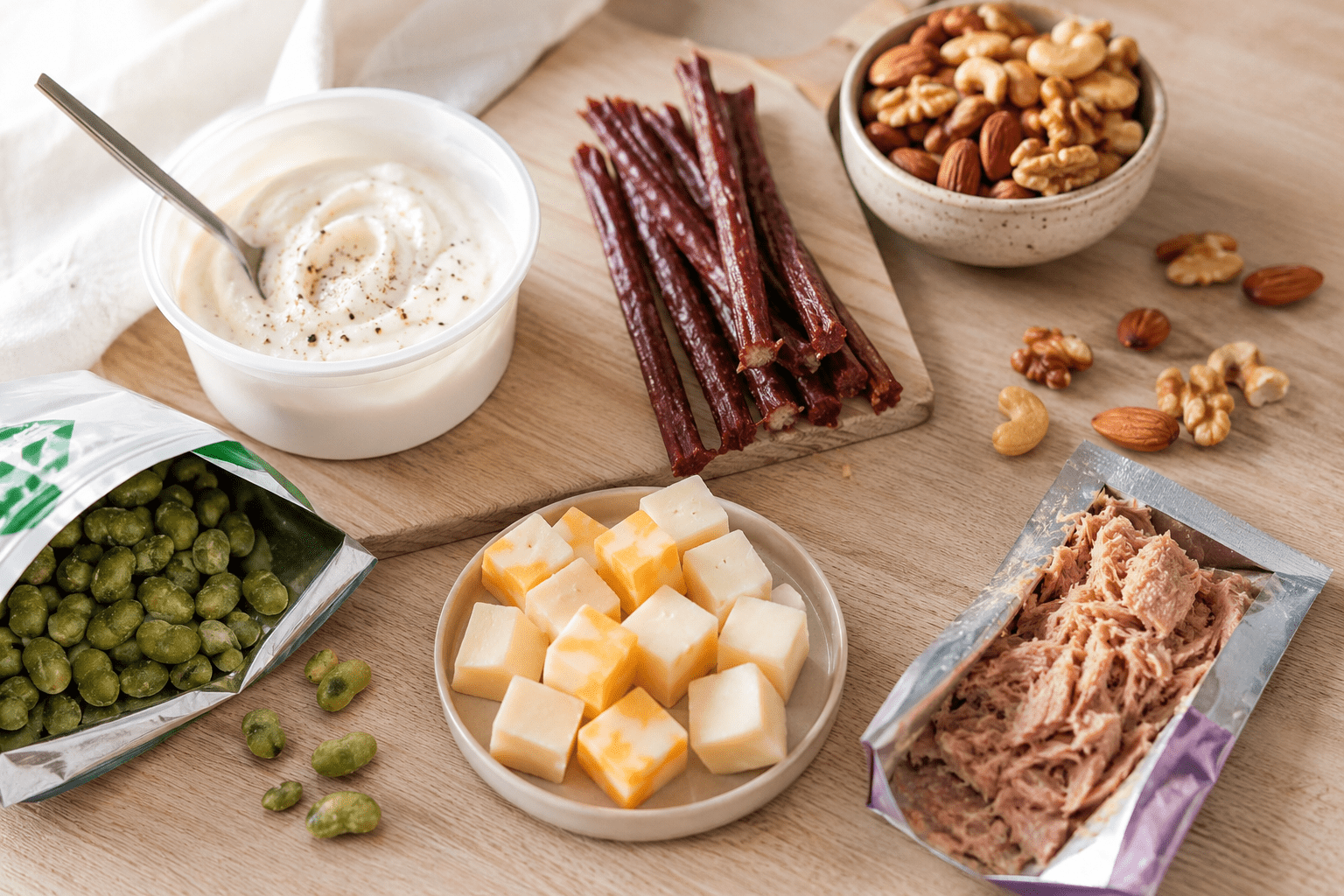
Getting enough protein used to mean packing a cooler of grilled chicken and hard-boiled eggs.
Not anymore. Walk down almost any aisle of a regular supermarket today — dairy, deli, frozen, even the checkout lane — and you’ll find snacks built around protein instead of sugar.
The catch is that not everything wearing a “high protein” label on the front of the box actually delivers on the back of it.
This guide breaks down the best high-protein snacks you can grab at a normal grocery store (no specialty health shop required), organized by aisle, plus a quick primer on how much protein you actually need and how to spot a snack that’s more marketing than muscle fuel.
Table of contents
Why Protein-Rich Snacks Are Worth Prioritizing
Protein does more heavy lifting between meals than most other nutrients.
It slows digestion, helps stabilize blood sugar, and triggers the release of hormones that signal fullness — which is why a protein-forward snack tends to hold you over far better than a bag of chips or a candy bar with the same number of calories.
There’s also a fresh reason to pay attention: the 2025–2030 Dietary Guidelines for Americans, released in January 2026, raised the recommended protein intake from the longstanding minimum of 0.8 grams per kilogram of body weight (about 0.36 g per pound) up to a range of 1.2–1.6 grams per kilogram (roughly 0.54–0.73 g per pound). For a 150-pound adult, that’s a jump from around 54 grams a day to somewhere between 81 and 109 grams. Older adults benefit in particular, since people typically lose about 10% of their muscle mass per decade after 60, and adequate protein helps slow that decline.
You don’t need to hit that number through meals alone — a couple of smart snacks can close a meaningful chunk of the gap.
How to Actually Choose a Good High-Protein Snack
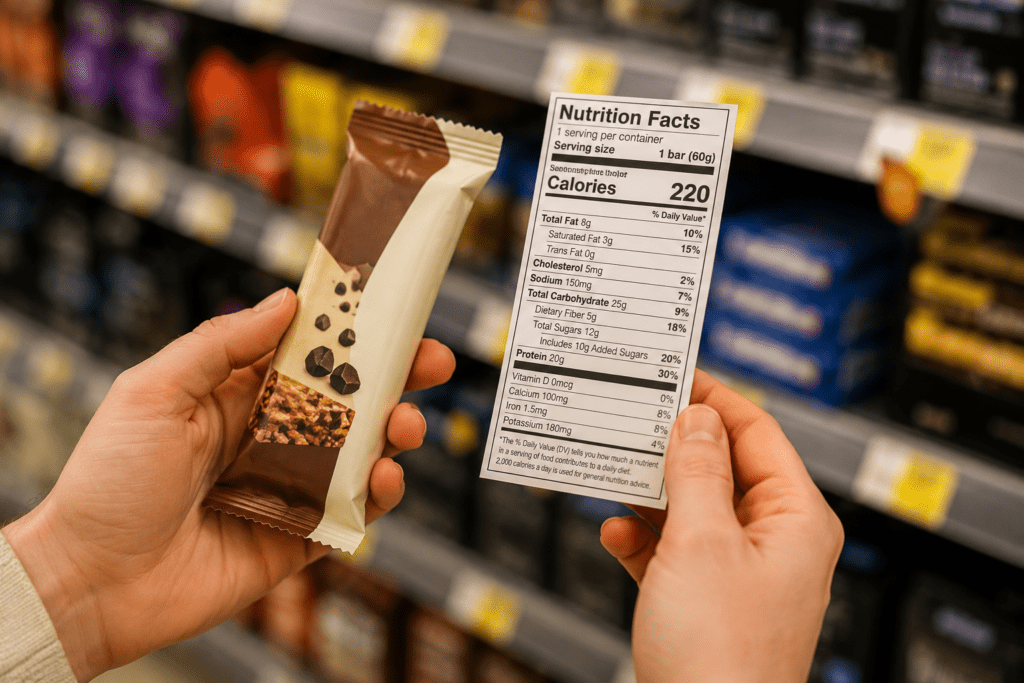
Before we get to the shopping list, it helps to know what to look for on the label, because “high protein” claims aren’t regulated as strictly as you’d hope.
- Aim for at least 10 grams of protein per serving if you want the snack to genuinely curb hunger (5–10g is fine for a lighter bite).
- Check the protein-to-calorie ratio. A 200-calorie bar with 20g of protein is doing a lot more for you than a 200-calorie bar with 6g.
- Watch for “protein-washing.” This is when a package highlights “20g protein!” on the front while quietly loading the product with added sugar or refined starch. A simple rule of thumb: added sugar should be lower than the grams of protein.
- Use the 5/20 rule on the Nutrition Facts panel. 5% Daily Value or less of a nutrient is considered low (good for added sugar and sodium); 20% DV or more is considered high (good for protein and fiber).
- Read the ingredient list, not just the front label. Ingredients are listed by weight — if sugar or syrup shows up in the first few lines, the “high protein” claim is doing a lot of marketing work.
With that in mind, here’s where to actually find the good stuff.
Dairy and Refrigerated Aisle
This is usually the fastest, cheapest place to find real protein with zero prep.
- Greek yogurt or skyr — Look for plain or low-sugar cups; expect roughly 12–18g of protein per serving. Icelandic-style skyr (like Siggi’s) tends to run even higher, often 16–18g, with a shorter, cleaner ingredient list than flavored Greek yogurt.
- High-protein yogurt lines — Newer “ultra-filtered” yogurt brands are now regularly hitting 20–25g of protein per single cup, roughly double a standard Greek yogurt, which is worth checking if your store carries them.
- Cottage cheese cups — About 12–18g of protein per half-cup serving, and small-curd varieties are noticeably milder if regular cottage cheese isn’t your thing. It also doubles as a mix-in for scrambled eggs or a savory dip base.
- String cheese or cheese snack packs — A quick 6–8g of protein per stick; not a full snack on its own, but easy to pair with fruit or nuts.
Shelf-Stable and Pantry Snacks
These are the ones worth keeping in a desk drawer, gym bag, or car for when hunger hits with no fridge in sight.
- Meat sticks and jerky — Beef or turkey sticks (Chomps and similar grass-fed brands, or lower-cost store-brand versions) typically deliver 9–12g of protein per stick with no added sugar or mystery preservatives.
- Meat snack bars — A step up from plain jerky, these blend real meat with spices into a bar format, often landing around 7–12g of protein per serving — a good savory alternative if you’re tired of sweet granola-style bars.
- Tuna or salmon pouches — Tear-and-eat seafood pouches pack 14–22g of protein with no can opener required, and flavored versions (buffalo, Thai chili, lemon pepper) have made canned fish a lot more snackable.
- Roasted edamame or chickpeas — Crunchy, plant-based, and shelf-stable, these run about 10–14g of protein per ounce and satisfy a chip craving without the grease.
- Cheese crisps — Baked cheese snacks (like Whisps) offer 10–13g of protein per serving with a satisfying crunch that granola bars can’t match.
Freezer Aisle
Often overlooked for snacking, but genuinely useful if you’re willing to spend two minutes on a microwave or air fryer.
- Frozen turkey or lean beef burger patties — A single lean patty can carry 20–25g of protein and works as a fast, low-effort snack or mini-meal.
- Breaded or grilled chicken strips — Typically 20–25g of protein per serving; a solid high-protein swap for drive-thru tenders.
- Rotisserie chicken from the deli/hot case — Not frozen, but worth a mention: shredding a store rotisserie chicken gives you roughly 19g of protein per serving and can be portioned into snacks for days.
Bars, Powders, and Ready-to-Drink Options
Useful for busy days, though it’s worth remembering these are processed foods first — check labels the same way you would a candy bar.
- Protein bars — Quality varies enormously. The best options land in the 200–300 calorie range with 15–20g of protein and added sugar kept below the protein count; weaker bars can carry as much sugar as a dessert.
- Protein pastries and baked snacks — Newer bakery-style protein snacks (toaster-pastry format, muffins, etc.) can hit 20g of protein per serving, offering a “treat” option that doesn’t completely derail a high-protein day.
- Protein popcorn — A newer category coating popcorn in milk protein isolate; typically 6–8g of protein per serving, letting you snack mindlessly on something crunchy without it being empty calories.
- Ready-to-drink shakes and meal-replacement blends — Convenient for 20–30g of protein in one grab, though they work best as a supplement to whole-food snacks rather than a replacement for all of them.
- Whey or plant protein powder — Store-brand and mid-tier whey options now perform comparably to premium brands for a fraction of the price; blend into oatmeal, yogurt, or a quick shake for 20–25g of protein.
Sample High-Protein Snack Pairings
Combining two smaller items is often more satisfying — and better nutritionally balanced — than one bar alone:
| Pairing | Approx. Protein |
|---|---|
| Greek yogurt + a handful of almonds | ~20g |
| String cheese + apple slices | ~10g |
| Tuna pouch + whole-grain crackers | ~18g |
| Cottage cheese + roasted chickpeas | ~20g |
| Jerky stick + edamame pack | ~20g |
Frequently Asked Questions
Tuna or salmon pouches and Greek yogurt cups tend to win here — no prep, no cooking, and both regularly deliver 14g or more of protein per serving.
Some are, some aren’t. Look for at least 15g of protein, added sugar lower than the protein count, and a short, recognizable ingredient list. Treat the healthiest ones as a snack, not a meal replacement.
Aim for a minimum of 10g if you want the snack to meaningfully curb hunger between meals; 15–20g is ideal if it’s replacing a smaller meal.
Not inherently — protein is protein. The bigger things to watch are sodium (jerky can be high) and added sugar (bars and flavored yogurts can be high).
Balancing packaged snacks with whole-food sources like eggs, nuts, and plain dairy is the more sustainable approach long-term.
Related Posts
Stay Informed With the Latest & Most Important News
Previous Post
Next Post










Advertisement