



















Now Reading: Sugar Alternatives Compared: Stevia vs Monk Fruit vs Allulose
-
01
Sugar Alternatives Compared: Stevia vs Monk Fruit vs Allulose


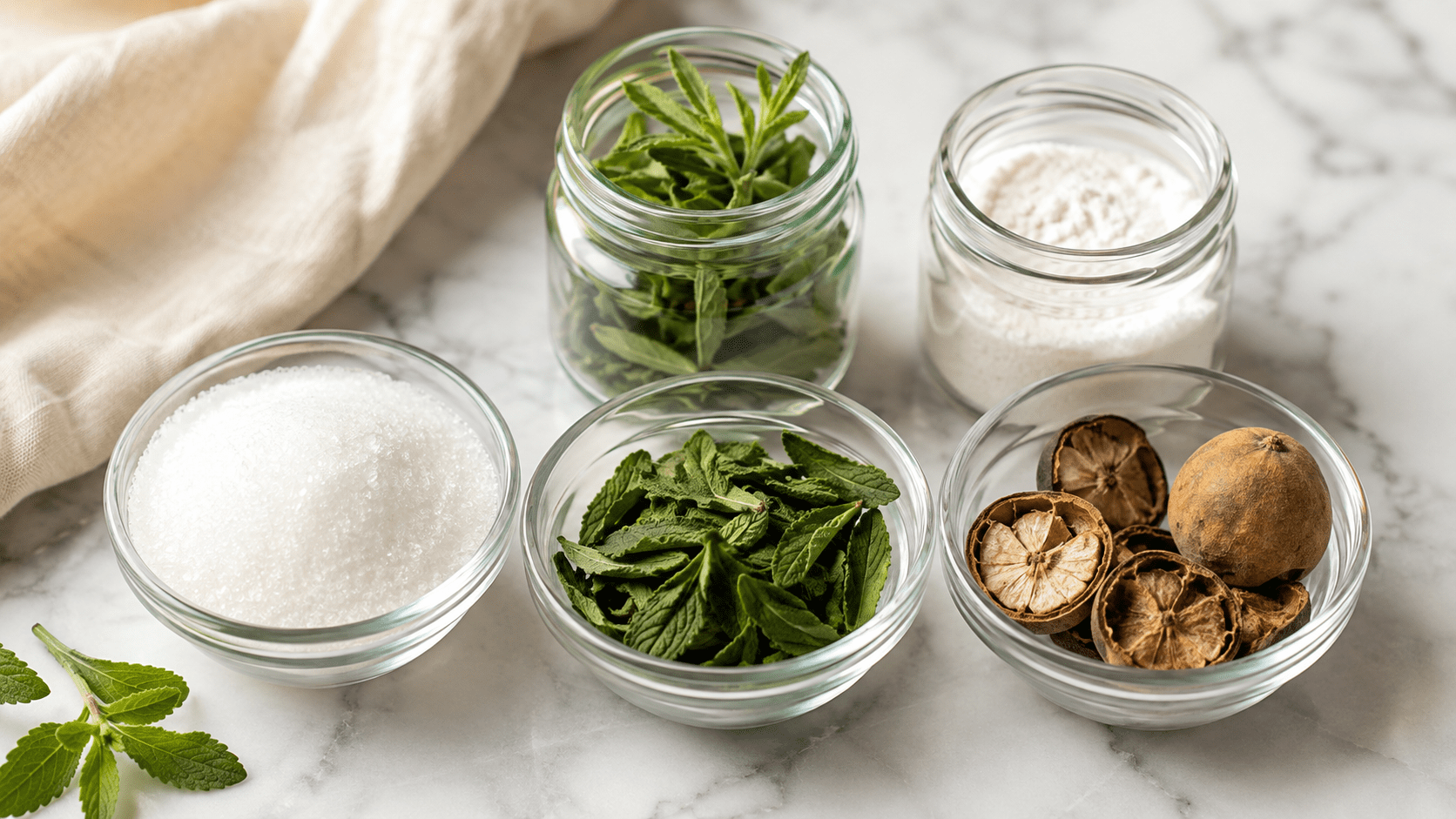
Sugar substitutes used to mean one thing: a pink, blue, or yellow packet next to the coffee station.
That’s no longer true. Walk down any grocery aisle in 2026 and you’ll find an entire wall of “natural” zero- and low-calorie sweeteners, and three names now dominate it — stevia, monk fruit, and allulose.
They’re often lumped together as if they’re interchangeable, but they behave nothing alike.
One is a plant extract 200+ times sweeter than sugar that you measure in drops.
Another is a real sugar molecule your body barely absorbs, and it’s the only one of the three that browns and caramelizes like the real thing. The third has a licorice-tinged reputation it’s spent a decade trying to shake, and largely has.
This guide breaks down what each one actually is, how they compare on sweetness, calories, and blood sugar impact, where each one shines (and fails) in the kitchen, and what the current research says about safety — including why a “monk fruit sweetener” bag might contain almost no monk fruit at all.
Table of contents
- Quick Comparison Table
- Why This Comparison Matters Now
- Stevia: The Original Plant-Based Sweetener
- Monk Fruit: Ancient Ingredient, Modern Marketing Problem
- Allulose: The One That Actually Behaves Like Sugar
- The Sweetener Hiding in Plain Sight: Erythritol
- How to Actually Read a Sweetener Label
- Which One Should You Actually Use?
- Frequently Asked Questions
- The Bottom Line
Quick Comparison Table
| Property | Stevia | Monk Fruit | Allulose |
|---|---|---|---|
| Source | Leaves of Stevia rebaudiana | Extract from luo han guo fruit | Rare sugar found in figs, raisins, maple syrup |
| Sweetness vs. sugar | 200–350x | 150–250x | ~70% as sweet |
| Calories | 0 | 0 | ~0.4 kcal/g |
| Glycemic index | 0 | 0 | ~0–1 |
| Counted as “added sugar” on US labels | No | No | Excluded by FDA guidance |
| Browns/caramelizes | No | No | Yes |
| Works 1:1 in baking on its own | No — needs a bulking agent | No — needs a bulking agent | Yes, close to 1:1 |
| Aftertaste | Can be bitter/licorice (varies by type) | Generally clean, sometimes faintly fruity | None reported |
| Best for | Drinks, coffee, tabletop use | Drinks, tabletop use, light baking with a carrier | Baking, ice cream, caramel, sauces |
| Regulatory status | GRAS since 2008 | GRAS | GRAS in the US; still a novel/pending food in some other markets, including Canada |
Why This Comparison Matters Now
Regular sugar intake is tied to obesity, type 2 diabetes, and heart disease, and most nutrition authorities recommend keeping added sugar under roughly 6–10% of daily calories. That’s pushed a lot of people toward substitutes — but not all substitutes are created equal.
Artificial sweeteners like aspartame, sucralose, and saccharin carry their own baggage: they don’t consistently help with weight or appetite control, and some research links heavy diet-soda consumption to worse metabolic outcomes. That’s part of why stevia, monk fruit, and allulose have become the go-to “clean label” alternatives — they’re derived from natural sources, don’t spike blood sugar, and (mostly) avoid the controversy following older artificial sweeteners.
But as this guide will show, “natural” doesn’t automatically mean simple, and the sweetener actually sitting in your kitchen cabinet might not be what the front of the bag suggests.
Stevia: The Original Plant-Based Sweetener
Stevia comes from the leaves of Stevia rebaudiana, a plant native to South America, and has been used as a sweetener there for centuries. Its sweetness comes from a family of compounds called steviol glycosides, which the body doesn’t metabolize — hence zero calories and a glycemic index of zero.
Sweetness: roughly 200 to 350 times sweeter than table sugar, depending on the specific glycoside blend.
Taste — the detail most people miss: “Stevia” isn’t one ingredient, it’s a family of related compounds, and two of them dominate the market with noticeably different flavor profiles:
- Reb A (Rebaudioside A) is the most abundant and cheapest glycoside to extract, and it’s what powered the first wave of stevia products. It’s also the one responsible for the bitter, licorice-like aftertaste that gave early stevia its reputation.
- Reb M (Rebaudioside M) occurs at less than 0.1% in the raw leaf, so it’s now produced mainly through fermentation to make it commercially viable. Sensory testing consistently rates it much closer to real sugar, with little to no bitterness. It’s become the standard in premium reformulations — including several major stevia-sweetened sodas — but costs noticeably more than Reb A.
If you tried stevia years ago and disliked it, there’s a good chance you were tasting Reb A. A product listing “Rebaudioside M” specifically is worth a second try.
In the kitchen: Stevia is heat-stable, so it survives baking and boiling fine, but pure stevia has no bulk or structure. A cup of sugar can’t be swapped for a pinch of stevia and produce the same cookie — the volume, browning, and moisture that sugar contributes to baked goods just isn’t there. That’s why most baking-oriented stevia products are blended with a bulking agent, most commonly erythritol.
Safety: Stevia has held Generally Recognized as Safe (GRAS) status in the US since 2008, and the Joint FAO/WHO Expert Committee on Food Additives (JECFA) set an acceptable daily intake far above what a typical person would realistically consume. Independent food-safety reviewers consistently place stevia in their safest tier of sweeteners.
Best for: coffee, tea, cold beverages (especially Reb M formulations), and any application where you’re not relying on the sweetener for bulk or browning.
Monk Fruit: Ancient Ingredient, Modern Marketing Problem
Monk fruit (also called luo han guo) is a small melon grown in parts of China and has been used in traditional medicine there for centuries. Its sweetness comes from antioxidant compounds called mogrosides — mainly mogroside V — extracted from the fruit with water.
Sweetness: roughly 150 to 250 times sweeter than sugar, depending on mogroside concentration.
Taste: Most tasters find pure monk fruit extract cleaner than older-style stevia, sometimes with a faint fruity note and a mild cooling sensation. It’s less likely than Reb A stevia to leave a bitter aftertaste.
Calories and blood sugar: Zero calories, glycemic index of zero — mogrosides pass through the body without being metabolized for energy.
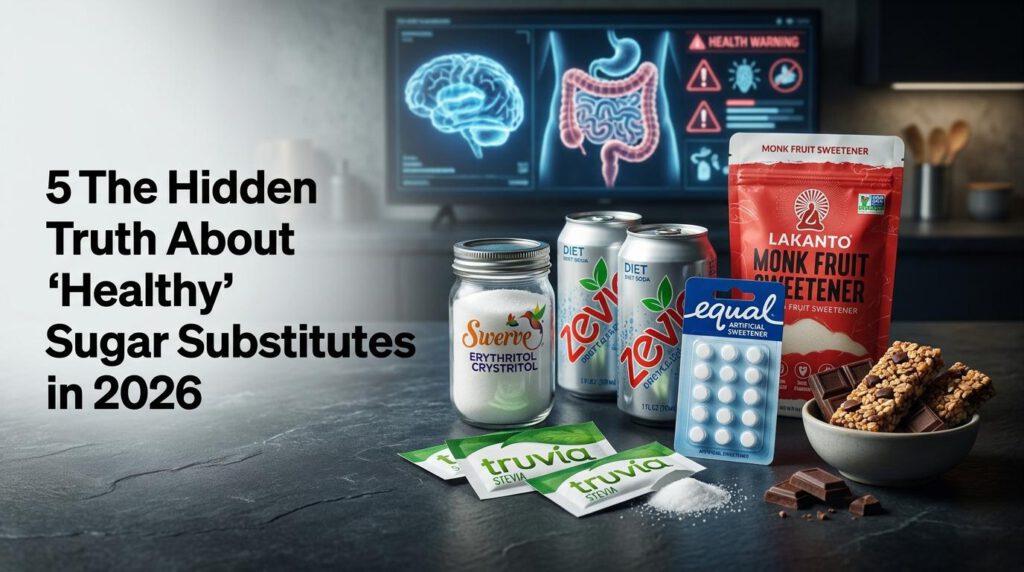
The label problem: This is the part most shoppers never see. Pick up almost any “monk fruit sweetener” bag from a major brand and flip it over. The ingredient list — ordered by weight — usually reads something like Erythritol, Monk Fruit Extract. By weight, the bulk sweetener typically makes up somewhere around 99% of what’s in the bag; actual monk fruit extract is present in trace amounts, just enough to season the mixture. This isn’t false advertising exactly — the product does contain monk fruit — but a spoonful of “monk fruit sweetener” is mostly a different ingredient entirely.
The reason comes down to math: a compound 200 times sweeter than sugar can’t be measured with a normal teaspoon at full strength — you’d need a fraction of a grain to hit the right sweetness. Bulking agents like erythritol let manufacturers package it as something you scoop and measure like sugar.
Two ways around this if you specifically want the monk fruit itself:
- Monk-fruit-and-allulose blends, now sold by a growing number of brands, which skip the sugar alcohol entirely.
- Concentrated liquid drops or micro-scoops of monk fruit extract, where a few drops replace a teaspoon of sugar — often cheaper per use than a bag of blended packets, since the dose needed is so small.
In the kitchen: Like stevia, monk fruit is heat-stable but lacks bulk, so most baking applications use it pre-blended with a carrier.
Best for: coffee, tea, smoothies, and tabletop sweetening — read the ingredient list if avoiding sugar alcohols matters to you.
Allulose: The One That Actually Behaves Like Sugar
Allulose is a “rare sugar” — it occurs naturally in small amounts in figs, raisins, jackfruit, and maple syrup, and is produced commercially by converting fructose derived from corn. Structurally, it’s a close relative of fructose, but your body absorbs a portion of it and excretes most of it unused, rather than metabolizing it for energy.
Sweetness: about 70% as sweet as table sugar — noticeably less intense than stevia or monk fruit, which is actually its biggest practical advantage: you use it in roughly the same volume as sugar.
Calories: approximately 0.4 kcal per gram, versus 4 kcal per gram for table sugar.
Glycemic index: effectively at or near zero. Some human studies have found that eating allulose alongside a meal can blunt the blood sugar and insulin response to that meal, which is why it’s drawn particular interest for people managing prediabetes or type 2 diabetes.
The FDA labeling quirk: In 2019 the FDA proposed, and in 2020 finalized, guidance allowing allulose to be excluded from both the “Total Sugars” and “Added Sugars” lines on US Nutrition Facts labels, while still requiring it to be counted toward total carbohydrates and calories at its 0.4 kcal/g rate. The agency’s stated reasoning is that allulose isn’t metabolized the way conventional sugars are, so it doesn’t contribute to the same health effects. This guidance operates under “enforcement discretion” rather than a finalized regulation, which is a genuine gray area — it’s the reason a food can legally list “0g Added Sugars” while containing allulose that tastes and behaves like sugar, and it has already drawn at least one class-action lawsuit from consumers who felt misled by “zero sugar” claims on allulose-sweetened products.
In the kitchen — where it wins: Allulose is the only one of the three that browns and caramelizes the way table sugar does, because it undergoes the same Maillard and caramelization reactions.
It also depresses the freezing point of liquids, which keeps ice cream and frozen desserts soft and scoopable instead of turning into a block of ice — a problem that plagues almost every other sugar substitute. For baking, a common substitution is roughly 1.3 cups of allulose per cup of sugar, with the oven temperature lowered by about 25°F since it browns faster than sucrose.
Digestive tolerance: This is allulose’s real limitation. Research on tolerance has found that gastrointestinal symptoms like bloating, gas, and diarrhea can appear at single doses around 0.4 grams per kilogram of body weight — for a 150-pound adult, that’s roughly 27 grams, or about seven teaspoons in one sitting.
Spread across a full day rather than eaten all at once, the tolerable threshold is higher. In practice, this means stacking allulose-sweetened coffee, a scoop of allulose ice cream, and a baked good in the same day can add up faster than people expect.
Availability: In the US, allulose is GRAS and widely used across baked goods, beverages, dairy, and confections. It hasn’t been approved in every market, though — as of 2026 it remains a novel or restricted ingredient in some regions, including Canada and parts of the EU, which limits how easy it is to find outside the US.
Best for: baking, ice cream and frozen desserts, caramel sauces, and BBQ glazes — anywhere you need sugar’s texture and browning, not just its sweetness.
The Sweetener Hiding in Plain Sight: Erythritol
You can’t fully compare stevia, monk fruit, and allulose without talking about erythritol, because it’s very likely already in your pantry disguised as one of the other two.
Erythritol is a sugar alcohol (polyol) made by fermenting glucose, and it also occurs naturally in trace amounts in some fruits and fermented foods. It has about 0.2 calories per gram, a glycemic index near zero, and is roughly 60–70% as sweet as sugar. Unlike stevia or monk fruit extract, it has real bulk, which is exactly why it’s the default carrier blended into most “stevia” and “monk fruit” tabletop products — it lets an intensely sweet extract be measured with an ordinary spoon.
The safety question: In February 2023, a study published in Nature Medicine by researchers at the Cleveland Clinic found that people with higher blood erythritol levels had significantly elevated rates of heart attack, stroke, and death over three years of follow-up across multiple patient cohorts, and that erythritol increased platelet clotting activity in lab and animal experiments.
A 2025 follow-up analysis of the long-running ARIC study (a large US cardiovascular cohort of older adults) found a similar association between circulating erythritol and cardiovascular events, and a separate human intervention study published in Arteriosclerosis, Thrombosis, and Vascular Biology found that consuming erythritol — but not glucose — increased platelet reactivity in healthy volunteers.
Genetic (Mendelian randomization) studies published in 2025 have also reported associations between erythritol and coronary heart disease, heart attack, and stroke risk.
Two important caveats keep this from being an open-and-shut case.
First, the human observational studies measured blood erythritol levels, not how much people actually ate — and the body also produces erythritol on its own from glucose, especially under metabolic stress, so elevated levels could partly reflect underlying metabolic problems rather than diet alone.
Second, no regulatory body has changed erythritol’s legal safety status: the FDA has acknowledged the findings warrant further study but hasn’t altered its GRAS classification, and food-safety reviewers have generally shifted erythritol from their “safe” category to “uncertain,” suggesting a cautious ceiling of roughly a few grams a day rather than declaring it dangerous outright.
The practical takeaway: if you have existing cardiovascular risk factors — diabetes, a prior heart event, high LDL cholesterol, or a strong family history — it’s reasonable to actively limit erythritol and check ingredient labels. If you’re generally healthy and occasionally consume small amounts in packaged food, current evidence doesn’t call for panic, but it’s a reasonable ingredient to watch rather than use freely.
How to Actually Read a Sweetener Label
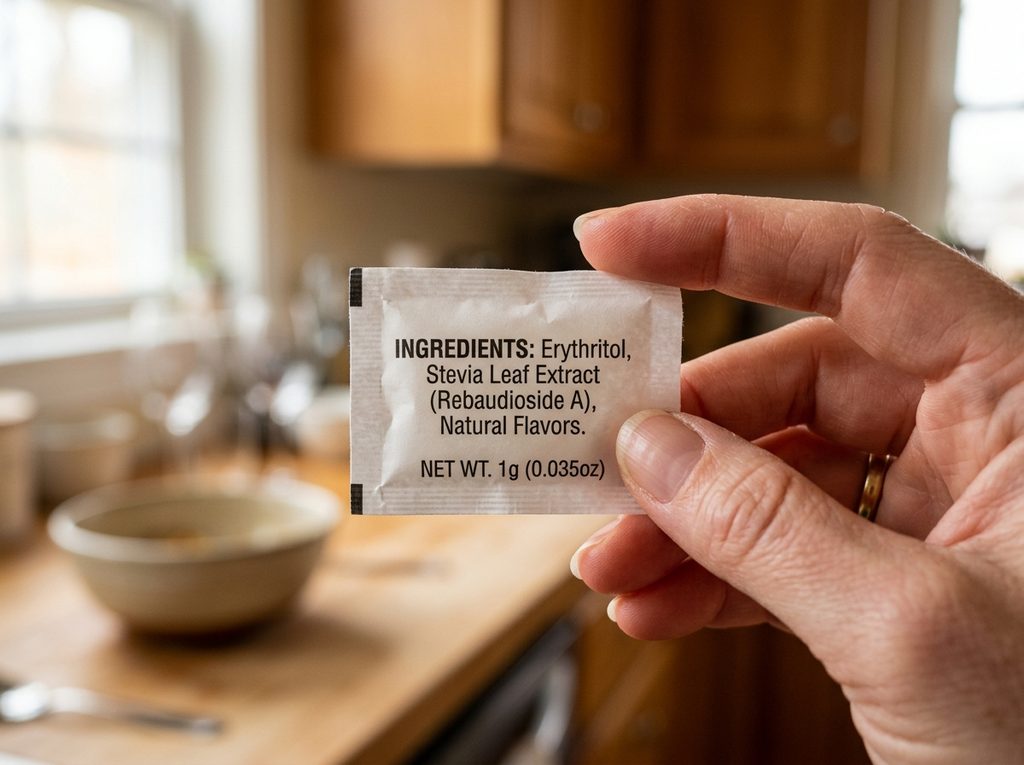
Since so many “monk fruit” and “stevia” products are mostly something else, a quick label-reading habit goes a long way:
- Ignore the front of the package. Names like “Monk Fruit Sweetener” describe the marketing angle, not the recipe.
- Read the ingredient list — it’s ordered by weight. Whatever’s listed first is the bulk of what you’re eating. “Erythritol, Monk Fruit Extract” is primarily an erythritol product.
- Look for the specific glycoside on stevia products. “Rebaudioside M” signals the cleaner-tasting, pricier option; “stevia leaf extract” alone, or “Rebaudioside A,” is more likely to carry a bitter aftertaste.
- A cooling sensation on the tongue is a tell. Erythritol produces a mild, mint-like cooling effect that stevia, monk fruit, and allulose don’t have. If a “monk fruit” packet feels cold in your mouth, it’s mostly erythritol.
- Do the math on “1:1” claims. A pure high-intensity extract is 150–350 times sweeter than sugar, so a product that substitutes cup-for-cup with sugar is, by necessity, almost entirely bulking agent.
Which One Should You Actually Use?
| Use case | Best pick | Why |
|---|---|---|
| Baking cookies, cakes, brownies | Allulose | Browns, caramelizes, and holds structure closest to real sugar |
| Ice cream and frozen desserts | Allulose | Depresses freezing point, stays scoopable instead of freezing rock-hard |
| Coffee and tea | Monk fruit drops or Reb M stevia | Dissolve instantly, no texture or bulk needed |
| Sodas and cold, acidic beverages | Stevia (Reb M) | Cleanest finish in cold, acidic liquids |
| Keto or low-carb baking | Allulose (cooking) + monk fruit (table) | Avoids heavy erythritol use and its sandy, gritty texture |
| Diabetes or blood sugar management | Any of the three | All sit at or near a glycemic index of zero; differences come down to gut tolerance and personal taste, not blood sugar |
| Avoiding sugar alcohols entirely | Pure monk fruit or stevia drops, or a fiber-based carrier product | Skip erythritol-blended packets |
Frequently Asked Questions
Is allulose, stevia, or monk fruit best for diabetes?
All three have a glycemic index at or near zero and don’t meaningfully spike blood sugar or insulin, so any of them is a reasonable swap for table sugar. Allulose has the added property of potentially blunting the blood sugar response of a whole meal when eaten alongside carbohydrates, which some research suggests makes it particularly useful for people managing prediabetes or type 2 diabetes.
As always, anyone managing diabetes should check with their doctor or dietitian before making dietary changes.
Why does my “monk fruit” or “stevia” sweetener taste and feel different from pure sugar?
It’s very likely blended with a bulking agent like erythritol, which has its own mild cooling sensation and different mouthfeel. Checking the ingredient list will tell you exactly what you’re getting.
Can I substitute allulose 1:1 for sugar in baking?
Close, but not exact. A common ratio is about 1.3 cups of allulose per cup of sugar, since allulose is roughly 70% as sweet. It also browns faster than sugar, so lowering the oven temperature by about 25°F helps prevent over-browning.
Is erythritol dangerous?
It’s not classified as unsafe by regulators, but multiple 2023–2025 studies have linked higher blood erythritol levels to increased cardiovascular risk markers, particularly in people who already have heart disease risk factors. The research is still developing and hasn’t changed erythritol’s regulatory status, but it’s a reasonable ingredient to limit if you have cardiovascular risk factors.
Why isn’t allulose available everywhere?
It’s approved and widely used as GRAS in the United States, but as of 2026 it’s still classified as a novel or restricted food ingredient in some other markets, including Canada and parts of the EU, which limits how easy it is to find outside the US.
The Bottom Line
Stevia, monk fruit, and allulose are all legitimate zero- or near-zero-glycemic alternatives to table sugar, and none of them deserve the blanket suspicion sometimes aimed at “artificial sweeteners” — they’re a genuinely different category.
But they aren’t interchangeable, and the biggest trap in this category isn’t the sweeteners themselves, it’s the labeling. A huge share of “monk fruit” and “stevia” products on shelves are mostly erythritol by weight, so the real decision is less “which of the big three do I want” and more “do I know what’s actually in the bag.”
A practical starting point: keep an allulose-based or erythritol blend on hand for baking, and a liquid monk fruit or Reb M stevia for drinks — that combination covers most kitchen needs, and you can adjust from there based on your own taste and how your digestive system responds.
This article is for general information and isn’t medical advice. If you’re managing diabetes, a cardiovascular condition, or another health issue, talk to your doctor or a registered dietitian before changing how you sweeten your food.
Stay Informed With the Latest & Most Important News
Previous Post
Next Post










Advertisement