















Now Reading: Walking Yoga for Fat Loss: Low-Impact Trend Taking Over TikTok
-
01
Walking Yoga for Fat Loss: Low-Impact Trend Taking Over TikTok


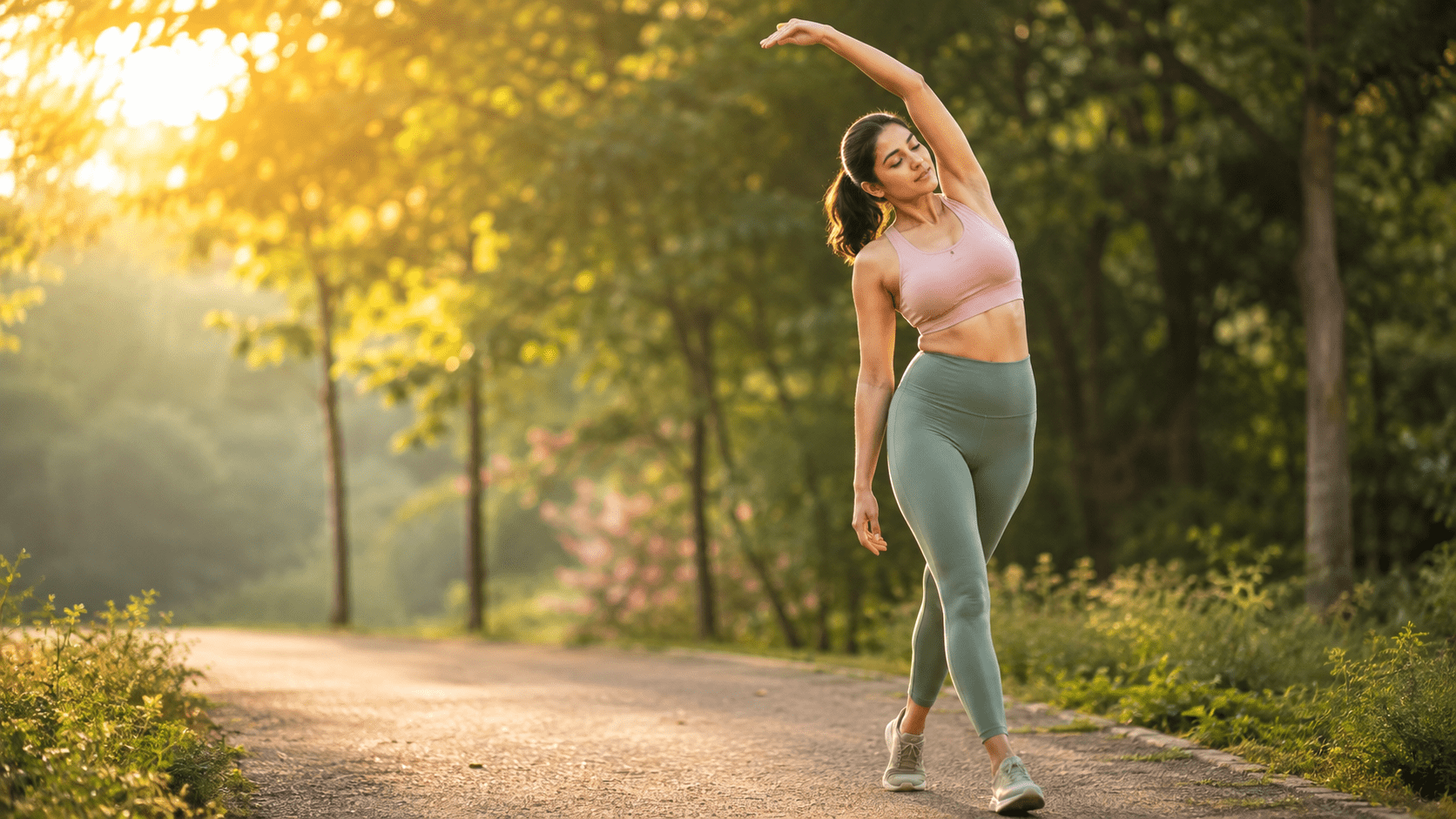
If your For You Page has suddenly filled up with people stretching into a forward fold mid-walk, you’re not imagining a niche moment — you’re watching one of 2026’s biggest fitness trends unfold in real time.
Walking yoga, a hybrid practice that blends slow, mindful walking with standing yoga stretches and breathwork, has seen search interest jump by roughly 2,414% since 2024, making it the second-fastest-growing fitness trend of the year, right behind Japanese interval walking.
Unlike high-intensity trends that dominated the last few years, walking yoga’s whole appeal is that it isn’t intense. No mat, no studio, no flexibility requirement — just a walk with intention.
But can something this gentle actually help with fat loss? Here’s a full breakdown of what walking yoga is, why it’s exploding on TikTok, what the science actually supports, and how to try a session yourself.
Table of contents
- What Is Walking Yoga?
- Why Walking Yoga Is Taking Over TikTok
- How Walking Yoga Works for Fat Loss
- What the Science Actually Says
- How to Do a Walking Yoga Session
- Walking Yoga vs. Other Viral Walking Trends
- Who Walking Yoga Is Best For
- Getting Started: A Few Practical Tips
- Frequently Asked Questions
- The Takeaway
What Is Walking Yoga?
Walking yoga takes the core principles of a traditional yoga practice — conscious breathing, body awareness, and gentle stretching — and folds them into an ordinary walk.
Instead of holding poses on a mat, you pause periodically to move through standing postures like forward folds, side bends, and gentle hip openers, then return to walking with your breath synced to your steps.
It isn’t entirely new — walking meditation and moving mindfulness practices have existed for decades — but the format has been repackaged for short-form video, and that’s part of why it’s resonating so strongly right now.
There’s no getting down on the floor, no props, and no class fee. If you can walk and stretch your arms overhead, you can do it.
Why Walking Yoga Is Taking Over TikTok
A few forces are driving the surge:
- Burnout fatigue. After years of HIIT, CrossFit, and “no days off” culture dominating fitness content, there’s a visible swing toward gentler, sustainable movement — and walking yoga sits right in that gap.
- Zero barriers to entry. No studio, no membership, no specific clothing, no baseline flexibility. That’s a big deal compared to a traditional yoga class, which can feel intimidating to beginners.
- It’s inherently video-friendly. The blend of movement and stillness, done outdoors, makes for calming, aesthetically pleasing content — a strong match for TikTok’s wellness and “soft life” corners.
- It rides the walking-trend wave. Walking yoga isn’t happening in isolation — it’s part of a broader 2026 boom in structured walking workouts, alongside Japanese interval walking and the 6-6-6 challenge, all of which are pulling people back toward walking as a legitimate form of exercise.
How Walking Yoga Works for Fat Loss
Walking yoga isn’t a high-calorie-burn workout, and it’s not trying to be. Its case for fat loss rests on three overlapping mechanisms:
1. Steady, low-impact calorie burn
Walking at a moderate pace for 20–30 minutes keeps your heart rate mildly elevated over a sustained period. It won’t torch calories the way running or HIIT does, but it adds up as a consistent, repeatable daily habit — and consistency is what most fat-loss plans actually live or die on.
2. Stress and cortisol regulation
This is the piece most walking yoga content leans on: chronically high cortisol is associated with increased fat storage, particularly around the midsection.
Low-intensity movement like walking doesn’t spike cortisol the way intense training can, and a systematic review in Psychoneuroendocrinology found that moderate physical activity, including walking, meaningfully lowers cortisol levels.
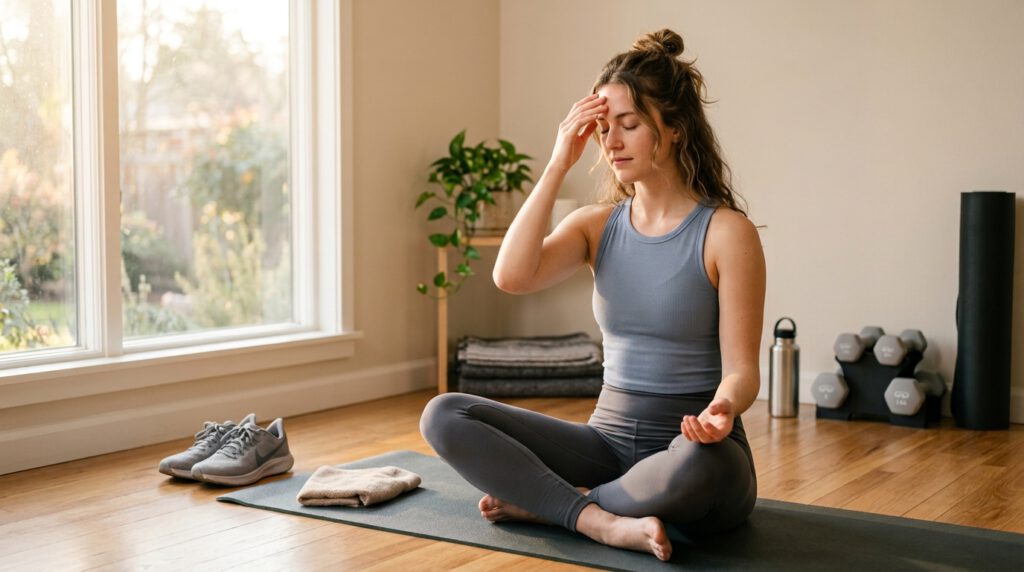
Pairing that with breathwork — which activates the parasympathetic (“rest and digest”) nervous system — gives walking yoga a plausible edge for stress-related fat storage specifically, even if it’s not a shortcut for fat loss in general.
It’s worth being precise here, though: cortisol’s role in belly fat is more nuanced than social media tends to present it. Cortisol is essential for basic physiological function, and the “high-intensity workouts spike cortisol and make you fat” narrative oversimplifies a hormone that’s more complicated than good-or-bad.
Walking yoga’s real strength is stress reduction on its own merits, not a hormonal loophole for effortless fat loss.
3. Zone 2 fat oxidation
Walking at a conversational pace typically keeps your heart rate around 50% of your max — what trainers call “Zone 2.” At this intensity, your body preferentially burns fat for fuel rather than glycogen, which is one reason low-intensity walking is often recommended alongside (not instead of) higher-intensity training for body composition goals.
What the Science Actually Says
It’s worth being upfront: no formal clinical trials have tested “walking yoga” as a defined protocol. What exists is strong supporting science for its individual components — walking and mindful breathwork — rather than head-to-head proof of the combined trend.
Research increasingly suggests that walking’s fat-loss benefit isn’t purely about calories burned during the walk itself. A widely cited 2016 study from Duke researcher Herman Pontzer found that the body partially compensates for exercise calories by adjusting energy spent elsewhere — including on inflammation and stress-hormone output.
In that framework, the value of low-intensity walking may come less from the calorie deficit and more from the metabolic and hormonal “reset” it provides, which lines up with what walking yoga is designed to deliver.
The bottom line: walking yoga is a legitimate low-impact tool for stress reduction, mobility, and modest, sustainable calorie expenditure — not a fast track to significant fat loss on its own. It works best as one piece of a broader routine that includes strength training and a sensible eating pattern.
How to Do a Walking Yoga Session
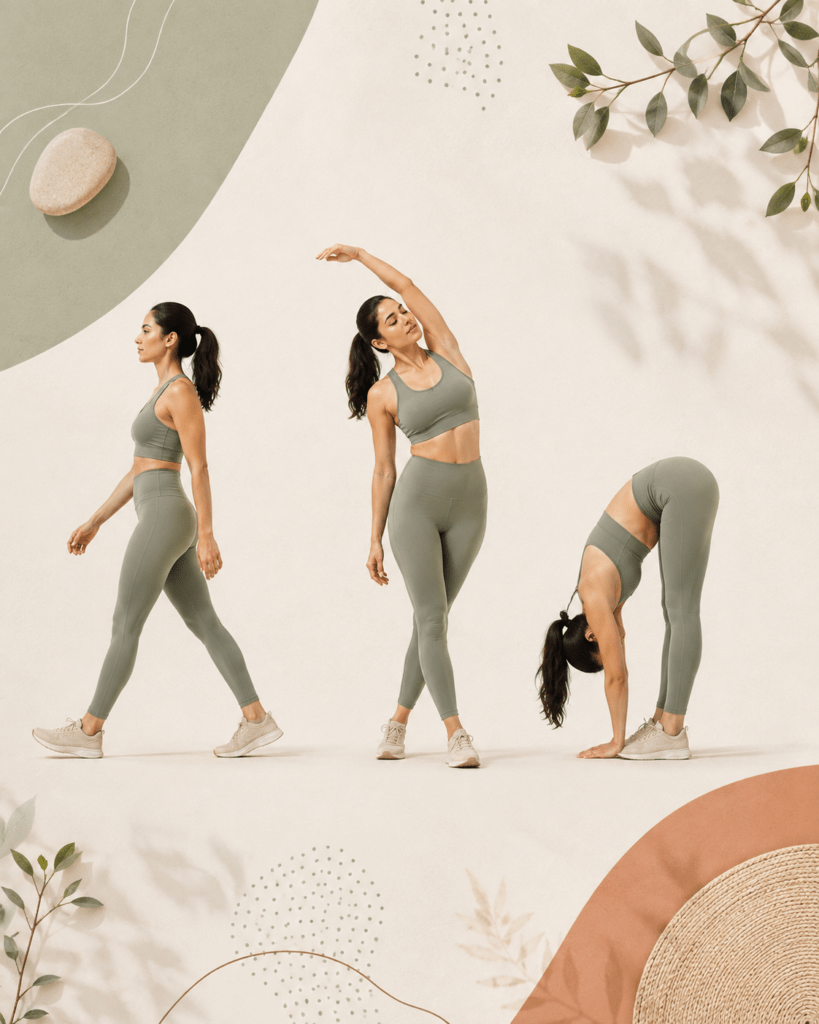
A simple 20–30 minute session looks like this:
- Warm up (5 minutes). Walk at an easy, natural pace to ease your body in.
- Sync breath to steps. Try inhaling for 4 steps and exhaling for 4 steps to bring your attention into your body.
- Add standing poses. Every few minutes, pause for a forward fold, a side bend, a gentle twist, or a low lunge stretch. Hold for 20–30 seconds, then keep walking.
- Stay present. Notice your posture, the ground under your feet, and your surroundings rather than scrolling your phone — this is where the “moving meditation” effect comes from.
- Cool down (5 minutes). Slow your pace and take a few final deep breaths before you stop.
You can do this outdoors, on a treadmill, or on a walking pad — outdoor sessions add the extra stress-lowering benefit of natural light and green space.
Walking Yoga vs. Other Viral Walking Trends
| Trend | Format | Best For |
|---|---|---|
| Walking Yoga | Walking + breathwork + standing stretches, 20–30 min | Stress relief, mobility, mindfulness alongside light fat loss |
| Japanese Walking | Alternating 3 min fast / 3 min slow, ~30 min total | Cardiovascular fitness and time efficiency |
| 6-6-6 Challenge | 6-min warm-up, 60-min brisk walk, 6-min cool-down | Maximum calorie burn and daily structure |
| 12-3-30 | 12% incline, 3.0 mph, 30 minutes on a treadmill | Higher-intensity calorie burn in a short window |
None of these trends are mutually exclusive. Many people rotate them — for example, walking yoga on a rest or high-stress day, and Japanese walking or the 6-6-6 on days with more time or energy.
Who Walking Yoga Is Best For
- Beginners intimidated by traditional yoga classes or gym environments
- People recovering from injury or managing joint pain who need low-impact movement
- Anyone using exercise primarily to manage stress or anxiety
- People who already walk regularly and want to add mindfulness without extra time commitment
- Experienced yoga practitioners who want to maintain a practice on days a full class isn’t realistic
If your primary goal is maximum calorie burn in minimal time, a more intense format like the 12-3-30 or Japanese walking will get you there faster — walking yoga is optimized for consistency and stress relief first, fat loss second.
Getting Started: A Few Practical Tips
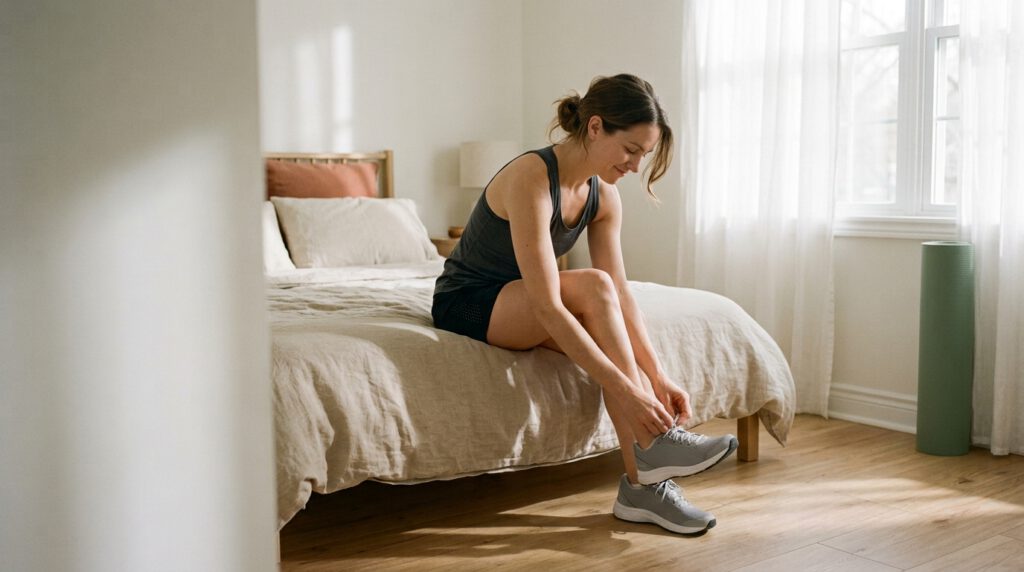
- Footwear matters most. A supportive walking or cross-training shoe protects your joints far more than any other gear choice.
- Wear something you can stretch in. Restrictive clothing limits the standing poses — moisture-wicking leggings or joggers work well.
- Start with shorter sessions. 15–20 minutes is plenty to begin; add time as it becomes a habit.
- Don’t skip the breathwork. The stretching alone is nice, but the breath-step syncing is what separates this from a regular walk with a stretch break.
Frequently Asked Questions
Does walking yoga actually help with fat loss?
It can support fat loss modestly, mainly through steady low-intensity calorie burn, reduced cortisol-related stress eating and fat storage, and easier long-term consistency compared to more demanding workouts. It’s not a substitute for a full fitness and nutrition plan if significant fat loss is the primary goal.
How long should a walking yoga session be?
Most sessions run 20–30 minutes, including a warm-up and cool-down. Beginners can start with as little as 15 minutes.
Can I do walking yoga indoors?
Yes — a treadmill or any open indoor space works. Outdoor sessions add extra stress-reduction benefits from natural light and green space, but they aren’t required.
Is walking yoga better than Japanese walking or the 6-6-6 challenge?
“Better” depends on your goal. Walking yoga is stronger for stress relief and mindfulness; Japanese walking and the 6-6-6 challenge are better suited to maximizing cardiovascular training and calorie burn. Many people combine two or more of these trends across the week.
Do I need any equipment?
No. Supportive shoes and comfortable, stretch-friendly clothing are the only real requirements.
The Takeaway
Walking yoga’s viral growth isn’t a fluke — it taps directly into 2026’s broader shift away from burnout-driven fitness and toward sustainable, low-impact movement.
It’s not the fastest route to fat loss, but as a stress-lowering, joint-friendly habit that’s easy to stick with every single day, it earns its place alongside the other walking trends dominating TikTok right now — and for a lot of people, that consistency is exactly what’s been missing.
Stay Informed With the Latest & Most Important News
Previous Post
Next Post










Advertisement